

Amid investment push, Turkmenistan foreign minister to visit Pakistan next week

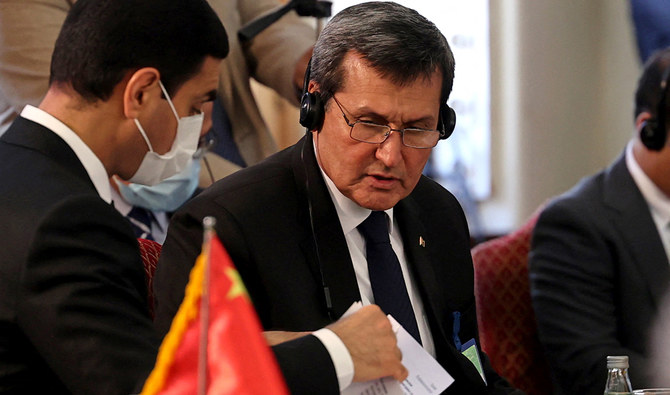
Turkmenistan Foreign Minister Rasit Meredow (C) attends the multilateral conference on Afghanistan, in the Iranian capital Tehran on October 27, 2021. (AFP/File)
Short Url
Updated 19 July 2024
Follow

Amid investment push, Turkmenistan foreign minister to visit Pakistan next week

  • Pakistan hopes to enhance its role as pivotal trade and transit hub connecting landlocked Central Asia to rest of the world
  • There has been a flurry of visits, investment talks and economic activity between Pakistan and Central Asian states recently

ISLAMABAD: Turkmenistan Foreign Minister Rasit Meredow will undertake a two-day visit to Pakistan from July 22-24, the foreign minister said on Friday, as the South Asian state pushes to boost trade with Central Asian states. 

Pakistan hopes to leverage its strategic geopolitical position and enhance its role as a pivotal trade and transit hub connecting the landlocked Central Asian republics with the rest of the world. In recent months, there has been a flurry of visits, investment talks and economic activity between Pakistan and Central Asian states, including meetings with leaders from Uzbekistan and Azerbaijan.

“Foreign Minister Rasit Meredown will visit Pakistan from July 22-24,” foreign office spokesperson Mumtaz Zahra Baloch said during a weekly press briefing on Friday. “He will hold extensive talks with Deputy Prime Minister and Foreign Minister Ishaq Dar and also call on the Pakistan leadership.”

The talks would cover “all aspects of bilateral relations” as well as regional and global developments, the FO added.

Located in a landlocked but resource-rich region, Central Asian countries need better access to regional markets including Pakistan, China, India, and the countries of West Asia. Meanwhile, Pakistan has huge energy demands that can be satisfied by growing trade with Central Asia. The China-Pakistan Economic Corridor project, in which Beijing has pledged around $65 billion in energy, infrastructure and other schemes in Pakistan, also presents a strategic opportunity for Central Asian states to transport their goods more easily in regional and global markets.

Islamabad is seeking to bolster trade and investment relations with allies to stabilize its fragile $350 billion economy as it faces an acute balance of payment crisis amid soaring inflation and surging external debt.

Last week, Pakistan and the International Monetary Fund (IMF) reached an agreement for a $7 billion, 37-month loan, capping negotiations that started in May after Islamabad completed a short-term, $3 billion program that helped stabilize the economy and avert a sovereign debt default.


Pakistan’s Punjab deploys satellites, drones, AI to combat smog

Updated 5 sec ago
Follow

Pakistan’s Punjab deploys satellites, drones, AI to combat smog

  • Senior minister warns industrial masks may become necessary without a change in public attitudes toward pollution
  • Cities in Punjab face worsening smog each winter, driven by crop burning, vehicle emissions and industrial pollution

ISLAMABAD: Punjab Senior Minister Marriyum Aurangzeb on Wednesday said Pakistan’s most populous province deployed satellites, drones and artificial intelligence to tackle smog, warning that industrial masks may become necessary if public attitudes toward air pollution did not change.

Punjab cities face worsening smog each winter, driven by crop burning, vehicle emissions and industrial pollution that threatens public health and daily life. The smog season typically begins in late October, peaks between November and January and can persist through February.

Smog causes symptoms such as sore throats, eye irritation and respiratory illnesses, while prolonged exposure raises the risk of stroke, heart disease and lung cancer. Children are more vulnerable due to higher breathing rates and weaker immune systems.

“We have the AI machine-learning forecasting system in place, surveillance drones and technology cameras,” Aurangzeb said while addressing an event.

“At present, what is considered one of the world’s best environmental protection forces — with training, equipment, technology and digitally integrated data — is operating in Punjab,” she added.

Aurangzeb said surveillance is now being carried out through drones.

“There is monitoring, technology, cameras,” she continued. “Everything is digital.”

The minister maintained the eastern corridor from India was a major source of smoke which becomes active during the winter season.

She said this was the first time a complete testing system was introduced by the Environmental Protection Agency to measure pollution released by vehicles.

She added the government has loaned 5,000 super seeders to farmers, which are agricultural machines that plant crops directly into fields without removing leftover stubble, reducing crop burning, and helping curb winter smog.

Aurangzeb warned the situation could reach a point where people may have to use industrial masks and carry therm around like a “purse or wallet.”

“This will become a mandatory item if we do not change our attitudes and habits toward air quality, climate and conservation.”

Pakistan’s main urban centers routinely rank among the most polluted cities in the world, with vehicular emissions remaining one of the top contributors to air pollution.

The severe air pollution also undermines economic productivity and diminishes the quality of life for millions of residents.