

Amid investment push, Turkmenistan foreign minister to visit Pakistan next week

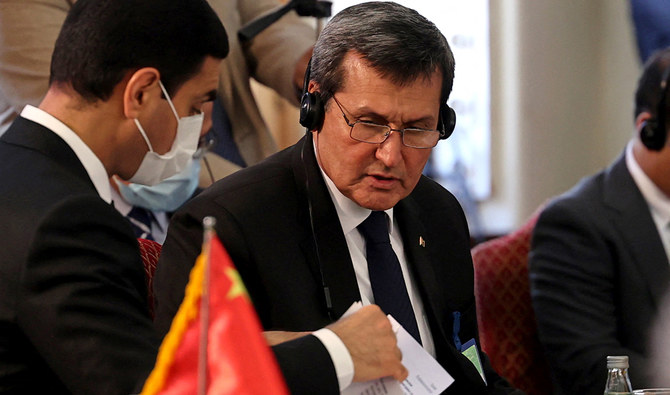
Turkmenistan Foreign Minister Rasit Meredow (C) attends the multilateral conference on Afghanistan, in the Iranian capital Tehran on October 27, 2021. (AFP/File)
Short Url
Updated 19 July 2024
Follow

Amid investment push, Turkmenistan foreign minister to visit Pakistan next week

  • Pakistan hopes to enhance its role as pivotal trade and transit hub connecting landlocked Central Asia to rest of the world
  • There has been a flurry of visits, investment talks and economic activity between Pakistan and Central Asian states recently

ISLAMABAD: Turkmenistan Foreign Minister Rasit Meredow will undertake a two-day visit to Pakistan from July 22-24, the foreign minister said on Friday, as the South Asian state pushes to boost trade with Central Asian states. 

Pakistan hopes to leverage its strategic geopolitical position and enhance its role as a pivotal trade and transit hub connecting the landlocked Central Asian republics with the rest of the world. In recent months, there has been a flurry of visits, investment talks and economic activity between Pakistan and Central Asian states, including meetings with leaders from Uzbekistan and Azerbaijan.

“Foreign Minister Rasit Meredown will visit Pakistan from July 22-24,” foreign office spokesperson Mumtaz Zahra Baloch said during a weekly press briefing on Friday. “He will hold extensive talks with Deputy Prime Minister and Foreign Minister Ishaq Dar and also call on the Pakistan leadership.”

The talks would cover “all aspects of bilateral relations” as well as regional and global developments, the FO added.

Located in a landlocked but resource-rich region, Central Asian countries need better access to regional markets including Pakistan, China, India, and the countries of West Asia. Meanwhile, Pakistan has huge energy demands that can be satisfied by growing trade with Central Asia. The China-Pakistan Economic Corridor project, in which Beijing has pledged around $65 billion in energy, infrastructure and other schemes in Pakistan, also presents a strategic opportunity for Central Asian states to transport their goods more easily in regional and global markets.

Islamabad is seeking to bolster trade and investment relations with allies to stabilize its fragile $350 billion economy as it faces an acute balance of payment crisis amid soaring inflation and surging external debt.

Last week, Pakistan and the International Monetary Fund (IMF) reached an agreement for a $7 billion, 37-month loan, capping negotiations that started in May after Islamabad completed a short-term, $3 billion program that helped stabilize the economy and avert a sovereign debt default.


IMF team expected in Islamabad today for loan reviews amid reform scrutiny

Updated 8 sec ago
Follow

IMF team expected in Islamabad today for loan reviews amid reform scrutiny

  • Talks to cover third review of $7 billion bailout and second climate resilience assessment
  • Analysts flag revenue shortfall and energy reforms as potential sticking points in negotiations

KARACHI: An International Monetary Fund (IMF) staff mission is expected to arrive in Islamabad today, Wednesday, to begin discussions on key program reviews that will determine Pakistan’s continued access to funding under its $7 billion bailout and a parallel climate resilience facility.

The visit, confirmed last week by IMF communications director Julie Kozack, will cover the third review under the Extended Fund Facility (EFF) and the second review under the Resilience and Sustainability Facility (RSF), which supports climate-vulnerable countries.

“We do have a staff team that is expected to visit Pakistan starting February 25th for discussions on the third review under the EFF and the second review under the RSF,” Kozack said at a regular press briefing last week.

The talks come at a sensitive moment for Islamabad, which has spent the past year implementing tax increases, subsidy rationalization and tight monetary policy to stabilize an economy that teetered on the brink of default in 2023.

IMF officials have credited those measures with producing measurable gains. Kozack said Pakistan’s policy efforts under the EFF had helped stabilize the economy and rebuild confidence, pointing to a primary fiscal surplus of 1.3 percent of GDP in the last fiscal year, contained inflation and the country’s first current account surplus in 14 years.

The review is expected to probe fiscal discipline and energy sector reforms, two areas that have historically complicated negotiations between Islamabad and the Fund.

Analysts told Arab News last week that while approval of the next tranche is likely, discussions might not be straightforward.

“This is expected to be a smooth sailing. However, questions might arise,” Shankar Talreja, head of research at Karachi-based Topline Securities Limited, said earlier.

He pointed to a revenue shortfall of Rs336 billion ($1.2 billion) against IMF targets and raised the possibility that the Fund may seek clarification over the government’s recent reduction in electricity tariffs for export-oriented industries, a move designed to support manufacturing but with fiscal implications.

A positive outcome of the review is vital for continued disbursements under the EFF and RSF programs. It will also be important to sustain investor confidence as the country seeks to consolidate its fragile economic recovery.

A successful staff-level review leads to a provisional agreement between the two sides, which then requires approval by the Fund’s Executive Board before the disbursement of the next tranche.
