

Tel Aviv blast leaves 1 dead, caused by ‘falling aerial target’

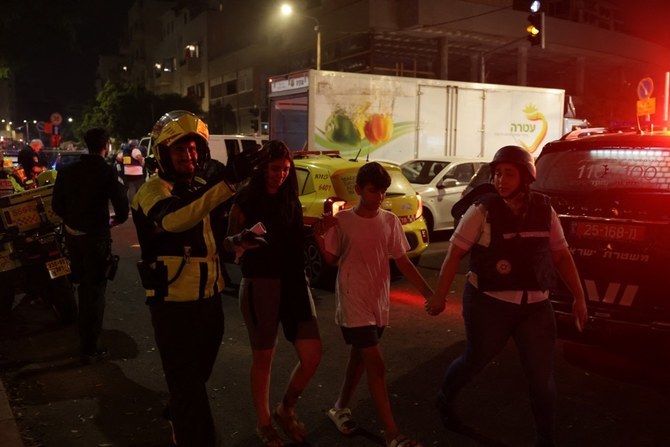
Emergency personnel assist people at the site of an explosion amid the Israel-Hamas conflict in Tel-Aviv, Israel. (Reuters)
Short Url
Updated 19 July 2024
Follow

Tel Aviv blast leaves 1 dead, caused by ‘falling aerial target’

  • Emergency services said the explosion took place around 0015 GMT in a building in the center of the city
  • Police and bomb disposal units were deployed to the scene and conducted searches for suspicious objects

TEL AVIV: An explosion in Tel Aviv early Friday left one person dead, an Israeli emergency services spokesperson said, with the army saying a falling “aerial target” caused the blast.

Emergency services said the explosion took place around 03:15 am (0015 GMT) in a building in the center of the city. Two people were lightly injured, Zaki Heller of the Magen David Adom medical service said.

An earlier police report had said seven people were injured, but they were mainly in a state of shock, Heller added.

The army said an initial inquiry showed that the explosion was “caused by the falling of an aerial target.”

“No sirens were activated,” it said in a statement, adding that the air force had “increased its air patrols in order to protect Israeli airspace.”

A resident of central Tel Aviv said he had been woken by a loud explosion.

“Everything shook,” he said.

Police found a body bearing injuries caused by shrapnel in the building, which is located on the corner of Ben-Yehuda Avenue and Shalom-Aleichem Street, not far from an annex of the US Embassy in Israel, spokesperson Dean Elsdunne said.

“It may have been an aerial explosion... We were very lucky,” said Peretz Amar, a Tel Aviv police commander at the scene, adding an investigation was “ongoing.”

“The police, along with emergency and rescue forces, discovered a man in his 50s in a nearby building who was found dead in his apartment, with shrapnel wounds on his body,” a police statement said.

Another 10 people with minor injuries were taken for medical treatment, it said.

Police and bomb disposal units were deployed to the scene and conducted searches for suspicious objects and additional threats, the statement added.

Residents were urged to “respect safety instructions and not to approach or touch debris or shrapnel that may contain explosives,” it said.


Soleimani warned Al-Assad about ‘spy’ Luna Al-Shibl: Al-Majalla

Updated 09 December 2025
Follow

Soleimani warned Al-Assad about ‘spy’ Luna Al-Shibl: Al-Majalla

LONDON: The late Iranian General Qassem Soleimani confronted Syria’s National Security Bureau chief Ali Mamlouk in late 2019 after seeing Luna Al-Shibl leaving his office. Al-Majalla magazine claims its reporters reviewed a document containing the full Arabic transcript of their exchange.

Soleimani reportedly asked, “Who is this?” and Mamlouk replied, “She is Louna Al-Shibl, the president’s adviser.”

The Quds Force commander pressed further: “I know, I know… but who is she really? Where did she work?”

According to Al-Majalla, a sister publication of Arab News, he said her former salary was “ten thousand dollars,” compared with her current salary of “five hundred thousand Syrian pounds,” before asking: “Does it make sense for someone to leave ten thousand dollars for five hundred thousand pounds? She is a spy.”

Both Soleimani and Maher Al-Assad, commander of the Syrian army’s powerful Fourth Division, had warned the ousted president’s inner circle about Al-Shibl, Al-Majalla reported.

‘Suspicious’ car crash

On July 2, 2024, Al-Shibl was involved in what officials described as a traffic accident on the Damascus-Dimas highway. She was hospitalized and died four days later.

But Al-Majalla reported that photos of her armored BMW showed only minor damage, raising immediate questions among those close to the case.

Eyewitnesses told the magazine that the crash was intentional. One said, “a car approached and rammed her vehicle,” and before her bodyguard could exit, “a man attacked her and struck her on the back of the head,” causing paralysis that led to her death.

She was first taken to Al-Saboura clinic, then transferred to Al-Shami Hospital. Several senior regime-linked figures, including businessman Mohammed Hamsho and an aide to Maher Al-Assad, were present when her condition deteriorated. One witness told Al-Majalla that when her bodyguard tried to explain what had happened, “he was arrested immediately in front of the others.”

The presidency later issued a brief statement announcing her death. Her funeral was attended only by a handful of officials. Then president Al-Assad did not attend.
