

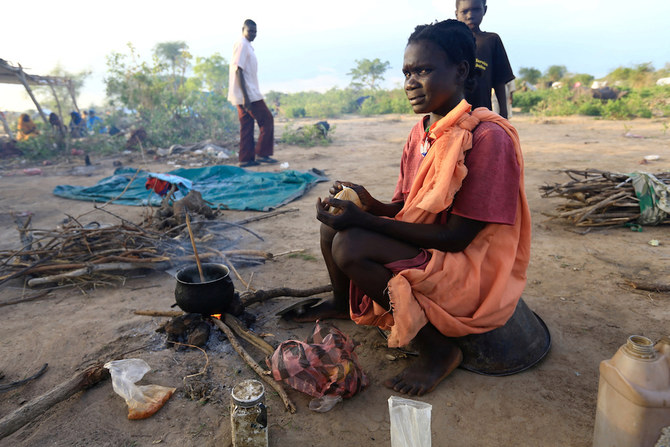
Displaced Sudanese eat dirt to survive, children too tired to cry says US envoy to UN

US representative to the UN Linda Thomas-Greenfield on Thursday painted a dire picture of the situation affecting the people of Sudan, which she said continues to be “the worst humanitarian crisis in the world.” (Reuters/File Photo)
Short Url
Updated 18 July 2024
Follow

Displaced Sudanese eat dirt to survive, children too tired to cry says US envoy to UN

  • Linda Thomas-Greenfield calls on international donors to honor the pledges of aid for Sudan they made during Paris conference in April
  • She says efforts continue in attempt to reach ceasefire agreement between rival military factions, and to open up access for humanitarian aid

NEW YORK CITY: The US representative to the UN on Thursday painted a dire picture of the situation affecting the people of Sudan, which she said continues to be “the worst humanitarian crisis in the world.”

Linda Thomas-Greenfield lamented the international silence regarding the tragedy that is unfolding in the civil war-ravaged country, and the failure of donors to honor a significant proportion of their financial pledges of aid for Sudan made during an international conference in Paris on April 15.

The conflict in the country erupted in April 2023, between two rival factions of the country’s military government: the Sudanese Armed Forces under Gen. Abdel Fattah Al-Burhan, and the paramilitary Rapid Support Forces led by Mohammed Hamdan Dagalo, more commonly known as Hemedti.

More than 10 million Sudanese civilians have been displaced by the conflict, including more than 2 million who have fled to neighboring countries in search of safety, Thomas-Greenfield said. The number of refugees from Sudan in Chad alone doubled during the first 12 months of the conflict, with more civilians fleeing there in a single year than during the previous 25 years combined, she added.

About 25. 6 million people now face food insecurity at crisis level or worse, Thomas-Greenfield said. About a third of them are dealing with emergency conditions and 750,000 people, including women, children, the very old and the very young, are at risk of famine and starvation.

Recalling her trip to a refugee camp in Chad last year, she said people were “eating dirt to survive, tree leaves for nutrition,” and children were so weak “they lacked energy to even cry.”

She added: “The room was quiet, totally quiet. That level of suffering is occurring all over Sudan, over and over and over again.

“I’ve said (before that) this is the worst humanitarian crisis in the world. And that has not changed. And sadly, the silence I heard that day in Chad has been met with even more silence across the world.”

Three months after the conference Paris, Thomas-Greenfield said, only two-thirds of the pledges have been paid out and only about a quarter of the required response to the crisis has been funded.

She also warned that humanitarian access to the country, which is “already severely restricted by the parties to the conflict, threatens to even further shrink.”

She highlighted in particular continued obstruction by the Sudanese Armed Forces at the Adre crossing on the border between Chad and West Darfur.

“This obstruction is completely unacceptable,” she said. “To make matters worse, experts predict that the rainy season will decrease already severely restricted cross-border access,

all while floodwaters worsen the already dire conditions in IDP (internally displaced persons) camps, putting hundreds of thousands at risk of waterborne diseases.”

Although the scale of the crisis is “overwhelming,” Thomas-Greenfield stressed that “now is not a moment to throw up our hands.”

She announced a further $203 million in humanitarian assistance from the US for the civilians in Sudan, Chad, Egypt and South Sudan who have been affected by “this brutal conflict,” and expressed hope that “this new round of aid serves as a call to action for others to follow suit.”

But she added that “this money is not a panacea,” and vowed her country will continue to urge the warring parties in Sudan to support “an immediate ceasefire and to remove barriers to humanitarian access and delivery of aid.”


UN issues ‘stark’ warning on Kordofan

Trucks transport displaced people from El-Fasher. (Reuters)
Updated 9 sec ago
Follow

UN issues ‘stark’ warning on Kordofan

  • Developments on the ground indicate clear preparations for intensified hostilities in Sudan, says Volker Turk

GENEVA: The UN has issued a “stark warning” over preparations for intensified fighting in Sudan’s Kordofan region, as it made a new call for an end to the violence.

The paramilitary Rapid Support Forces, who have been locked in conflict with Sudan’s regular army since April 2023, announced on Thursday that they had agreed to a humanitarian truce proposal made by mediators.
Following the RSF capture of El-Fasher in late October — the army’s last major stronghold in western Darfur — the paramilitaries appear to be shifting their focus eastward toward Khartoum and Kordofan.
UN human rights chief Volker Turk said traumatized and trapped civilians were being prevented from leaving El-Fasher.
“I fear that the abominable atrocities such as summary executions, rape, and ethnically motivated violence are continuing within the city,” he said in a statement.
And for those who do manage to escape, the exit routes have been the scenes of “unimaginable cruelty,” he added.
“At the same time, I issue a stark warning about events unfolding in Kordofan,” said Turk.
“Since the capture of El-Fasher, the civilian casualties, destruction, and mass displacement there have been mounting. There is no sign of de-escalation.
“To the contrary, developments on the ground indicate clear preparations for intensified hostilities, with everything that implies for its long-suffering people.”
The RSF has been accused of mass killings, looting, and sexual violence in El-Fasher.
Turk said that given the “cataclysmic violence” in the city, countries were on notice that without quick and decisive action, “there will be more of the carnage and atrocities that we have already witnessed.”
He said the provision of military support to sustain parties committing serious violations must stop.
“I repeat my plea for an immediate end to the violence both in Darfur and Kordofan. The international community requires bold and urgent action,” said Turk.
The fall of El-Fasher gave paramilitaries control over all five state capitals in Darfur, raising fears that Sudan would effectively be partitioned along an east-west axis.
Witnesses to the first days of the RSF’s takeover said civilians in El-Fasher were shot in the streets, targeted in drone strikes, and crushed by trucks,
Reuters spoke to people who fled to the city of Al-Dabba, more than 1,000 km away in northern Sudan, and one person who fled to the nearby town of Tawila.
One witness said he was in a group trying to flee intense shelling when RSF trucks surrounded them, and sprayed civilians with machine-gun fire and crushed them with their vehicles.
“Young people, elderly, children, they ran them over,” said the witness, who did not want to give his name for fear of retribution, speaking by phone from Tawila.