

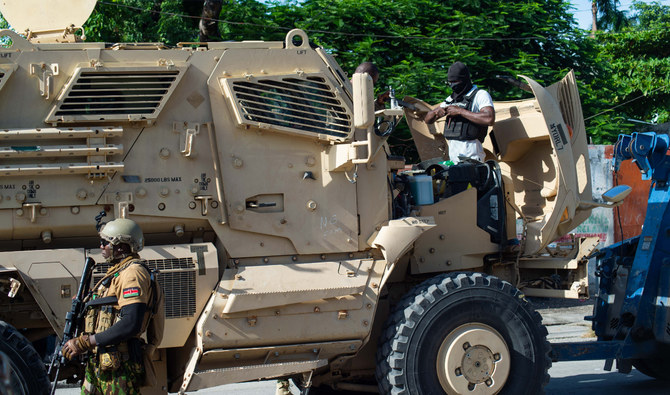
Kenya police patrol Haiti capital after more forces arrive

Kenyan police exit an armored vehicle during a deployment of Kenyan police officers near the national palace, in the city center of Port-au-Prince, Haiti, July 17, 2024. (AFP)
Short Url
Updated 18 July 2024
Follow

Kenya police patrol Haiti capital after more forces arrive

PORT-AU-PRINCE: Kenyan police patrolled Haiti’s capital in armored vehicles Wednesday, a day after the arrival of 200 additional personnel from the African country as part of a multinational security mission, local officials said.

The vehicles patrolled the area around the National Palace and other parts of Port-au-Prince with Kenyan forces and Haitian police on board, according to the official, who spoke on condition of anonymity and did not provide details about the objectives of the operation.

Several bangs were heard as the vehicles passed by, according to an AFP journalist, although it was unclear if they were shots fired by police or the armed gangs who control some 80 percent of the capital.

Kenya stepped up last year to lead the long-sought international force to help Haiti tackle its soaring insecurity.

The UN-approved mission, with an initial duration of one year, will total 2,500 personnel from countries also including Bangladesh, Benin, Chad, the Bahamas and Barbados.

Kenya has now sent around 400 personnel to Haiti — 200 on June 25 and 200 on Tuesday — with promises of another 600 in the coming weeks.

The United States has ruled out sending forces, but is contributing funding and logistical support to the mission.

Haiti has long been rocked by gang violence, but conditions sharply worsened at the end of February when armed groups launched coordinated attacks in Port-au-Prince, saying they wanted to overthrow then-prime minister Ariel Henry.

The violence in Port-au-Prince has affected food security and humanitarian aid access, with much of the city in the hands of gangs accused of abuses including murder, rape, looting and kidnappings.


Poland slow to counter Russia’s ‘existential threat’: general

Updated 4 sec ago
Follow

Poland slow to counter Russia’s ‘existential threat’: general

  • The general highlighted a low “pace of technical modernization,” compared to increases in the army’s size
  • Kukula said the Polish army should reach 500,000 soldiers by 2039

WARSAW: Russia poses an “existential threat” to Poland and its military is lagging, the country’s armed forces chief warned senior officials on Wednesday.
Poland, the largest country on NATO’s eastern flank and a neighbor of Russia, Belarus, and Ukraine, is the western alliance’s largest spender in relative terms.
This year, the country is allocating 4.8 percent of its GDP to defense, just shy of the alliance’s five percent target to be met by 2035.
However, that record defense spending was not enough to “make up for nearly three decades of chronic underfunding of the armed forces,” General Wieslaw Kukula, chief of the general staff, argued at the meeting, which included top officers, the defense minister and Poland’s president.
The general highlighted a low “pace of technical modernization,” compared to increases in the army’s size.
Kukula said the Polish army should reach 500,000 soldiers by 2039, compared with around 210,000 at present.
As a result of a lack of updates, some new Polish units “are not achieving combat readiness,” due to insufficient equipment, rather than a personnel shortage, the general argued.
Meanwhile, he added, “the Russian Federation remains an existential threat to Poland.”
Russia “is constantly reorganizing its forces, drawing on the lessons from its aggression in Ukraine, and building up the capacity for a conventional conflict with NATO countries,” he stressed.
Poland is to receive 43.7 billion euros ($51,5 billion) in loans under the European Union’s Security Action For Europe (SAFE) scheme, designed to strengthen Europe’s defensive capabilities.
Warsaw plans to use these funds to boost domestic arms production.
The Polish government claims that Poland will be able to access SAFE finance even if President Karol Nawrocki — backed by Poland’s conservative-nationalist opposition — vetos a law setting out domestic arrangements for its implementation.
Law and Justice (PiS) — the main opposition party — argues that SAFE could become a new tool for Brussels to place undue pressure on Poland, thanks to a planned mechanism for monitoring the funds, which they claim risks undermining Polish sovereignty.