

Daesh claims responsibility for mosque attack in Oman, four Pakistanis killed

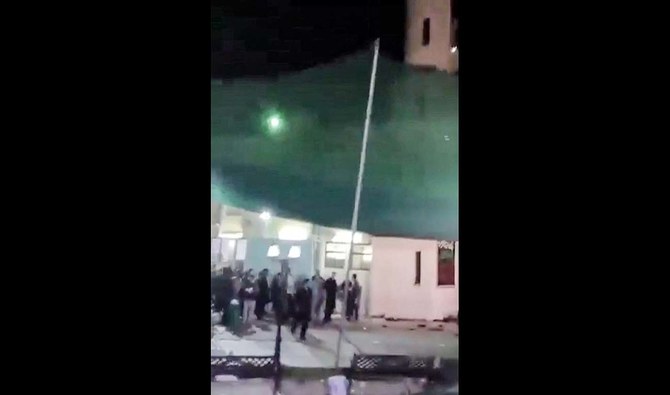
This image grab from a UGC video taken on July 16, 2024 shows shows people fleeing the scene of a shooting at the Imam Ali Mosque in the Al-Wadi Al-Kabir area in the east of Oman's capital Muscat. (AFP/File)
Short Url
Updated 17 July 2024
Follow

Daesh claims responsibility for mosque attack in Oman, four Pakistanis killed

  • Attack took place at Shiite mosque in Wadi Al-Kabir in Omani capital of Muscat
  • Attack raises fears that Daesh may be trying to gain a foothold in new territory

ISLAMABAD: The Daesh group claimed responsibility for an attack at a Shiite Muslim mosque in Oman, the group said on Tuesday, which left at least nine people dead, including four Pakistanis, a rare security breach in the oil-producing Gulf state.

The attack on Monday, which is unusual in the wealthy Gulf state, raises fears that Daesh may be trying to gain a foothold in new territory.

“Three suicide attackers from the Islamic State attacked last night a gathering of Shiite (Muslims) while they were practicing their annual rituals at a temple in the Wadi Al-Kabir district in the (Omani) capital,” according to the group’s statement, which cited three security sources.

The Daesh fighters fired on Shiite worshippers and exchanged gunfire with Omani security forces until morning, the statement added.

Daesh late on Tuesday published what it said was a video of the attack on its Telegram site. The group also said that the attack left more than 30 Shiite Muslims and five Omani forces, including a police officer, killed or wounded.

“According to the latest information received from the Omani authorities, four Pakistanis were martyred as a result of gunshots in the dastardly terrorist attack on the Ali bin Abi Talib mosque in Wadi Kabeer area in Muscat,” the Pakistani foreign ministry said. “Another thirty Pakistanis are under treatment in hospitals.”

Videos shared by the embassy in Oman showed Pakistan’s ambassador to Oman Imran Ali visiting the injured in hospital. 

“This is my message to the Pakistani community that in this emergency situation, please don’t go toward Wadi Al-Kabir, that area is cordoned off,” Ali said in a video message recorded at a hospital. “If anyone has injured relatives, kindly please don’t give up on your patience.”

He said he had visited up to four hospitals and the injured people he had met were in “relatively” stable condition. 

“People in their homes, please stay safe, and don’t go there [toward Wadi Al-Kabir] because our information is that the emergency situation is still ongoing,” the ambassador concluded.

A handout from the embassy said the “terrorist” attack by “unknown assailants” took place around 11pm on Monday night on the Imam Bargah Ali bin Abu Talib in Wadi Al-Kabir. Authorities evacuated people from the area following the attack and started an operation around 230am.

“Assailants have taken worshippers hostages while reportedly [there are] several casualties; authorities have cordoned off the area,” it added. “Hostage evacuation has started now. Military units have reached.”

The Pakistani embassy’s Facebook page said emergency had been imposed at the Khulla Hospital, Nahida Hospital and Royal Hospital, which Ambassador Ali had visited. 

The attack comes during the Islamic month of Muharram, when Shiite Muslims commemorate the seventh-century battlefield martyrdom of Imam Hussein, the grandson of Prophet Muhammad (pbuh).


Pakistan IT exports rise nearly 20 percent to $2.61 billion in first seven months of fiscal year

Updated 4 sec ago
Follow

Pakistan IT exports rise nearly 20 percent to $2.61 billion in first seven months of fiscal year

  • January ICT exports climb to $374 million year-on-year
  • Sector remains country’s top-earning services export

KARACHI: Pakistan’s information and communication technology (ICT) export earnings rose 19.78 percent year-on-year to $2.61 billion in the first seven months of the fiscal year ending June 2026, the IT ministry said on Tuesday, highlighting the sector’s growing role as a source of foreign exchange.

Pakistan’s IT and IT-enabled services sector has emerged as one of the country’s fastest-growing sources of foreign exchange, generating over $3 billion annually and employing roughly a million freelancers in addition to formal software firms.

Unlike traditional manufacturing exports, the industry relies primarily on remote digital labor, from software development to back-office services, making it resilient during economic crises but constrained by payment barriers, talent migration and infrastructure reliability challenges. However, IT services require minimal imports and benefit from a large pool of young workers and freelancers, making the sector central to government plans to boost dollar inflows and reduce pressure on the balance of payments.

“ICT export remittances surged 19.78 percent, reaching $ 2.61 billion during the first seven months of FY 2025-26 compared to $ 2.18 billion achieved during the corresponding period last year,” the IT ministry said in a statement.

Monthly exports also expanded, with ICT services exports reaching $374 million in January 2026, up 19.5 percent from $313 million a year earlier, according to the ministry’s data.

The ministry said ICT remained the country’s highest-earning services sector, well ahead of “other business services,” which generated $1.21 billion over the same July-January period.

Pakistan has increasingly relied on technology exports, including software development, outsourcing and freelance services, to generate foreign exchange as the economy adjusts under structural reforms and tight import controls following a balance-of-payments crisis.

Officials say continued growth will depend on easing payment bottlenecks, improving digital infrastructure and expanding higher-value technology services beyond traditional outsourcing.