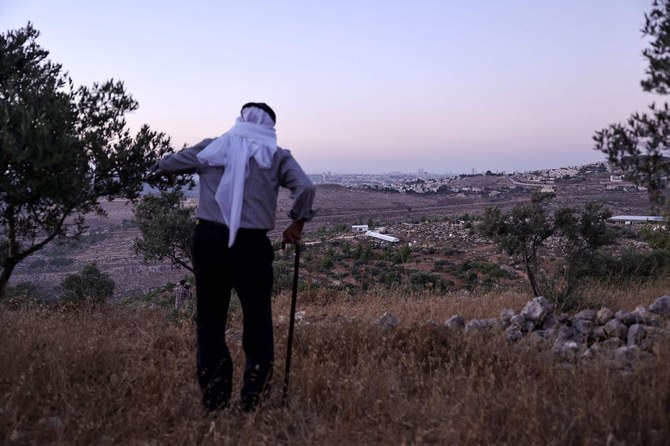
BATTIR, Palestinian Territories: On a hillside near Palestinian landowner Olayan Olayan’s olive groves, young Israeli settlers are hammering out a new, illegal outpost in a UNESCO-protected zone.
Olayan and his neighbors have long battled attempts to settle the land in Battir, a heritage site in the Israeli-occupied West Bank famed for its ancient stone terraces.
Israeli construction in the West Bank has boomed since the war began in the Gaza Strip, even though all settlements in the territory are considered illegal under international law.
The new outpost on a Battir hilltop, also not approved by Israel, was served an eviction notice that Olayan’s cousin Ghassan Olayan said has not been enforced because of the Gaza war.
The outpost already has a flagpole, living quarters and a barn for sheep that roam a rocky hill covered by olive trees belonging to Palestinian farmers.
“I plowed the land and planted it until it bore fruit trees,” said Olayan, who at 83 is older than the state of Israel itself.
“Some trees were 50 years old, or even more, and suddenly the settlers came and wanted to devour the land and take it from us,” he added, his voice shaky.
Even more concerning to the Olayans than the encroaching outpost is the adjacent, future settlement of Heletz.
Yonatan Mizrahi of settlement watchdog Peace Now said Heletz was among five settlements “deep in Palestinian territory” approved by the Israeli government on June 27.
“It is a settlement that is going to block Battir and in many ways create tension between the neighbors,” he said.
Heletz and the outpost sit inside the UNESCO protection zone for Battir, one of four listed heritage sites in the West Bank.
The UNESCO classification means the village can get technical, legal, and monetary assistance to preserve sites deemed in danger.
In Battir, children splash in the Roman-era fountain that waters the terraces where tomatoes, corn, aubergines and olive trees grow.
The 2,000-year-old dry stone walls supporting the landscape earned the village its cultural inscription in 2014. But the classification has done little to prevent seizures of the surrounding farmland.
Battir’s inhabitants have beaten in court at least three previous Israeli settlement outpost attempts.
But Ghassan Olayan fears the war since the Hamas attacks of October 7 on Israel will make the new, government-approved Heletz more likely to become reality.
According to Olayan, Heletz is intended to link Jerusalem to Gush Etzion, a cluster of settlements deeper in the West Bank.
If that is achieved, Battir and the nearby Palestinian villages would be cut off from Bethlehem and the rest of the West Bank, a process they fear will fragment a future Palestinian state.
“There will be no (territorial) continuity,” said Olayan, leaving only what some observers describe as an archipelago of Palestinian sovereignty.
Israel’s far-right Finance Minister Bezalel Smotrich, a settler himself, openly states that preventing Palestinian statehood is the objective.
“We will continue to develop the settlements in order to maintain Israel’s security and prevent the establishment of a Palestinian state,” he wrote on the X social media platform after the five latest settlements were approved in June.
In recent months, Israeli forces have blocked a road to Battir, nearly doubling the time it takes to reach Jerusalem just 10 kilometers (six miles) north.
When asked about the new outpost in Battir, an Israeli security official acknowledged that “an Israeli farm had been established without proper authorization.”
The official told AFP “the possibility of authorizing the farm will be weighed” as the development of Heletz gets under way.
Battir residents “raised several claims that the land belongs to them” but have “not presented documentation to support their position,” according to the official.
Olayan said documents from Ottoman times prove Battir inhabitants’ ownership of the land.
A UNESCO spokesperson said the UN cultural agency’s world heritage committee had been told about “reports of illegal constructions” and that Battir would be discussed at a session in late July.
Olayan fears that sleepy Battir, with its collective life centered around the Roman fountain’s irrigation system allotting each family a specific time slot to irrigate their crops, faces a difficult future.
“Battir is a peaceful village and the settlement will only bring trouble,” he said.


Israeli settlement threatens Palestinian UNESCO village
https://arab.news/yqvez
Israeli settlement threatens Palestinian UNESCO village

- Palestinians have long battled attempts to settle the land in Battir, a heritage site in the Israeli-occupied West Bank famed for its ancient stone terraces
- Israeli construction in the West Bank has boomed since the war began in the Gaza Strip, even though all settlements in the territory are considered illegal


How one displaced family in Gaza is observing Ramadan’s first day under a fragile ceasefire deal
KHAN YOUNIS, Gaza Strip: Waleed al Zamli longingly recalled the joys and traditions of the first day of Ramadan before the Israel-Hamas war had drastically altered his life: Lanterns for the children. Sweets. Special dishes.
“Before the war, we would greet it with happiness,” the father of 11 said, speaking from Muwasi, an area crowded with tents sheltering Palestinians who were forced by the Israeli military offensive to flee their homes.
Not anymore, he said.
It saddens and pains him that he’s unable to provide for his family, which now ekes out an existence in displacement. Al Zamli lost his job after the shop where he had worked was destroyed, he said.
So, for the first Ramadan “iftar,” the fast-breaking meal, his wife picked up meals Wednesday from a charity kitchen that the family has heavily depended on. She made soup to go with it.
“This year, there’s no happiness,” al Zamli said.
Hardships and losses dampen Ramadan’s spirit for many
Ramadan arrived in Gaza under a fragile ceasefire deal, but many Palestinians there say the month’s typically festive spirit is eluding them as they grapple with the hardships of their daily lives and the grief and losses of the war.
Some of these difficulties were on display at the charity kitchen where dozens crowded, many with their arms outstretched as they vied for a spot and held empty pots. They included children, women and elderly people.
During Ramadan, observant Muslims fast daily from dawn to sunset. It’s a time for increased worship, religious reflection and charity. In normal circumstances, the month often brings families and friends together to break their fast in joyous gatherings.
But circumstances in Gaza are far from normal. Israel’s military offensive has killed more than 72,000 Palestinians, according to Gaza’s Health Ministry, and caused widespread destruction and displaced most of the territory’s residents. Israel launched the offensive after Hamas-led militants killed some 1,200 people, mostly civilians, and took another 251 hostage in their attack on Oct. 7, 2023.
For al Zamli, the biggest challenge this Ramadan is providing food for his family. He said he’s received limited aid. Foods, like meat and poultry, are more expensive than their prewar prices, he said, and with no income many items are beyond his reach.
“The children want to feel happy like other people’s children, to get dressed and to eat something clean and special,” he said.
The financial strain can be especially amplified during Ramadan, he said. Typically, many shoppers throng to markets to stock up on food staples and buy decor and other supplies. Food can play a central role as the daily fasting gives way to nourishing, and for some elaborate, iftar meals. Muslims also eat a predawn meal known as “suhoor” to nurture their bodies ahead of the fast.
As Gaza residents visited markets this week, some lamented how economic woes cast a pall on the month.
Ramadan decorations among the ruins
Still, amid the struggles, some in the Gaza Strip have worked to bring a taste of the month’s festivities — for example, hanging strands of Ramadan decorations among the ruins. At their displacement camp, al Zamli’s children played with empty soda cans fashioned to look like Ramadan lanterns.
The Oct. 10 US-brokered ceasefire deal attempted to halt more than two years of war between Israel and Hamas. While the heaviest fighting has subsided, the ceasefire has seen almost daily Israeli fire.
Israeli forces have carried out repeated airstrikes and frequently fire on Palestinians near military-held zones, killing more than 600 Palestinians, according to Gaza health officials. The ministry, which is part of the Hamas-led government, maintains detailed casualty records that are seen as generally reliable by UN agencies and independent experts. But it does not distinguish between civilians and militants.
Militants have carried out shooting attacks on Israeli troops, and Israel says its strikes are in response to that and other violations. Four Israeli soldiers have been killed.
Despite some much-needed respite under the shaky ceasefire deal, many daily struggles, big and small, persisted.
Al Zamli said the war has deprived him and his family of many things. A son-in-law, he said, was killed, shortly after he married his now-widowed daughter.
This Ramadan, he will pray “for the bloodshed to end … and to feel security, safety, and tranquility” and “to be able to provide good food and clothes for our children.”


