Gaza city says water treatment stops, 700,000 face health ‘crisis’

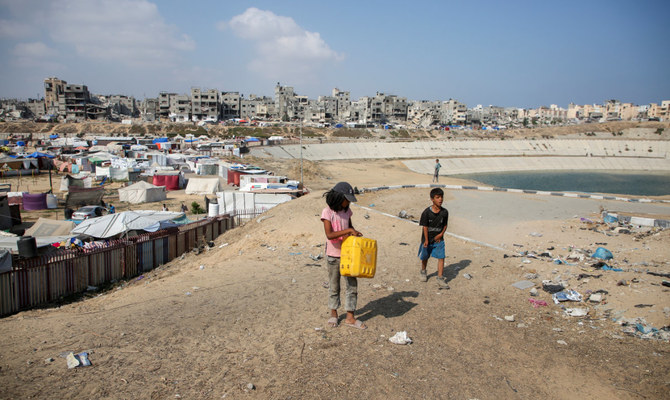
Palestinian children walk near a wastewater pool as displaced Palestinians shelter in a tent camp, amid the Israel-Hamas conflict, in Khan Younis in the southern Gaza Strip, July 15, 2024. (Reuters)
Short Url
Updated 16 July 2024
Follow

Gaza city says water treatment stops, 700,000 face health ‘crisis’

  • “Deir Al-Balah municipality announces the halt of water waste pumping stations because stocks of fuel necessary for their functioning are exhausted,” said a city statement

GAZA STRIP, Palestinian Territories: Wastewater pumping stations in one of Gaza’s main cities stopped working on Tuesday because fuel had run out, the local authority said, expressing fears that disease could rapidly spread.
Tens of thousands of people displaced by the Israel-Hamas war have sought shelter in Deir Al-Balah, and city authorities said more than 700,000 people could be at risk from a “health and environmental crisis.”
“Deir Al-Balah municipality announces the halt of water waste pumping stations because stocks of fuel necessary for their functioning are exhausted,” said a city statement.
It predicted that “roads will be flooded by waste water” and “diseases will spread.”
Gaza has had no electricity supplies since the war was unleashed by the October 7 Hamas attacks on Israel. The fuel-powered waste plants treat water that is then put into the Mediterranean.
“Nineteen pits and two large reservoirs are unusable in Deir Al-Balah,” Ismail Sarsour, an official with the city’s emergency committee, said ahead of the release of the statement.
He said the stations handle wastewater for more than 140 points of shelter where tens of thousands of people have taken refuge.
The Palestinian Authority’s water department, the PWA, which is based in Ramallah in the occupied West Bank, said recently it had arranged for tens of thousands of liters of fuel to enter Gaza.
But Palestinian experts said the water crisis is so deep that the fuel alone would not help. Sarsour and the experts said there was also a critical shortage of spare parts to repair damaged infrastructure.
Israel said this month that, with help from the UN children’s agency UNICEF, it has connected one desalination plant in southern Gaza to its electricity network. It is unclear if the plant has started working.
The Palestinian Authority also said Tuesday that it expected electricity supplies to start again in central Gaza in “coming days” to power public infrastructure. Israeli authorities have not confirmed the move.
Israel’s military offensive since October 7 has killed at least 38,713 people, mostly civilians, according to figures from Hamas-run Gaza’s health ministry.
The war began with Hamas’s unprecedented attack on Israel which resulted in the deaths of 1,195 people, mostly civilians, according to an AFP tally based on Israeli figures.


Gulf countries offer support to Yemen’s legitimate government, Saudi security

Updated 31 December 2025
Follow

Gulf countries offer support to Yemen’s legitimate government, Saudi security

  • Qatar, Kuwait say their security is based on the security of Saudi Arabia and the GCC
  • Bahrain said it had confidence in the leadership of Saudi Arabia and the UAE to contain differences

LONDON: Gulf and Arab countries on Tuesday offered support to the internationally recognized government in Yemen after the UAE withdrew its forces from the country.

The statements were issued after the military coalition supporting Yemen’s government carried out airstrikes on a shipment of weapons and vehicles destined for southern separatist forces.

The shipment arrived in the port of Mukalla on board two vessels from Fujairah in the UAE.

The Emirates was asked by Rashad Al-Alimi, head of Yemen’s presidential council, to withdraw its troops from Yemen within 24 hours.

Saudi Arabia said the separatists, operating under the Southern Transitional Council and supported by the UAE, posed a direct threat to the Kingdom’s national security and regional stability by recently seizing territory in the  governorates of Hadramaut and Al-Mahra.

Qatar said it was following the developments “with keen interest.”

A foreign ministry statement said Doha fully supported the legitimate Yemeni government and stressed the importance of preserving Yemen's unity and  safeguarding the interests of the Yemeni people.

It added that the security of Saudi Arabia and the security of the member states of the Gulf Cooperation Council (GCC) “constitute an inseparable part of the security of the State of Qatar, reflecting the deep-rooted fraternal ties and shared destiny that unite the GCC states.”

The ministry commended the statements issued by Saudi Arabia and the UAE “which reflect a commitment to prioritizing the interests of the region.”

Kuwait also offered “unwavering support” for Yemen’s government and said the security of Saudi Arabia and GCC is the basis of its own national security.

Its foreign ministry praised the “responsible approach” taken by both Saudi Arabia and the UAE.

Bahrain, the current GCC chair, said it had confidence in the leadership of Saudi Arabia and the UAE “and their ability to contain any differences in viewpoints within the framework of a unified Gulf.”

The foreign ministry statement offered “unequivocal” support toward regional and international initiatives and efforts aimed at reaching a comprehensive and lasting political solution in Yemen.

Egypt said it had full confidence in Saudi Arabia and the UAE “to handle the current developments in Yemen with wisdom.”

Cairo will continue efforts toward a comprehensive political settlement for Yemen, the statement said.