

Washington says banning of political party in Pakistan of ‘great concern’

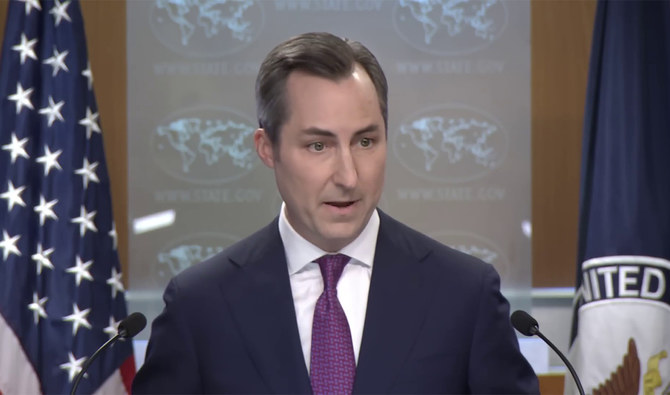
State Department spokesperson, Matthew Miller, is addressing a press briefing in Washington, US on July 15, 2024. (US State Department)
Short Url
Updated 16 July 2024
Follow

Washington says banning of political party in Pakistan of ‘great concern’

  • Government has announced it will pursue ban on Pakistan Tehreek-e-Insaf party of jailed ex-PM Imran Khan
  • PTI says ban yet another attempt by weak governing coalition to squash Khan and PTI’s political popularity

ISLAMABAD: The United States State Department said on Monday it was following reports of the Pakistan government’s plans to ban the Pakistan Tehreek-e-Insaf (PTI) party of ex-premier Imran Khan, adding that outlawing any political party was of “great concern” to Washington.

Information Minister Ataullah Tarar announced on Monday the government of Prime Minister Shehbaz Sharif was planning to ban the PTI and move the country's top court to press treason charges against Khan.

“We’ve seen the reports and the statements made by the government,” a State Department spokesperson told reporters in response to a question. 

“Our understanding is this is the beginning of a complex process, but certainly the banning of a political party is something that would be of great concern to us.”

Tarar has said the decision to ban the PTI was based on the "proven" charge of the party receiving foreign funding, which is illegal in Pakistan, rioting by its supporters last year that targeted military properties and because Khan had leaked, for political gains, state secrets by disclosing the contents of a classified diplomatic cable in what has come to be popularly called the cipher case.

Other reasons included that Khan's party had lobbied in Washington to get the US House of Representatives to support a resolution calling for a probe into Pakistan's elections and Khan had written to the IMF for an election audit before approving a new bailout loan.

The PTI has said the announcement of the ban was yet another attempt by the weak governing coalition to squash Khan and his party’s political popularity.

Jailed since August, Khan was last week acquitted, along with his third wife, on charges that they married unlawfully but he will not be freed after authorities issued new orders to arrest him.

Khan came to power in 2018 and was ousted in 2022 after what is widely believed to be a falling out with Pakistan's powerful military, which denies political interference. His popularity has grown since his ouster and jailing and the candidates he had backed won the most seats in Feb. 8 general elections. 


Pakistan reviews austerity measures amid Middle East crisis, urges strict nationwide implementation

Updated 11 March 2026
Follow

Pakistan reviews austerity measures amid Middle East crisis, urges strict nationwide implementation

  • Deputy Prime Minister Ishaq Dar chairs review meeting of austerity steps
  • Officials briefed on salary cuts, school closures, four‑day week, petrol conservation

ISLAMABAD: Pakistan’s government on Wednesday assessed progress on a sweeping set of austerity measures introduced to mitigate the country’s economic strain from sharply rising global oil prices and supply disruptions linked to the ongoing war in the Middle East.

Prime Minister Shehbaz Sharif this week announced a series of austerity steps, including a four‑day work week for government offices, requiring 50  percent of staff to work from home, cutting fuel allowances for official vehicles by half, grounding up to 60  percent of the government fleet and closing all schools for two weeks to conserve fuel amid the global oil crisis.

The measures were unveiled in response to global oil market volatility triggered by the conflict involving the United States, Israel and Iran, which has disrupted supply routes such as the Strait of Hormuz and pushed crude prices sharply higher, straining Pakistan’s heavily import‑dependent energy sector.

“The meeting stressed the importance of strict and transparent adherence to the austerity measures, promoting fiscal responsibility and prudent use of public resources,” Deputy Prime Minister and Foreign Minister Senator Mohammad Ishaq Dar said in a statement.

He was chairing a meeting of the Committee for Monitoring and Implementation of Conservation and Additional Austerity Measures, constituted under the directions of the PM, bringing together federal and provincial officials to review execution of the broad cost‑cutting plan. 

Dar emphasized the government’s commitment to enforcing the PM’s austerity steps nationwide. The committee’s review also covered reductions in departmental expenditure, deductions from salaries of senior officials earning over Rs. 300,000 ($1,120), and coordination with provincial administrations to ensure uniform implementation of the plan.

Participants at the meeting reiterated that all ministries and divisions must continue strict monitoring and reporting, with transparent oversight mechanisms, as Pakistan navigates the economic pressures from the prolonged Middle East crisis and its fallout on global energy and trade markets.