

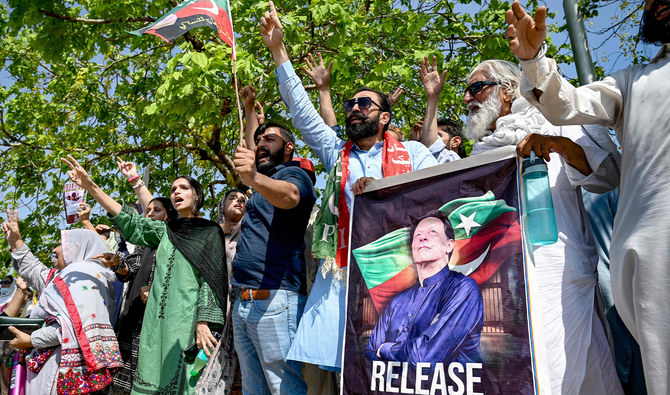

ISLAMABAD: The federal government’s plans to push for a ban on former prime minister Imran Khan’s Pakistan Tehreek-e-Insaf (PTI) was “unlikely” to be sanctioned by the Supreme Court and could be seen as a latest attempt to dent the popularity of the ex-premier and his party, political observers said this week.
Pakistan’s federal government announced on Monday it was planning to ban Khan’s political party and move the country’s Supreme Court to press high treason charges against him. The decision to ban the PTI was based on what Information Minister Ataullah Tara said was the “proven” charge of the party receiving foreign funding, which is illegal in Pakistan, rioting by its supporters last year that targeted military properties and because Khan had leaked state secrets by disclosing the contents of a classified diplomatic cable for political gains in what has come to be popularly called the cipher case.
Under Article 17 of the Pakistani constitution, “should the Federal Government declare any political party as acting against these interests, it must refer the matter to the Supreme Court within fifteen days for a final decision.”
Several analysts Arab News spoke to agreed that it was unlikely that the decision to ban the PTI would be upheld in court and reflected an attempt by the federal government to assert its authority after a general election marred by accusations of rigging against the broadly popular PTI. The party won more seats than any other in the election despite what it says is a crackdown on its candidates and supporters and has become ever-more popular since Khan was ousted in a parliamentary vote of no-confidence in 2022.
“This move will probably backfire as it is the Supreme Court that will finally decide … and if the court does not see robust, solid evidence in support of declaring it unlawful, which I do not think they have, then probably the government will not succeed,” Ahmed Bilal Mehboob, president of the Islamabad-based Pakistan Institute of Legislative Development And Transparency (PILDAT) think tank, told Arab News.
“I do not think this will materially affect the PTI as long as there are people supporting the party, as long as there are people who love the party, who stand beside it.”
Chaudhry Fawad Hussain, a former close Khan aide, agreed.
“The move is highly unlikely to succeed as under Article 17, government recommendations have to be approved by the SC and the likelihood of its approval is almost null,” he said.
“BAD OPTICS”
The ban announcement comes in the wake of the PTI winning a number of important legal battles. Among four cases in which Khan was convicted and has been jailed since August last year, two have been suspended by courts since and he has been acquitted in the others, though new cases have since been brought against him. Arguably Pakistan’s most popular politician, Khan says all cases against him are motivated to keep him out of politics and behind bars.
Last week, the PTI also won a major victory when the Supreme Court declared that the party was eligible for over 20 extra reserved seats in parliament, which has stripped the governing coalition, led by Prime Minister Shehbaz Sharif, of its two-thirds majority in parliament, weakening an already fragile government that is widely believed to lack mass popular support.
All PTI candidates contested the Feb. 8 elections as independents after the party was barred from the polls on the technical grounds that it did not hold genuine intra-party polls, which is a legal requirement. Subsequently, they won the most seats in the national election, 93, but the election commission said independents were ineligible for their share of 70 reserved seats — 60 for women, 10 for non-Muslims — distributed among political parties in proportion to the number of seats they win in general polls. This completes the National Assembly’s total strength of 336 seats.
The reserved seats were then distributed among other parties, mostly those in the ruling coalition, a decision Khan’s party appealed. On Friday the Supreme Court ruled that the PTI was indeed a political party for the purposes of the election and entitled to reserved seats. The court has now given the PTI 15 days, starting July 12, to submit its list of candidates entitled to the reserved seats and asked independent candidates to formally declare their allegiance to the PTI.
Experts said the announcement of the ban could also be seen as the government’s way to discourage successful independent candidates from rejoining Khan’s party.
“The government may be hoping that because of this announcement, some of the PTI members who currently have to give their affidavit, whether they will join the PTI or not — 41 of them in the National Assembly and about 60 in the Provincial Assemblies — they will get the message that if the party is declared unlawful by the Supreme Court, then they will also stand disqualified,” Mehboob from PILDAT explained, referring to a law that parliamentarians from a particular party stand disqualified if their party is banned.
Mazhar Abbas, a senior journalist and longtime observer of Pakistani politics, was doubtful a ban on the popular political party could hold.
“In any adverse situation, the PTI can come out with a new name with a more aggressive posture,” he said.
Chaudhry, the former Khan aide, also cautioned that a ban would weaken the government further as the public, already stirred up over what they saw as a rigged election and trumped-up cases against Khan, would see the ban a “an attempt to sabotage democracy and against the constitution.”
Political analyst Zoya Tariq warned a ban on the PTI or any other political party would have “serious repercussions” for the country.
“This is bad optics and will set a very wrong precedent as all political decisions in a democratic country should be made by the people,” she told Arab News. “It is the moral duty of the current government to take action to maintain stability in the country.”
“This [ban announcement] has caused no worry to PTI,” PTI spokesman Zulfi Bukhari said in a video message to reporters. “It has only demonstrated what we have been trying to say earlier that there is absolute fascism in Pakistan, there is an undeclared martial law in Pakistan.”


