

Pakistan hikes prices of petrol, diesel — finance ministry

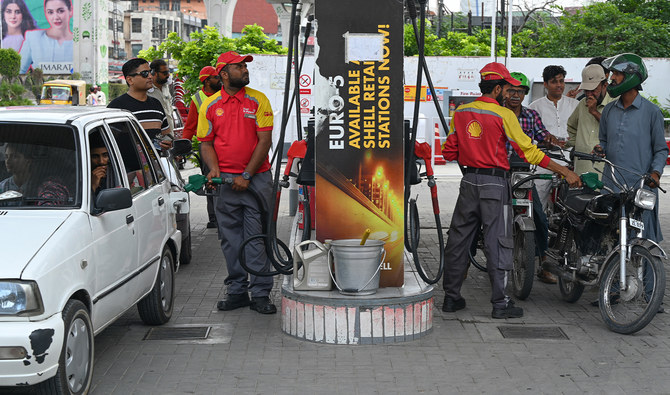
A worker pumps petrol in vehicles at a fuel station in Rawalpindi on July 16, 2023. (AFP/File)
Short Url
Updated 16 July 2024
Follow

Pakistan hikes prices of petrol, diesel — finance ministry

  • Pakistan has increased price of petrol by Rs9.99 to Rs275.60, of high speed diesel by Rs6.18 to Rs283.63
  • Fortnightly price adjustment comes as Pakistan and International Monetary Fund reached $7 billion bailout deal

ISLAMABAD: Pakistan has increased the price of petrol for the next fortnight by Rs9.99 ($0.036) to Rs275.60, with effect from today, Tuesday, the finance ministry said in a post on messaging platform X.

The government also increased the price of high speed diesel by Rs6.18 to Rs283.63, the finance ministry said, adding that the new prices were based on “price variations in the international market.”

“There will be no change in the applicable duties/levies, which will remain at the existing level,” the ministry of finance statement said. 

The government has jacked up the maximum limit of petroleum development levy (PDL) to Rs70 per liter in the Finance Bill to collect Rs1.28 trillion in the current fiscal year against Rs960 billion collection during the previous one — almost Rs91 billion higher than the Rs869 billion budget target.

The fortnightly fuel price adjustment came as Pakistan and the International Monetary Fund reached an agreement for a $7 billion, 37-month loan program that comes with tough measures, sending the benchmark share index to a record high on Monday.

Among the reforms the IMF wants Pakistan to take is to maintain power and gas tariffs at levels that ensure cost recovery, with adjustments made to safeguard the financially vulnerable, through existing progressive tariff structures.

Petroleum and electricity prices have been the key drivers of high inflation in Pakistan. Petrol is mostly used in private transport, small vehicles, rickshaws and two-wheelers while any increase in the price of diesel is considered highly inflationary as it is mostly used to power heavy transport vehicles and particularly adds to the prices of vegetables and other eatables.

Inflation averaged close to 30 percent in FY23 and 23.4 percent in FY24, which ended on June 30.


Bangladesh requests Pakistan to play T20 World Cup match against India on Feb. 15

Updated 8 sec ago
Follow

Bangladesh requests Pakistan to play T20 World Cup match against India on Feb. 15

  • Islamabad announced boycotting the Feb. 15 match in Colombo to protest the ICC’s exclusion of Bangladesh from the T20 World Cup
  • ’We are deeply moved by Pakistan’s efforts to go above and beyond in supporting Bangladesh during this period,’ the BCB chief says

ISLAMABAD: The Bangladesh Cricket Board (BCB) on Monday formally requested Pakistan to play its scheduled T20 World Cup match against arch-rival India on Feb. 15, following Islamabad’s decision to boycott the high-profile fixture.

Islamabad announced boycotting the Feb. 15 Pakistan-India match in Colombo to protest the International Cricket Council’s (ICC) exclusion of Bangladesh from the T20 World Cup, following Dhaka’s decision to not play matches in India owing to security fears.

On Sunday, ICC Deputy Chairman Imran Khwaja arrived in Lahore for talks with PCB officials and BCB President Aminul Islam as the sport’s governing body strived to save the high-stakes T20 World Cup encounter.

In a statement, the BCB thanked the PCB, ICC and all others for their positive roles in trying to “overcome recent challenges,” particularly thanking PCB Chairman Mohsin Naqvi and Pakistani cricket fans for demonstrating “exemplary sportsmanship and solidarity.”

“We are deeply moved by Pakistan’s efforts to go above and beyond in supporting Bangladesh during this period. Long may our brotherhood flourish,” BCB President Islam said in a statement.

“Following my short visit to Pakistan yesterday and given the forthcoming outcomes of our discussions, I request Pakistan to play the ICC T20 World Cup game on 15 February against India for the benefit of the entire cricket ecosystem.”

The dispute stemmed from the ICC’s decision to replace Bangladesh with Scotland last month after Bangladesh refused to play tournament matches in India. Dhaka’s decision followed the removal of Mustafizur Rahman from the Indian Premier League (IPL). He was bought for $1 million by the IPL’s Kolkata Knight Riders, but on Jan. 3 the Board of Control for Cricket in India (BCCI) ordered Kolkata to release Mustafizur without a public explanation but amid regional tensions.

Pakistani cricket authorities subsequently announced boycotting the match against India at R. Premadasa Stadium in Colombo on Feb. 15. An India-Pakistan fixture is the sport’s most lucrative asset, generating a massive share of global broadcasting and sponsorship revenue.

The PCB has remained defiant amid reports of potential sanctions. On Saturday, it rejected claims by Indian media that it had initiated a dialogue with the ICC to find a way out of the standoff.

The standoff highlights the growing friction within the sport’s governance, with Pakistan accusing India’s cricket board of influencing the ICC’s decisions. India generates the largest share of cricket’s commercial revenue and hence enjoys considerable influence over the sport. Critics argue that this financial contribution translates into decisive leverage within the ICC.

A large part of that revenue comes from the Indian Premier League (IPL), the sport’s most lucrative T20 cricket competition, which is run by the Board of Control for Cricket in India (BCCI). Between 2024 and 2027, the IPL is projected to earn $1.15 billion, nearly 39 percent of the ICC’s total annual revenue, according to international media reports.