

Irish prime minister condemns anti-immigration clashes

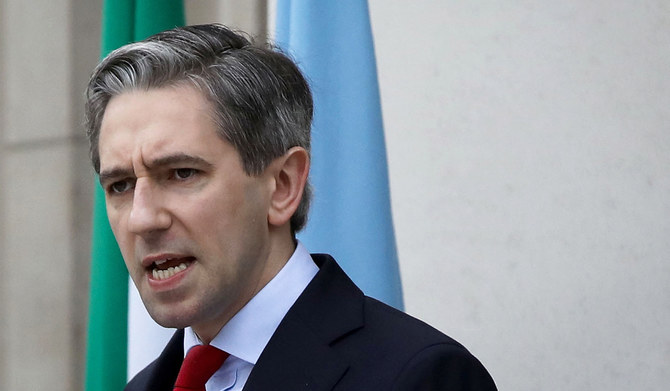
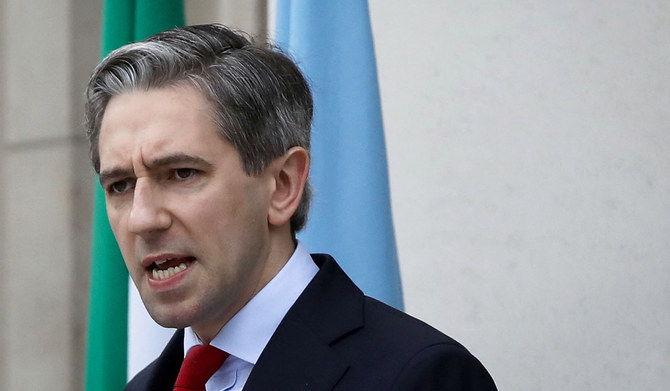
Ireland's Prime Minister Simon Harris, delivers a speech during a press conference, to recognise the state of Palestine at the Government buildings, in Dublin, on May 22, 2024. (AFP)
Short Url
Updated 16 July 2024
Follow

Irish prime minister condemns anti-immigration clashes

  • The violence was sparked by a provider attempting to start work, said the ministry, which is responsible for housing asylum seekers

DUBLIN: Irish Prime Minister Simon Harris condemned violent anti-immigration clashes on Monday at a planned asylum-seeker housing facility in Dublin as “reprehensible,” as 15 were arrested.
The clashes are the latest at sites earmarked for asylum seekers who have arrived in Ireland in growing numbers in recent years.
Videos posted on social media showed machinery and construction materials on fire at the building site, a former paint factory in the north of the capital.
Protesters threw bricks and launched fireworks at police, who used pepper spray to disperse the crowd of more than 100 mostly male teenagers.
Irish Prime Minister Simon Harris said “no person has a right to burn cars, damage property” or attack the police.
“These actions are criminal and are designed to sow fear and division. We should not accept them being legitimized in any way by describing them as ‘protest’,” Harris added in a statement.
“A number of Garda vehicles have been damaged,” police said, using the name for the Irish national force.
One video showed a person, believed to be a worker at the site, which is planned for repurposing as an accommodation facility for up to 500 asylum seekers, being removed from the scene on a stretcher.
Protests at the site entrance have delayed the start of work “for several months,” the integration ministry said.
The violence was sparked by a provider attempting to start work, said the ministry, which is responsible for housing asylum seekers.
“The (ministry) condemns all acts of criminality and intimidation of providers and their employees,” it said.
Ireland’s Justice Minister Helen McEntee told the Irish Times newspaper that she was “appalled” by the scenes and that those involved would face the “full rigours of the law.”
Since 2022, there has been a sharp increase in arson attacks on properties around the country linked to accommodating asylum seekers.
During violent riots in Dublin last November that were sparked by unrest over increased immigration and ignited by a knife attack outside a school, rioters also targeted a number of properties used to house asylum seekers.


Trump pivots to new 10 percent global tariff, new probes after Supreme Court setback

Updated 21 February 2026
Follow

Trump pivots to new 10 percent global tariff, new probes after Supreme Court setback

WASHINGTON: US President Donald Trump moved swiftly on Friday to replace tariffs struck down by the Supreme Court with a temporary ​10 percent global import duty for 150 days while opening investigations under other laws that could allow him to re-impose the tariffs.
Trump told a briefing he was ordering new tariffs under Section 122 of the Trade Act of 1974, duties that would go on top of surviving tariffs. These would partly replace tariffs of 10 percent to 50 percent under the 1977 International Emergency Economic Powers Act that the top court declared illegal.
Trump said later on Truth Social that he had signed an order for the tariffs on all countries “which will be effective almost immediately.”
A spokesperson for the US Customs and Border Protection agency declined comment when asked when collections of the illegal IEEPA tariffs would halt at ports of entry.
Trump’s Treasury Secretary, Scott Bessent, said the new 10 percent duties and potentially enhanced tariffs under the Section 301 unfair practices statute and the Section 232 national security statute would result in virtually unchanged tariff revenue in 2026.
“We will get back to the same tariff level for the countries. ‌It will just be ‌in a less direct and slightly more convoluted manner,” Bessent told Fox News, adding that the Supreme ​Court ‌decision had ⁠reduced Trump’s ​negotiating ⁠leverage with trading partners.
The never-used Section 122 authority allows the president to impose duties of up to 15 percent for up to 150 days on any and all countries to address “large and serious” balance of payments issues. It does not require investigations or impose other procedural limits. After 150 days, Congress would need to approve their extension.
“We have alternatives, great alternatives,” Trump said. “Could be more money. We’ll take in more money and we’ll be a lot stronger for it,” Trump said of the alternative tools.
While the administration will likely face legal challenges, the Section 122 tariffs would lapse before any final ruling could be made, said Josh Lipsky, international economics chair at the Atlantic Council, a think tank in Washington.
Trump said his administration also was initiating several new country-specific investigations under Section 301 of the Trade Act of 1974 “to protect our country from unfair trading practices of ⁠other countries and companies.”
Trump’s shift to other statutes, including Section 122, while initiating new investigations under Section 301 ‌had been widely anticipated, but these have often taken a year to complete.
The 10 percent tariffs only last ‌five months, but Trump said that would allow his administration to complete investigations to enhance tariffs.
Asked if rates ​would ultimately end up being higher after more probes, Trump said: “Potentially higher. ‌It depends. Whatever we want them to be.”
He said some countries “that have treated us really badly for years” could see higher tariffs, whereas for others, “it’s going to ‌be very reasonable for them.”
The fate of dozens of trade deals to cut IEEPA-based duties and negotiations with major US trading partners remained unclear in the wake of the ruling, though Trump said he expected many of them to continue. He said deals that are abandoned “will be replaced with the other tariffs.”
“This is unlikely to affect reciprocal trade negotiations with our trading partners,” said Tim Brightbill, trade partner with the law firm Wiley Rein in Washington. “Most countries would prefer the certainty of a trade deal to the chaos of last year.”
US ‌Trade Representative Jamieson Greer said details on new Section 301 investigations would be revealed in coming days, adding these are “incredibly legally durable.” Trump relied on Section 301 to impose broad tariffs on Chinese imports during his first term.
The Supreme Court’s ruling puts about $175 ⁠billion in tariff revenue collected over the past year subject to potential refunds, according to estimates provided to Reuters by Penn-Wharton Budget Model economists.
Asked if he would refund the IEEPA duties, Trump said, “I guess it has to get litigated for the next two years,” a response indicating that a quick, automatic refund process was unlikely.
Speaking in Dallas, Bessent told business leaders that since the Supreme Court did not provide any instructions on refunds, those were “in dispute,” adding: “My sense is that could be dragged out for weeks, months, years.”
Part of the reason why Trump opted for IEEPA to impose tariffs last year was because the 1977 sanctions statute allowed fast and broad action with almost no constraints. Until Friday, he had also used it as a cudgel to swiftly punish countries over non-trade disputes, such as Brazil’s prosecution of former president and Trump ally Jair Bolsonaro.
While Trump’s new investigations will prolong tariff uncertainty, they could inject more order into his tariff policy by forcing him to rely on trade laws that have well-understood procedures, research and public comment requirements, and longer timelines, said Janet Whittaker, senior counsel with Clifford Chance in Washington.
“The administration will need to follow these set processes, conduct the investigations, and so for businesses, that means more visibility into the process,” Whittaker said.
Robert Lighthizer, Trump’s trade chief during his ​first term, said on Fox News that he hoped Congress would revise decades-old ​trade laws to give Trump new tariff tools.
“I think there’s consensus in this Congress that we have to change the old system, and I hope that they will take this as an opportunity to do that,” Lighthizer said.