England and Wales population rises by most in 75 years amid influx from Pakistan, elsewhere

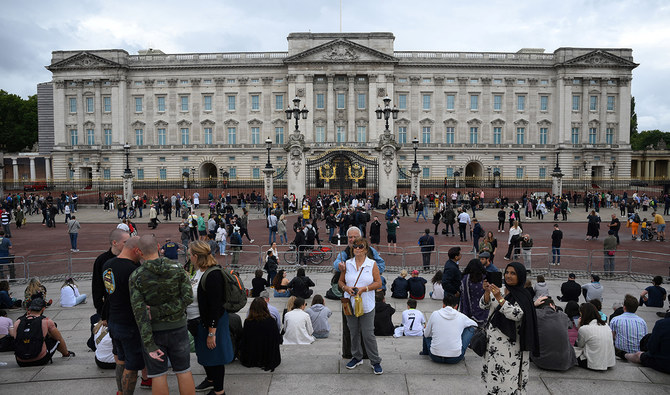
Crowds gather outside Buckingham Palace, central London, on September 8, 2022. (AFP/File)
Short Url
Updated 15 July 2024
Follow

England and Wales population rises by most in 75 years amid influx from Pakistan, elsewhere

  • Post-Brexit changes to visas sharply reduced the number of EU migrants to Britain
  • But new work visa rules led to a surge in immigration from Pakistan, India and Nigeria

LONDON: Record immigration caused the population of England and Wales to rise by 610,000 to 60.9 million in mid-2023, the largest annual increase in 75 years, official data showed on Monday.
What statisticians term ‘natural’ population growth — the difference between births and deaths — fell to just 400, the lowest since 1978, while net international migration rose to 622,000, up from 548,500 in the previous 12 months.
A net 13,800 people also moved from England and Wales to Scotland or Northern Ireland.
Britain’s Office for National Statistics said the population increase in England and Wales was the largest since 1948, when a post-World War Two baby boom and the return of British military personnel serving overseas caused a rise of 1.5 million.
The population for the whole United Kingdom was 67.6 million in mid 2022. Data for 2023 is not yet available.
Economic output has not kept up with the rising population. Based on provisional population figures, gross domestic product per head in 2023 was 0.7 percent lower than a year earlier.
Net migration to the United Kingdom hit a record 764,000 in 2022 and fell 10 percent to 685,000 in 2023, but is more than double its level in 2015, just before the Brexit referendum.
Reducing immigration was a key goal of many Britons who voted to leave the European Union.
Britain’s previous Conservative government said it wanted to reduce net immigration, and Prime Minister Keir Starmer’s Labour Party pledged in the election campaign to do so too by making the economy less reliant on foreign workers.
Post-Brexit changes to visas sharply reduced the number of EU migrants to Britain, but new work visa rules led to a surge in immigration from India, Nigeria and Pakistan, often to fill health and social care vacancies.
At the end of last year the government tightened rules to stop low-paid social care workers from bringing dependents.


Sindh assembly passes resolution rejecting move to separate Karachi

Updated 21 February 2026
Follow

Sindh assembly passes resolution rejecting move to separate Karachi

  • Chief Minister Shah cites constitutional safeguards against altering provincial boundaries
  • Calls to separate Karachi intensified amid governance concerns after a mall fire last month

ISLAMABAD: The provincial assembly of Pakistan’s southern Sindh province on Saturday passed a resolution rejecting any move to separate Karachi, declaring its territorial integrity “non-negotiable” amid political calls to carve the city out as a separate administrative unit.

The resolution comes after fresh demands by the Muttahida Qaumi Movement (MQM) and other voices to grant Karachi provincial or federal status following governance challenges highlighted by the deadly Gul Plaza fire earlier this year that killed 80 people.

Karachi, Pakistan’s largest and most densely populated city, is the country’s main commercial hub and contributes a significant share to the national economy.

Chief Minister Syed Murad Ali Shah tabled the resolution in the assembly, condemning what he described as “divisive statements” about breaking up Sindh or detaching Karachi.

“The province that played a foundational role in the creation of Pakistan cannot allow the fragmentation of its own historic homeland,” Shah told lawmakers, adding that any attempt to divide Sindh or separate Karachi was contrary to the constitution and democratic norms.

Citing Article 239 of Pakistan’s 1973 Constitution, which requires the consent of not less than two-thirds of a provincial assembly to alter provincial boundaries, Shah said any such move could not proceed without the assembly’s approval.

“If any such move is attempted, it is this Assembly — by a two-thirds majority — that will decide,” he said.

The resolution reaffirmed that Karachi would “forever remain” an integral part of Sindh and directed the provincial government to forward the motion to the president, prime minister and parliamentary leadership for record.

Shah said the resolution was not aimed at anyone but referred to the shifting stance of MQM in the debate while warning that opposing the resolution would amount to supporting the division of Sindh.

The party has been a major political force in Karachi with a significant vote bank in the city and has frequently criticized Shah’s provincial administration over its governance of Pakistan’s largest metropolis.

Taha Ahmed Khan, a senior MQM leader, acknowledged that his party had “presented its demand openly on television channels with clear and logical arguments” to separate Karachi from Sindh.

“It is a purely constitutional debate,” he told Arab News by phone. “We are aware that the Pakistan Peoples Party, which rules the province, holds a two-thirds majority and that a new province cannot be created at this stage. But that does not mean new provinces can never be formed.”

Calls to alter Karachi’s status have periodically surfaced amid longstanding complaints over governance, infrastructure and administrative control in the megacity, though no formal proposal to redraw provincial boundaries has been introduced at the federal level.