WASHINGTON: Former US President Donald Trump’s website featured an image of him with a bloodied face on Monday morning to urge supporters to donate to his campaign and come together in the spirit of unity and peace following this weekend’s shooting.
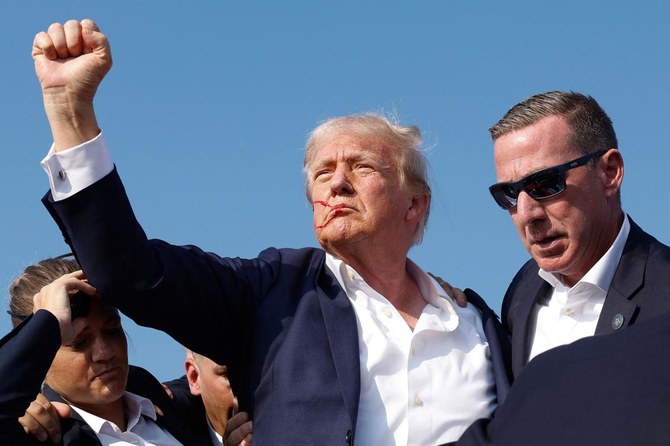
The website redirected prospective donors to a page on fundraising platform WinRed that shows a black and white image taken by an Associated Press photographer that Trump has described as “iconic.”
It shows the Republican candidate’s face streaked with blood and his fist raised in defiance after a bullet pierced his upper right ear at a rally in Pennsylvania. The image was captioned with the words “FEAR NOT” written in upper case letters.
A message below the image read: “Unity. Peace. Make America Great Again.” The page also carried Trump’s signature and gave visitors to the website options to contribute at different levels.
In an interview published late on Sunday by the New York Post, Trump spoke about the images taken of him immediately after he was shot, including the photo featured on his campaign website.
“A lot of people say it’s the most iconic photo they’ve ever seen,” Trump was quoted as saying in the New York Post. “They’re right and I didn’t die. Usually you have to die to have an iconic picture.”
Trump, who is running against Democratic US President Joe Biden in November’s election, was shot by a 20-year-old man with a semiautomatic rifle on Saturday at the rally in Butler, Pennsylvania, authorities said.
One Trump supporter who attended the rally was killed, two others were wounded and the suspect was shot dead by security agents. The FBI said it was investigating the shooting as an assassination attempt.
Leaders of both the Republican and Democratic parties, including Trump and Biden, appealed to the bitterly divided country to unite and maintain calm after the shooting.
A GoFundMe campaign backed by Trump for the victims of the shooting at the former president’s rally had raised over $3.5 million by the end of Sunday.

Trump website features image of his bloody face to raise funds
https://arab.news/ygrrz
Trump website features image of his bloody face to raise funds
Burkinabe teen behind viral French ‘coup’ video has no regrets
- “Coup d’etat in France,” declared the video, posted by the 17-year-old, showing what appeared to be journalists reporting on an ongoing takeover by an unidentified colonel
- Posted on December 9 on TikTok, then shortly afterwards on Facebook, the post went viral, garnering more than 12 million views and tens of thousands of “likes”
PARIS: A Burkinabe teenager who used artificial intelligence to post fake news of a French coup on Facebook got more than he bargained for.
As well as millions of views and tens of thousands of “likes,” he also acquired a certain notoriety — and French President Emmanuel Macron, for one, was not amused.
And what he had planned as a money-making scheme only netted him seven euros, he said. But he has no regrets.
“Coup d’etat in France,” declared the video, posted by the 17-year-old, showing what appeared to be journalists reporting on an ongoing takeover by an unidentified colonel.
In one shot, the Eiffel Tower and the blue lights from a police car flashed in the background.
“Demonstrators have gathered to support the colonel who seems to have taken power yesterday,” said the reporters.
It was all fake, of course: the product of his online training in the use of artificial intelligence.
Posted on December 9 on TikTok, then shortly afterwards on Facebook, the post went viral, garnering more than 12 million views and tens of thousands of “likes.”
Last Tuesday, when Macron was asked about the video during a visit to Marseille, he spoke of his frustration at not having been able to force Facebook to take it down.
They had told him that it did not violate their rules, he said.
Money-making goal
In the end, it was the creator himself who deleted it, shortly after the French news media started contacting him.
Speaking to AFP, he explained that he had got into creating AI-generated videos last year after finding a training course on YouTube. But he only really started producing in October 2025.
He was taken aback by his sudden celebrity and that the French media was reporting on and even interviewing him.
He laughed about all the fuss in a video posted to his Facebook page.
But the teenager, who preferred to remain anonymous, was clear that his real aim had been to make money from advertising attached to his posts.
Not that he was living in poverty, he added.
“I eat, I can get to school, my parents take good care of me, thank God,” he told AFP.
But he wanted more to gain “financial independence,” he added.
He had seen “loads of pages that get millions of views” and had heard that TikTok paid money to producers, so he jumped into social media to see what he could do.
After a bit of trial and error, he latched on to AI-generated fake news because it generated more online traffic.
“I haven’t yet made a lot of money that way,” he admitted.
His Facebook page was not yet monetised, though he had made a little money from TikTok.
Normally, Africa is not a region that is eligible for monetization on the platform but he said he had found a way around that.
While his viral video on the fake coup in France may not have been a moneyspinner, he has used it to promote an offer of online training in AI-generated content on Facebook.
“There are people who have got in touch with me after this video, at least five people since last week,” he said.
For one hour’s coaching, he makes 7,000 CFA francs (10 euros).
No regrets
France is frequently the target of disinformation, in particular from the Alliance of Sahel States (AES) — Mali, Niger and Burkina Faso.
Since a string of military coups there, all three countries have distanced themselves from France, the former colonial power, and moved instead toward Russia.
The Burkinabe junta in particular has become adept at AI-generated propaganda videos. They have included false clips of celebrities such as singer Beyonce or Pope Leo XIV singing the praises of Ibrahim Traore, the military government’s leader.
Burkina Faso also has a group of influential cyberactivists who promote the government’s propaganda online, known as the “Rapid-Intervention Communication Battalion.”
The teenager behind the fake French coup video told AFP he was not part of that group.
But while his main motivation was far from being political, he was happy to take a passing shot at France.
“I also created this video to scare people,” he said.
Some French media personalities and politicians do not present a fair view of what is going on in Africa’s Sahel region, instead broadcasting “fake news,” he said.
He cited recent reports that the Malian capital, Bamako, was on the point of falling to jihadist forces.
Informed sources agree that if the military government there was in difficulty recently from a jihadist blockage of supply routes, it has not so far been threatened to the point of losing power.
The French authorities “have no regrets about publishing false statements on the AES,” said the teenager.
“So I’m not going to regret publishing false things about them!“


