

Pakistan government says will file treason case against ex-PM Khan, ban his party 

1 / 2
Supporters of Pakistan's former Prime Minister and Pakistan Tehreek-e-Insaf party (PTI) chief Imran Khan, wave flags during a rally to celebrate the 75th anniversary of Pakistan's independence day in Lahore on August 13, 2022. (AFP/File)
2 / 2
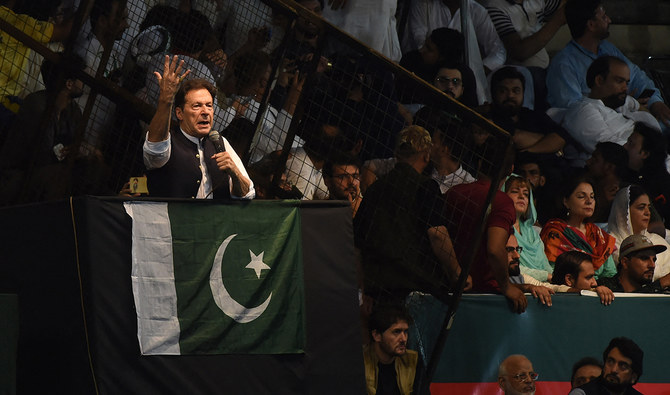
Pakistan's former Prime Minister and Pakistan Tehreek-e-Insaf party (PTI) chief Imran Khan, delivers a speech to his supporters during a rally to celebrate the 75th anniversary of Pakistan's independence day in Lahore on August 13, 2022. (AFP/File)
Short Url
Updated 16 July 2024
Follow

Pakistan government says will file treason case against ex-PM Khan, ban his party 

  • PM Sharif-led coalition says will file review of Supreme Court decision in reserved parliamentary seats case
  • PTI says government’s announcements were “sign of panic” because it could not threaten or pressure courts 

ISLAMABAD: The federal government has decided to file a high treason case against former Prime Minister Imran Khan and pursue a case to ban his Pakistan Tehreek-e-Insaf (PTI), Information Minister Attaullah Tarar said on Monday, unleashing a new challenge for the embattled party and its jailed leader.

The government’s decision comes days after the Supreme Court ruled that Khan’s party was eligible for over 20 extra reserved seats in parliament, ramping up pressure on the weak coalition government of Prime Minister Shehbaz Sharif. Adding to the government’s worries are recent favorable court rulings against Khan and the PTI. 

Among four cases in which Khan was convicted and has been jailed since August last year, two have been suspended by courts and he has been acquitted in the others, though new cases have since been brought against him. Arguably Pakistan’s most popular politician, Khan says all cases against him are motivated to keep him out of politics and behind bars. 

“The government has decided to pursue a case to ban PTI,” Tarar said at a press conference on Monday.

“Under Article 17 of the Constitution, which relates to banning political parties and grants power to the federal government in this regard, this issue will be sent to the Supreme Court ... We believe there is credible evidence for banning PTI due to foreign funding, the May 9 attacks, and the cipher episode.”

Tarar was referring, respectively, to cases related to the PTI receiving millions of dollars in illegal funds from foreign countries, riots last May by alleged supporters of Khan in which government and military buildings were damaged and accusations that the ex-premier leaked state secrets. He also said Khan had tried to sabotage a $7 billion bailout deal with the IMF, which was approved last week.

“PTI and Pakistan cannot co-exist,” Tarar added, saying the government would also file high treason cases against Khan and his close aide Dr. Arif Alvi, who was appointed president by him, under Article 6, which relates to high treason.

Responding to the government’s press conference, the PTI called all cases against the party and Khan as being “politically motivated.” 

“This is a sign of panic as they [federal government] have realized the courts can’t be threatened and put under pressure,” senior PTI leader Sayed Zulfikar Abbas Bukhari said in a statement shared with reporters. “I have been saying for a while now that we are under a soft martial law and this move only proves our point further.”

NEW CHALLENGES

All PTI candidates contested the Feb. 8 elections as independents after the party was barred from the polls on the technical grounds that it did not hold genuine intra-party polls, which is a legal requirement. Subsequently, they won the most seats in the national election, 93, but the election commission said independents were ineligible for their share of 70 reserved seats — 60 for women, 10 for non-Muslims — distributed among political parties in proportion to the number of seats they win in general polls. This completes the National Assembly’s total strength of 336 seats. 

The reserved seats were then distributed among other parties, mostly those in the ruling coalition, a decision Khan’s party appealed. On Friday the Supreme Court ruled that the PTI was indeed a political party for the purposes of the election and entitled to reserved seats. 

In his press conference, Tarar announced the government would file a review against the Supreme Court’s judgment in the reserved seats case. 

The government’s latest announcements come amid a spate of new challenges for Khan and his party.

Last week, Khan and his third wife Bushra Khan were acquitted on charges their 2018 marriage broke Islamic law but the National Accountability Bureau (NAB) immediately filed a new corruption case against them, providing fresh grounds for keeping them in jail. Earlier this month, a lower court also dismissed bail pleas by Khan in three cases involving the May 9 riots last year and declared there was “reasonable” evidence to connect him to the violence. 

PM Sharif formed a weak coalition with other parties after the Feb. 8 elections produced a hung parliament.

Sharif’s PML-N party’s 79 and the PPP’s 54 seats together made a simple majority in parliament to form a government at the center and also roped in smaller parties in the coalition.

Khan’s convictions had ruled the 71-year-old out of the elections as convicted felons cannot run for public office under Pakistani law. The PTI has rejected the polls’ results, saying they were rigged, a charge the election commission denies.


Pakistan orders four-day workweek, shuts schools to save fuel amid Middle East oil crisis

Updated 09 March 2026
Follow

Pakistan orders four-day workweek, shuts schools to save fuel amid Middle East oil crisis

  • The development comes as ongoing US-Israeli strikes on Iran disrupt oil supplies in Strait of Hormuz, push prices past $119 a barrel
  • Islamabad bans government purchases, cuts fuel allocation for vehicles as well as workforce in public and private offices by 50 percent

ISLAMABAD: Prime Minister Shehbaz Sharif on Monday announced austerity measures, including a four-day work week, cuts in government expenditures and closure of schools, to offset the impact of rising global oil prices due to an ongoing conflict in the Middle East.

Global fuel supply lines have been disrupted in the Strait of Hormuz, which supplies nearly a fourth of world oil consumption, after Tehran blocked it following United States-Israeli strikes on Iran and counterattacks against US interests in the Gulf region.

Oil prices surged more than 25 percent globally on Monday to $119.50 a barrel, the highest levels since mid-2022, as some major producers cut supplies and fears of prolonged shipping disruptions gripped the market due to the expanding US-Israeli war with Iran.

In his televised address on Sunday night, Sharif said global oil prices were expected to rise again in the coming days but vowed not to let the people bear their brunt, announcing austerity measures to lessen the impact of fuel price hikes.

“Fifty percent staff in public and private entities will work from home,” he announced, adding this would not be applicable to essential services. “Offices will remain open for four days a week. One-day additional off is being given to conserve oil, but it would not be applicable to banks.”

Sharif didn’t specify working days of the week and the government was likely to issue a notification in this regard.

He said a decrease of 50 percent was being made in fuel allocation for government vehicles immediately for the next two months, but they would not include ambulances and public buses.

“Cabinet members, advisers and special assistants will not draw salaries for the next two months, 25 percent salaries of parliamentarians are being deducted, two-day salaries of Grade 20 and above officers, or those who are paid Rs300,000 ($1,067) a month, are being deducted for public relief,” he said.

Similarly, there will be 20 percent reduction in public department expenses and a complete ban on the purchase of cars, furniture, air conditioners and other goods, according to the prime minister.

Foreign trips of ministers and other government officials will also be banned along with government dinners and iftar buffets, while teleconferences and online meetings will be given priority.

“All schools will be off for two weeks, starting from the end of this week, and all higher education institutions should immediately begin online classes,” he said.

Sharif’s comments were aired hours after Pakistani authorities said the country had “comfortable levels” of petroleum stocks and the supply chains were functioning smoothly, despite intensifying Middle East conflict.

Petroleum Minister Ali Pervaiz Malik said three oil shipments were due to reach Pakistan this week, state media reported.

Meanwhile, Pakistan Navy (PN) launched ‘Operation Muhafiz-ul-Bahr’ to safeguard national energy shipments, the Pakistani military said on Monday, amid disruptions to critical sea lanes due to the conflict.

The navy is conducting escort operations in close coordination with the Pakistan National Shipping Corporation (PNSC), according to the Inter-Services Public Relations (ISPR), the military’s media wing. It is fully cognizant of the prevailing maritime situation and is actively monitoring and controlling the movement of merchant vessels to ensure their safe and secure transit.

“With approximately 90 percent of Pakistan’s trade conducted via sea, the operation aims to ensure that vital sea routes remain safe, secure, and uninterrupted,” the ISPR said on Monday. “Currently, PN ships are escorting 2 x Merchant Vessels, one of which is scheduled to arrive Karachi today.”
