

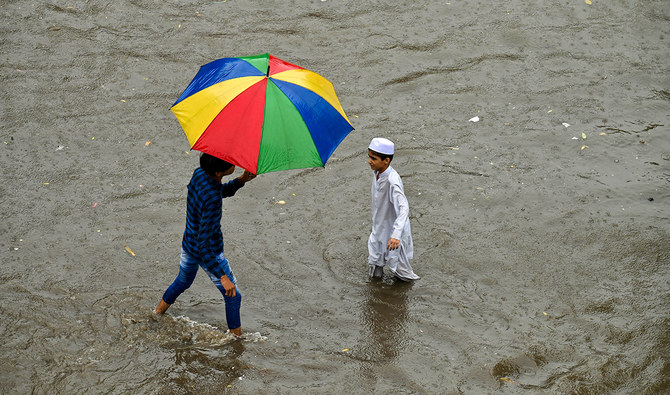
At least 24 killed, 80 injured due to heavy rains in Pakistan’s Punjab this month

People wade across a flooded street amid heavy rainfall in Lahore on July 12, 2024. (AFP/File)
Short Url
Updated 14 July 2024
Follow

At least 24 killed, 80 injured due to heavy rains in Pakistan’s Punjab this month

  • More heavy rains expected across the province on Monday, Tuesday
  • Authorities warn citizens against unnecessary travel in bad weather

ISLAMABAD: At least 24 people were killed and 80 others injured in rain-related incidents in Pakistan’s Punjab province this month, the Provincial Disaster Management Authority (PDMA) said on Sunday, warning of more showers in the next two days.

Pakistan’s National Disaster Management Authority (NDMA) this month warned that the country’s Punjab and Sindh provinces could face an “emergency” situation due to torrential rains this monsoon season.
Torrential rains lashed Lahore, Sargodha, Toba Tek Singh, Faisalabad, Kot Addu and Bahawalpur cities of the Punjab province in the last two days, according to the Punjab PDMA.
“At least 24 people were killed and another 80 were injured due to torrential rains, while around 40 houses were damaged this month across the province,” Punjab PDMA spokesperson Muhammad Mazhar told Arab News.
“Tonight, there are chances of heavy rains in different districts of Punjab, with more heavy rains expected across the province on Monday and Tuesday.”
The provincial government had directed authorities to provide financial compensation to relatives of the victims, according to the PDMA spokesperson.
Mazhar urged people to maintain a safe distance from electric poles and wires, and avoid gatherings on dilapidated roofs during the forecast period.
The PDMA has asked district authorities to activate round-the-clock control rooms to monitor situation in each district.
“Municipalities and the Water and Sanitation Agency (WASA) have been asked to remain vigilant, especially in low-lying areas, and keep de-watering and pumping stations ready,” it said in a statement.
Monsoon rains in Punjab are expected to continue till July 15, while the flow of water in the province’s rivers and barrages is at normal level for the time being.
“In emergency situations, call on PDMA’s flood helpline 1129,” the PDMA added.
Earlier in April, heavy rains triggered landslides and flash floods in Pakistan, leaving 92 people dead and another 116 wounded.
Pakistan’s Punjab reported 21 deaths from lightning and roof collapses while the country’s southwestern Balochistan province reported at least 15 deaths from torrential rains.
The NDMA this month launched a community engagement app for Pakistanis ahead of the monsoon season. The ‘Pak NDMA Disaster Alert’ mobile app generates alerts and updates guidance for organizations and individual responders in national and provincial languages.
Large swathes of the South Asian nation were submerged in 2022 due to extremely heavy monsoon rains and melting glaciers, a phenomenon linked to climate change, that damaged crops and infrastructure. killed at least 1,700 people, displaced millions, and inflicted billions of dollars in losses.


Pakistan’s Mahnoor Omer named among TIME’s ‘Women of the Year’ for 2026

Updated 01 March 2026
Follow

Pakistan’s Mahnoor Omer named among TIME’s ‘Women of the Year’ for 2026

  • Omer moved a Pakistani court against the so-called ‘period tax’ in Sept. 2025 which has since sparked a national debate
  • Taxes on sanitary pads in Pakistan can add up to 40 percent to retail price, UNICEF says only around 12 percent women use such products

ISLAMABAD: Pakistani women’s rights activist Mahnoor Omer, who fought against taxes on menstrual products, has been named among the TIME magazine’s ‘Women of the Year’ for 2026.

Omer’s efforts have been recognized alongside 16 activists, artists, athletes and businesswomen in the TIME’s Women of the Year 2026 list, including Olympic gold medalist Sydney McLaughlin-Levrone and Oscar-nominated filmmaker Chloe Zhao.

Dissatisfied with the efforts to educate Pakistani girls about sexual violence, Omer founded the Noor Foundation at the age of 14 and held her own workshops with village girls about everything from climate change to menstruation, according to the TIME magazine.

Two years later, a conversation with a domestic worker about the price of pads made her realize that not everyone could afford these essentials. She moved a court against the so-called “period tax” in Sept. 2025 and the case has sparked a national debate on the subject, considered a taboo by many in Pakistan, since its first hearing late last year.

“A decade and one law degree after her interest in activism was sparked, Omer, now 25, is putting her passion and expertise to work in the name of gender equity,” TIME wrote about Omer on its website.

Taxes imposed on sanitary products in Pakistan can add up to 40 percent to the retail price. UNICEF estimates just 12 percent of women in the country use commercially produced pads or tampons. The alternative, using cloth, risks health impacts including rashes and infections, and can make it impossible for girls to attend school while menstruating.

Omer’s suit, which awaits the government response, has sparked a national discussion. She says she spoke about menstruation to her father and male cousins, who thanked her for standing up for their daughters.
The 25-year-old, who is currently enrolled in a master’s degree in gender, peace, and security at the London School of Economics, sees this case as just the first of many.

“I’m not free until every woman is free,” she was quoted as saying by TIME. “I want to leave no stones unturned in terms of what I can do with the next few decades, as a lawyer for the women in my country and gender minorities in general.”