GAZA: A senior Hamas official said on Sunday that the Islamist group has not withdrawn from ceasefire talks with Israel after this weekend's deadly attacks in Gaza that Israel said had targeted the group's military leader Mohammed Deif.
But Izzat El-Reshiq, a member of the political office of Hamas, accused Israel of trying to derail efforts by Arab mediators and the United States to reach a ceasefire deal by stepping up its attacks in the enclave.
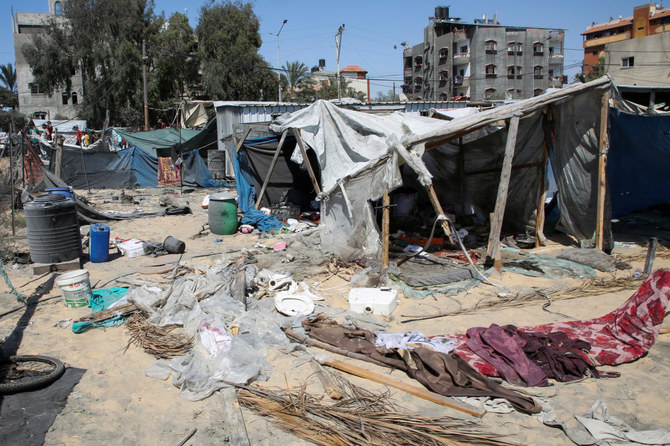
Saturday's strike in the Khan Younis area of Gaza, in which at least 90 Palestinians were killed, according to local health authorities, has put the ceasefire talks in doubt.
There had been increasingly hopeful signs in recent days that a deal could be reached to halt fighting and return hostages held in Gaza.
Two Egyptian security sources at ceasefire talks in Doha and Cairo said on Saturday that negotiations had been halted after three days of intense talks.
Israeli Prime Minister Benjamin Netanyahu was expected to convene his close circle of ministers later on Sunday to discuss the talks.
The strike on Saturday which targeted Deif killed Rafa Salama, commander of Hamas' Khan Younis brigade, the Israeli military said on Sunday, but there was no confirmation about the fate of Deif.
"The strike in Khan Younis was a result of surgical intelligence," the head of the Shin Bet domestic security service said in a video released by the service from Rafah. He said 25 Hamas operatives who took part in the deadly Oct. 7 attack in southern Israel that triggered the war had been killed in the past week.
On Saturday, a senior Hamas official denied that Deif had been killed and the group said Israeli claims were aimed at justifying the attack.
Israel's military chief said on Sunday in a televised statement that Hamas was concealing the truth about Deif's fate, but stopped short of confirming whether he was alive or dead.
Israeli forces pressed ahead on Sunday with aerial and ground shelling of several areas across the Gaza Strip, home to 2.3 million people, most of whom have been displaced by the war.
A strike on a UN-run school in Nuseirat camp, one of Gaza's eight longstanding refugee camps, killed 15 Palestinians and wounded dozens more, Hamas media and health officials said.
The Israeli military said the site was used as a base for Hamas fighters to attack Israeli forces and said numerous steps were taken to limit the risk of harming civilians, including the use of precise munitions and intelligence.
Residents said two missiles targeted the upper floor of the school, not far from the camp's local market, usually busy with shoppers, where displaced families have also taken shelter nearby.
Earlier on Sunday, Israeli airstrikes on four houses in Gaza City killed at least 16 Palestinians and wounded dozens of others, medics said.
The Gaza health ministry said at least 38,584 Palestinians have been killed and 88,881 others injured in Israel's military offensive since Oct. 7.
It added that 141 Palestinians were killed by Israeli military strikes across the Gaza Strip in the past day, the biggest one-day death toll in many weeks.
Gaza's health ministry does not distinguish between combatants and non-combatants but officials say most of the dead throughout the war have been civilians.
Israel says it has lost 326 soldiers in Gaza and says at least a third of the Palestinian fatalities are fighters.
The war began after a Hamas-led attack inside Israel on Oct. 7, that killed 1,200 people, mostly civilians, and saw around 250 taken hostage to Gaza, according to Israeli authorities.


![]()

Hamas says it has not left ceasefire talks after Israeli attacks
Short Url
https://arab.news/2yrbk
Hamas says it has not left ceasefire talks after Israeli attacks
- Militant group says leader Mohammed Deif is ‘fine’ after Israeli strike
- Said it was “ready to resume negotiations” when Israel’s government “demonstrates seriousness”


Latest updates


© 2026 SAUDI RESEARCH & PUBLISHING COMPANY, All Rights Reserved And subject to Terms of Use Agreement.