UN chief urges funds for Palestinians, saying Israel is forcing Gazans 'to move like human pinballs'

1 / 2
UNRWA Commissioner-General Philippe Lazzarini and Jordan's Foreign Minister Ayman Safadi hold a joint press conference in Amman, Jordan, on July 9, 2024. (REUTERS)
2 / 2
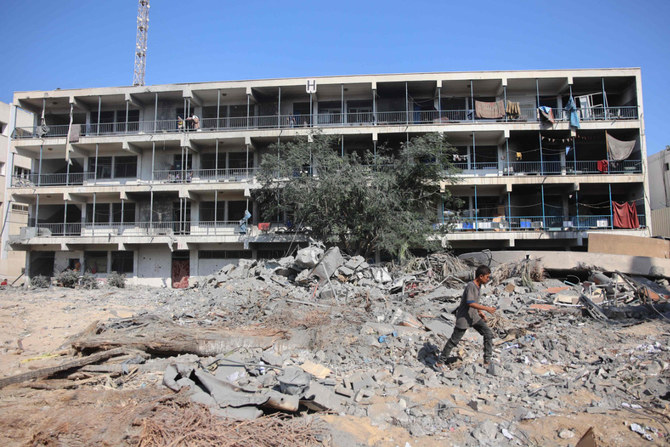
A view of the UN Relief and Works Agency for Palestine Refugees (UNRWA) building complex in western Gaza City's Al-Sinaa neighborhood, destroyed by Israeli bombardment. (AFP)
Short Url
Updated 13 July 2024
Follow

UN chief urges funds for Palestinians, saying Israel is forcing Gazans 'to move like human pinballs'

  • UN chief Antonio Guterres earlier pleaded for help from donors to fund the embattled agency, warning that Palestinians would lose a “critical lifeline” without UNRWA

GENEVA: The United Nations chief appealed for funding Friday for the beleaguered UN agency helping Palestinian refugees in Gaza and elsewhere in the Middle East, accusing Israel of issuing evacuation orders that force Palestinians “to move like human pinballs across a landscape of destruction and death.”

Secretary-General Antonio Guterres told a donor’s conference that the agency, known as UNRWA, faces “a profound funding gap.” The head of the UN agency for Palestinian refugees said it had enough funds to continue operating through September, following a pledging conference for the embattled body where UN chief Antonio Guterres pleaded for help from donors.
“We have worked tirelessly with partners to restore confidence in the agency,” UNRWA chief Philippe Lazzarini said, after several nations withheld funding following Israeli allegations in January that a number of UNRWA’s employees participated in the October 7 attack by Hamas.
Lazzarini said new pledges of funds would help ensure emergency operations until September.
Guterres had pleaded with donors to fund the embattled UN agency, warning that Palestinians would lose a “critical lifeline” without UNRWA. Without financial support to UNRWA, Guterres said “Palestinian refugees will lose a critical lifeline and the last ray of hope for a better future.”
“Let me be clear — there is no alternative to UNRWA,” he said.
“Just when we thought it couldn’t get any worse in Gaza — somehow, appallingly, civilians are being pushed into ever deeper circles of hell,” Guterres added.
According to Guterres, 195 UNRWA staff members have been killed in the war, the highest death toll for staff in UN history.
The US Congress has barred further funding for UNRWA. President Joe Biden’s administration has instead directed funding for Palestinian civilians to other bodies while saying that UNRWA is uniquely equipped to distribute aid.
The war started with Hamas’s October attack on southern Israel, which resulted in the deaths of 1,195 people, mostly civilians, according to an AFP tally based on Israeli figures.
Israel responded with a military offensive that has killed at least 38,345 people in Gaza, also mostly civilians, according to the health ministry in Hamas-ruled Gaza.


Israeli army takes journalists into a tunnel in a Gaza city it seized and largely flattened

Updated 10 December 2025
Follow

Israeli army takes journalists into a tunnel in a Gaza city it seized and largely flattened

  • Israel and Hamas are on the cusp of finishing the first phase of the truce, which mandated the return of all hostages, living and dead, in exchange for Palestinians held by Israel
  • Hamas has said communication with its remaining units in Rafah has been cut off for months and that it was not responsible for any incidents occurring in those areas

RAFAH, Gaza Strip: One by one, the soldiers squeezed through a narrow entrance to a tunnel in southern Gaza. Inside a dark hallway, some bowed their heads to avoid hitting the low ceiling, while watching their step as they walked over or around jagged concrete, crushed plastic bottles and tattered mattresses.
On Monday, Israel’s military took journalists into Rafah — the city at Gaza’s southernmost point that troops seized last year and largely flattened — as the 2-month-old Israel-Hamas ceasefire reaches a critical point. Israel has banned international journalists from entering Gaza since the war began more than two years ago, except for rare, brief visits supervised by the military, such as this one.
Soldiers escorted journalists inside a tunnel, which they said was one of Hamas’ most significant and complex underground routes, connecting cities in the embattled territory and used by top Hamas commanders. Israel said Hamas had kept the body of a hostage in the underground passage: Hadar Goldin, a 23-year-old soldier who was killed in Gaza more than a decade ago and whose remains had been held there.
Hamas returned Goldin’s body last month as part of a US-brokered ceasefire in the war triggered by the militants’ Oct. 7, 2023, attack on southern Israel in which 1,200 people were killed and hundreds taken hostage. Israel’s retaliatory offensive has killed more than 70,000 Palestinians, according to Gaza’s Health Ministry, which operates under the Hamas-run government. The ministry does not differentiate between civilians and combatants, but says roughly half the dead have been women and children.
Israel and Hamas are on the cusp of finishing the first phase of the truce, which mandated the return of all hostages, living and dead, in exchange for Palestinians held by Israel. The body of just one more hostage remains to be returned.
Mediators warn the second phase will be far more challenging since it includes thornier issues, such as disarming Hamas and Israel’s withdrawal from the strip. Israel currently controls more than half of Gaza.
Israeli Prime Minister Benjamin Netanyahu is set to travel to Washington this month to discuss those next steps with US President Donald Trump.
Piles of rubble line Rafah’s roads
Last year, Israel launched a major operation in Rafah, where many Palestinians had sought refuge from offensives elsewhere. Heavy fighting left much of the city in ruins and displaced nearly one million Palestinians. This year, when the military largely had control of the city, it systematically demolished most of the buildings that remained standing, according to satellite photos.
Troops also took control of and shut the vital Rafah crossing, Gaza’s only gateway to the outside world that was not controlled by Israel.
Israel said Rafah was Hamas’ last major stronghold and key to dismantling the group’s military capabilities, a major war aim.
On the drive around Rafah on Monday, towers of mangled concrete, wires and twisted metal lined the roads, with few buildings still standing and none unscathed. Remnants of people’s lives were scattered the ground: a foam mattress, towels and a book explaining the Qur’an.
Last week, Israel said it was ready to reopen the Rafah crossing but only for people to leave the strip. Egypt and many Palestinians fear that once people leave, they won’t be allowed to return. They say Israel is obligated to open the crossing in both directions.
Israel has said that entry into Gaza would not be permitted until Israel receives all hostages remaining in the strip.
Inside the tunnel
The tunnel that journalists were escorted through runs beneath what was once a densely populated residential neighborhood, under a United Nations compound and mosques. Today, Rafah is a ghost town. Underground, journalists picked their way around dangling cables and uneven concrete slabs covered in sand.
The army says the tunnel is more than 7 kilometers (4 miles) long and up to 25 meters (82 feet) deep and was used for storing weapons as well as long-term stays. It said top Hamas commanders were there during the war, including Mohammed Sinwar — who was believed to have run Hamas’ armed wing and was the younger brother of Yahya Sinwar, the Hamas leader who helped mastermind the Oct. 7 attack. Israel has said it has killed both of them.
“What we see right here is a perfect example of what Hamas did with all the money and the equipment that was brought into Gaza throughout the years,” said Lt. Col. Nadav Shoshani. “Hamas took it and built an incredible city underground for the purposes of terror and holding bodies of hostages.”
Israel has long accused Hamas of siphoning off money for military purposes. While Hamas says the Palestinians are an occupied people and have a right to resist, the group also has a civilian arm and ran a government that provided services such as health care, a police force and education.
The army hasn’t decided what to do with the tunnel. It could seal it with concrete, explode it or hold it for intelligence purposes among other options.
Since the ceasefire began, three soldiers have been killed in clashes with about 200 Hamas militants that Israeli and Egyptian officials say remain underground in Israeli-held territory.
Hamas has said communication with its remaining units in Rafah has been cut off for months and that it was not responsible for any incidents occurring in those areas.
Both Israel and Hamas have accused each other of repeated violations of the deal during the first phase. Israel has accused Hamas of dragging out the hostage returns, while Palestinian health officials say over 370 Palestinians have been killed in continued Israeli strikes since the ceasefire took effect.