

Ex-PM Khan’s party rules out coalition with Peoples Party, says no-trust vote always an option

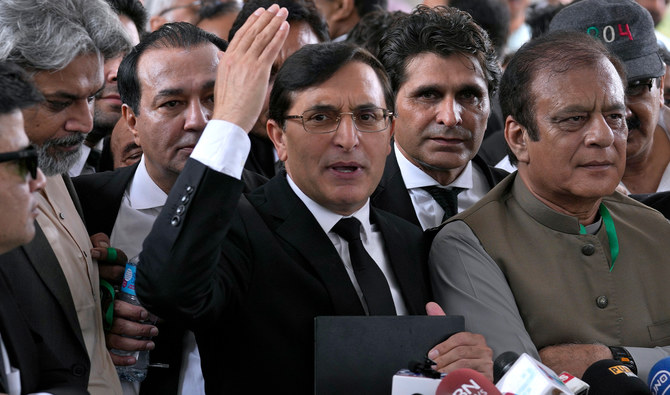
Chairman of Pakistan's Tehreek-e-Insaf party Gohar Khan, center, talks to the media while party supporters react after a Supreme Court decision in a case of reserved seats for women and minorities in parliament, in Islamabad, Pakistan, on July 12, 2024.(AP)
Short Url
Updated 13 July 2024
Follow

Ex-PM Khan’s party rules out coalition with Peoples Party, says no-trust vote always an option

  • Barrister Gohar Khan says PTI took ‘principled stance’ by refusing to form government with PPP in February
  • He says PTI will determine its course of action after getting reserved seats in national, provincial legislatures

ISLAMABAD: Former premier Imran Khan’s Pakistan Tehreek-e-Insaf (PTI) party announced on Friday it had no plans to form a coalition government with the Pakistan Peoples Party (PPP), though it reserved the option of bringing a no-confidence motion against the sitting Prime Minister Shehbaz Sharif.

The statement was issued by the current PTI chairman, Barrister Gohar Khan, after securing a major legal victory in the Supreme Court in a case involving the reserved seats for women and minorities in the national and provincial assemblies, which are distributed among winning political factions on a proportional basis.

The PPP decided to support the ruling Pakistan Muslim League-Nawaz (PML-N) party after the February 8 general elections, though it did not join the federal cabinet, creating the impression that it was interested in keeping its political options open.

“If we had to form a government with the Pakistan Peoples Party, that option was available to us on February 9,” he told Independent Urdu in an interview. “We took a principled stance. Imran Khan does not believe in power-sharing. He practices people’s politics, so he does not need power-sharing.”

He maintained that his party was not against political dialogue, though its founding leader and the former Pakistani prime minister had ruled out any negotiations with the PPP, PML-N and Muttahida Qaumi Movement (MQM).

Asked about the no-trust vote after emerging as the single largest party in the National Assembly, the PTI chairman said the proposal had not come up for discussion, though it was always an option that political parties could exercise.

“Once we get the seats and come into the majority, we will see what needs to be done,” he said. “This issue can come under consideration since any political party always has this option. However, the party leadership has not made any decision regarding this matter yet.”


Pakistani business federation says EU envoy pledges support for training industrial workforce

Updated 4 sec ago
Follow

Pakistani business federation says EU envoy pledges support for training industrial workforce

  • Support aims to boost competitiveness as Pakistan expands skilled labor for exports and remittances
  • FPCCI says the country’s economic future hinges on preparing its workforce for modern technologies

ISLAMABAD: The European Union’s top diplomat in Pakistan has pledged support for the country’s push to train its industrial workforce, exporters and small businesses through the national technical and vocational education system, Pakistan’s top business federation said in a statement on Tuesday, calling the assistance critical for boosting competitiveness.

The commitment came during the first annual conference on Technical and Vocational Education and Training (TVET), jointly organized by the Federation of Pakistan Chambers of Commerce and Industry (FPCCI) and the TVET Sector Support Program, where the EU envoy addressed business leaders and government officials.

“Pakistani industries, exporters, trade bodies and SMEs will be facilitated and supported in their training, and exporters should draw maximum benefit from the GSP+ program,” said EU Ambassador Raymonds Kroblis, according to the FPCCI statement, referring to the EU trade scheme that grants Pakistan preferential, duty-free access for most exports in return for implementing international conventions.

He added that Pakistan’s economic future depended on preparing its workforce for modern technologies.
FPCCI President Atif Ikram Sheikh said Pakistan could “change its economic trajectory” through large-scale skills development and called for a sustained public–private partnership to modernize vocational training.

He said the federation would train 1,000 officials from chambers and trade bodies to strengthen workforce readiness.

Sheikh said Pakistan’s youth had “immense potential” and required structured opportunities to advance, both for domestic industry and for overseas employment.

Pakistan has been working to expand its pool of skilled workers to tap opportunities in Gulf economies, where higher-skilled migration could help lift remittances, a major stabilizing force for Pakistan’s economy.

Speakers at the conference said aligning Pakistan’s workforce with international standards was key to improving productivity, securing export growth and preparing workers for global labor markets.