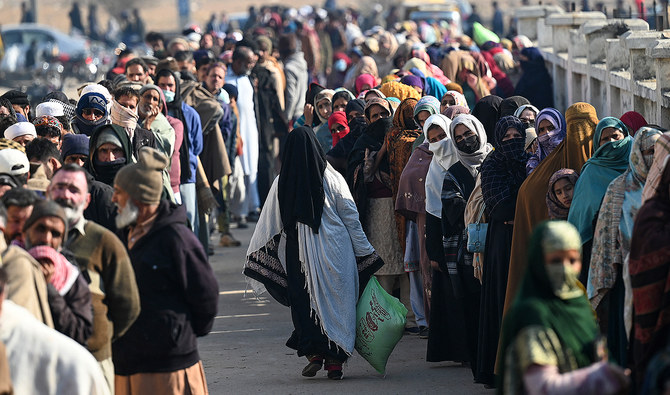
ISLAMABAD: A strike by Pakistani flour millers due to a dispute with the government over the imposition of new taxes on sales entered its second day on Friday, threatening flour shortages in parts of the South Asian country.
Hundreds of mills across Pakistan went on strike on Thursday on a call by the Pakistan Flour Mills Association (PFMA), which represents over 900 mills, against a new 5.5 percent withholding tax imposed on the sales of flour mills in the federal budget for fiscal year 2024-25, which came into effect on July 1.
The PFMA says the government has also directed flour mills to collect another 2.5 percent withholding tax on the sale of essential commodities to retailers (non-filers) and 2 percent from wholesalers (non-filers). The association says millers also now have to collect 0.5 percent withholding tax on the sale of flour from retailers (filers) and 0.10 percent tax from wholesalers (filers).
“We are observing a nationwide strike against the government for imposing taxes and making flour millers tax collection agents,” Javed Yusuf, a former PFMA chairperson, told Arab News.
“Our strike will continue till the government accepts our demand of withdrawal of all taxes levied in the budget.”
Yusuf said around 1,600 flour mills, which directly employed some 4,000 workers, were shut across Pakistan:
“We cannot collect taxes on behalf of the FBR, it’s not our job,” he added.
The strike takes place as Pakistan navigates a tricky path to economic recovery amid double-digit inflation and a deepening macroeconomic crisis. The South Asian country has been scrambling to secure foreign investment from friendly nations and a bailout from the IMF in a bid to keep its fragile $350 billion economy afloat.
The tax-laden budget with a tax revenue target of Rs13 trillion ($46.66 billion) for the current fiscal year, up about 40 percent from the previous one, has been rejected by almost all major trade bodies and opposition parties. Pakistan’s government has taken the unpopular measures amid negotiations with the IMF, which has made tax reforms and increasing revenue a major precondition for a fresh loan program.
There are 1,725 flour mills in Pakistan and the daily national flour consumption stands at around 45,000 tons, according to the PFMA.
The ongoing strike has already halted flour supply to grocery stores across Punjab, the country’s most populous province, and market stocks are expected to last only one week.


Pakistan flour millers’ strike over withholding tax enters second day, threatening shortages
https://arab.news/8ekcv
Pakistan flour millers’ strike over withholding tax enters second day, threatening shortages

- Budget for fiscal year 2024-25 imposed 5.5% withholding tax on sales of flour mills
- Around 1,600 flour mills employing some 4,000 workers are shut across Pakistan

Babar Azam dropped for scoring too slowly, says Pakistan coach Hesson
- Shaheen Shah Afridi was left out after conceding 101 runs in three matches
- Pakistan will now face New Zealand in the opening match of the second phase
COLOMBO: Batting great Babar Azam was dropped for Pakistan’s final T20 World Cup group game against Namibia for scoring too slowly, said head coach Mike Hesson on Friday.
Azam, who is the highest run-scorer in T20 international history with 4,571 runs, was left out for the must-win game against Namibia as Pakistan racked up 199-3 and secured a place in the Super Eights by 102 runs.
The 2009 champions face New Zealand in Colombo on Saturday in the opening match of the second phase.
“I think Babar is well aware that his strike rate in the power play in the World Cup is less than 100 and that’s clearly not the role we think we need,” Hesson told reporters after Pakistan’s final practice session on Friday was washed out by rain.
Pakistan left out Azam for the same reason at last year’s Asia Cup and even after dismal showing in the Big Bash League, he was still selected for the T20 World Cup.
“We brought Babar back in for a specific role post the Asia Cup,” said Hesson.
“We’ve got plenty of other options who can come in and perform that role toward the end.
“Babar is actually the first to acknowledge that.
“He knows that he’s got a certain set of skills that the team requires and there are certain times where other players can perform that role more efficiently.”
Hesson also defended dropping pace spearhead Shaheen Shah Afridi after he conceded 101 runs in three matches, including 31 in two overs against India.
“We made a call that Salman Mirza was coming in for Shaheen, and he bowled incredibly well,” said Hesson.
“To be fair, he was probably really unlucky to not be playing the second and third games.”
Hesson was wary of Pakistan’s opponents on Saturday.
“New Zealand have played a huge amount in the subcontinent in recent times so we have to play at our best.”


