Pakistan police claim foiling Muharram attack in Karachi by arresting suspected militant

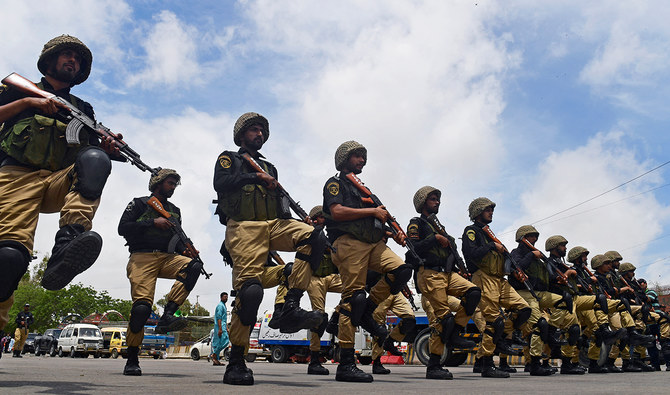
Security personnel patrol a street during a procession on the eighth day of Ashura in the Islamic month of Muharram in Karachi on July 27, 2023. (AFP/File)
Short Url
Updated 10 July 2024
Follow

Pakistan police claim foiling Muharram attack in Karachi by arresting suspected militant

  • Muhammad Shoaib, key Pakistani Taliban commander, was involved in multiple cases of murder, attacks on army, say police
  • CTD official says Shoaib planned to carry out suicide attack on Muharram procession in Karachi’s Orangi Town area 

KARACHI: Police in Pakistan’s southern Sindh province on Wednesday announced it had arrested a highly wanted militant who planned to target a Muharram procession with a suicide blast in Karachi, saying that the attack could have caused “large-scale destruction.” 

Muhammad Shoaib, an alleged commander of the Pakistani Taliban or Tehreek-e-Taliban Pakistan (TTP) group, was arrested by the Counter-Terrorism Department (CTD) of Sindh Police on Wednesday. 

The Khyber Pakhtunkhwa Police had placed a Rs2 million [$7182] bounty on Shoaib, who was arrested in Karachi’s Ittehad Town area following a shootout with police, a CTD Sindh official said during a news conference. 

“The arrested terrorist disclosed that he had to carry out a suicide attack during Muharram-ul-Haram with his accomplices in Orangi Town, Karachi,” deputy inspector-general of CTD, Asif Ejaz Shaikh, told reporters in Karachi. 

The attack, Shaikh added, could have posed a “risk of large-scale casualties and large-scale destruction in Karachi.”

He said the alleged TTP commander planned to meet his accomplices and relative Ishaq to plan the attack.

“Ishaq too was involved in serious offenses and was wanted for terrorism,” Shaikh disclosed. “Ishaq was supposed to arrive [in Karachi] and join forces with the suspect to carry out this terrorist plot.”

The official said Shoaib was also implicated in the 2021 kidnapping of 16 coal miners in KP.

“When their relatives refused to pay ransom, the workers were allegedly killed and buried in a mass grave,” Shaikh said. “The initial report of this incident was filed at CTD Kohat.”

He said Shoaib was also wanted in multiple cases of murder, kidnapping for ransom, attacks on the army, clashes with peace committees and bombings.

Shaikh said Shoaib’s son, Muaz, had previously been shot dead in an encounter with security forces.

Muharram marks the beginning of the new year in the Islamic lunar calendar during which Shia Muslims across Pakistan hold gatherings and organize religious processions to pay homage to Imam Hussain, the grandson of Prophet Muhammad (peace be upon him).

Hundreds of thousands take out processions across the country on Ashura, the 10th of Muharram, to mourn Hussain’s martyrdom centuries ago in Karbala, present-day Iraq. Militants in the past have stoked sectarian tensions in the country by attacking religious processions in Muharram. 

The government each year adopts heightened security measures to protect Muharram processions from militant attacks. 

In 2009, an Ashura procession was targeted in a bomb attack on Karachi’s busy M.A. Jinnah Road. At least 43 people were killed and 60 wounded in the attack that was claimed by the TTP. 

In response to a question, Shaikh said Shoaib was part of a large TTP network operating in Karachi, adding that the outfit also has sleeper cells in the port city.

When asked if the TTP was involved in a gun attack in Karachi on Sunday that killed a counterterrorism official, Shaikh said it was highly likely that the banned outfit was involved.

“There is a 90 percent likelihood that the TTP was involved in the killing of Deputy Superintendent of Police Ali Raza,” he said.

Raza, who was an official working in Sindh CTD’s investigation cell, was fatally attacked by unidentified assailants in the city. 


EU, Pakistan sign €60 million loan agreement for clean drinking water in Karachi

Updated 17 December 2025
Follow

EU, Pakistan sign €60 million loan agreement for clean drinking water in Karachi

  • Project will finance rehabilitation, construction of water treatment facilities in Karachi city, says European Investment Bank
  • As per a report in 2023, 90 percent of water samples collected from various places in city was deemed unfit for drinking

ISLAMABAD: The European Investment Bank (EIB) and Pakistan’s government on Wednesday signed a €60 million loan agreement, the first between the two sides in a decade, to support the delivery of clean drinking water in Karachi, the EU said in a statement. 

The Karachi Water Infrastructure Framework, approved in August this year by the EIB, will finance the rehabilitation and construction of water treatment facilities in Pakistan’s most populous city of Karachi to increase safe water supply and improve water security. 

The agreement was signed between the two sides at the sidelines of the 15th Pak-EU Joint Commission in Brussels, state broadcaster Radio Pakistan reported. 

“Today, the @EIB signed its first loan agreement with Pakistan in a decade: a €60 million loan supporting the delivery of clean drinking water for #Karachi,” the EU said on social media platform X. 

Radio Pakistan said the agreement reflects Pakistan’s commitment to modernize essential urban services and promote climate-resilient infrastructure.

“The declaration demonstrates the continued momentum in Pakistan-EU cooperation and highlights shared priorities in sustainable development, public service delivery, and climate and environmental resilience,” it said. 

Karachi has a chronic clean drinking water problem. As per a Karachi Water and Sewerage Corporation (KWSC) study conducted in 2023, 90 percent of water from samples collected from various places in the city was deemed unsafe for drinking purposes, contaminated with E. coli, coliform bacteria, and other harmful pathogens. 

The problem has forced most residents of the city to get their water through drilled motor-operated wells (known as ‘bores’), even as groundwater in the coastal city tends to be salty and unfit for human consumption.

Other options for residents include either buying unfiltered water from private water tanker operators, who fill up at a network of legal and illegal water hydrants across the city, or buying it from reverse osmosis plants that they visit to fill up bottles or have delivered to their homes.

The EU provides Pakistan about €100 million annually in grants for development and cooperation. This includes efforts to achieve green inclusive growth, increase education and employment skills, promote good governance, human rights, rule of law and ensure sustainable management of natural resources.