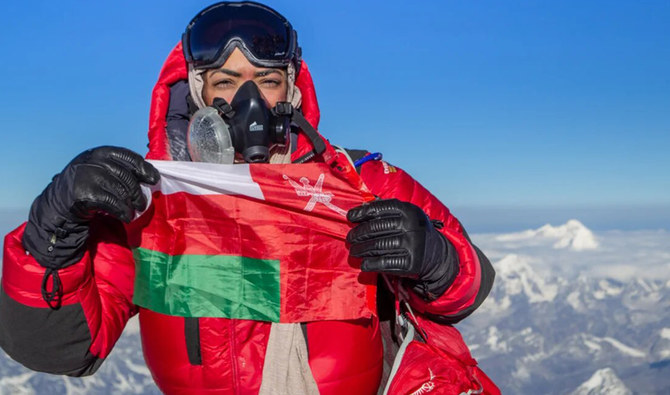
KHAPLU, GILGIT-BALTISTAN: Oman’s Nadhira Alharthy became the first person from her country to summit the 8,126-meter Nanga Parbat mountain in northern Pakistan on Wednesday, a Nepal-based adventure tour company confirmed.
Gilgit-Baltistan, a sparsely populated northern region administered by Pakistan as an autonomous territory, is home to some of the highest peaks in the world and a major tourist destination. Hundreds of tourists visit the region each year for expeditions on various peaks, paragliding and other sports activities.
Nanga Parbat, also known as “Killer Mountain,” is Pakistan’s second-highest peak and the world’s ninth-highest mountain. Several climbers have died in the past attempting to summit the towering mountain.
“Huge congratulations to our team members and Sherpa who reached the pinnacle of Nanga Parbat on 10 July 2024,” Seven Summit Treks, the Nepalese company that organized the expedition, wrote on its social media platforms. it mentioned Alharthy’s name among the successful climbers.
“Against all odds, the team conquered this majestic peak, fueled by determination and teamwork,” it added.
Alharthy’s latest achievement makes her the first Omani woman to summit four peaks higher than 8,000 meters.
The 46-year-old climber has previously summited Mount Everest (8,849 meters) in 2019, Mount Manaslu (8,156 meters) in 2021, and K2 (8,611 meters) in 2022. She also climbed the 4,478-meter high Matterhorn in 2023 and the 6,812-meter high Ama Dablam mountain in Nepal in 2021.
Thaneswar Guragai, the company’s general manager, told Arab News that nine people summitted Nanga Parbat on Wednesday.
He said that of the nine climbers, three are from Nepal, one each from Oman, Azerbaijan, France, Norway, Ecuador and Greece.
“Professionally she works as a government officer in the Ministry of Education [of Oman]. However, for the last few years she has been continuously climbing peaks,” he disclosed.
According to the Gilgit-Baltistan Tourism Department, more foreign climbers and trekkers have been issued permits to climb Pakistan’s mountains this year compared to 2023.
“This year, more than 2000 climbers and trekkers have been issued permits to climb and trek different peaks of Pakistan,” Sajid Hussain, deputy director for the GB Tourism Department, told Arab News.
He said last year, 650 mountaineers visited Pakistan while this year the government has issued permits to over 800 mountaineers.
“Out of 800 mountaineers, almost 200 climbers will try their luck to conquer K2,” Hussain said. “Women teams are also at the K2 base camp.”
Four foreigners have died in GB in less than two months this year. A Brazilian tourist was killed in a paragliding accident while a Japanese climber died while descending the Spantik mountain, with both deaths taking place this month.
Last month, two Japanese climbers went missing in GB. The body of one of the climbers was found after which authorities presumed the other dead and called off the search to recover him. The two Japanese climbers had also attempted to summit the Spantik mountain in GB’s Nagar district.


![]()

Nadhira Alharthy becomes first Omani to summit Pakistan’s ‘Killer Mountain’
Short Url
https://arab.news/wan8m
Nadhira Alharthy becomes first Omani to summit Pakistan’s ‘Killer Mountain’
- Alharthy, 46, was part of 10-member expedition that summited Nanga Parbat mountain on Wednesday
- Her latest achievement makes Alharthy first Omani to summit four peaks higher than 8,000 meters
Latest updates


Recommended


© 2026 SAUDI RESEARCH & PUBLISHING COMPANY, All Rights Reserved And subject to Terms of Use Agreement.