



RIYADH: New archaeological evidence reshapes the understanding of Neolithic life in northwest Saudi Arabia, according to a study published in the journal Levant.
The research, conducted under the auspices of the Royal Commission for AlUla, reveals a more sophisticated society than previously imagined, the Saudi Press Agency reported.
Jane McMahon from the University of Sydney, working with a research team as part of an RCU-supervised excavation project explained that they have uncovered a complex community that engaged in cattle herding, crafted jewelry, and participated in extensive trade networks. The strategic location of these settlements facilitated commerce with distant regions, including eastern Jordan and coastal areas along the Red Sea.
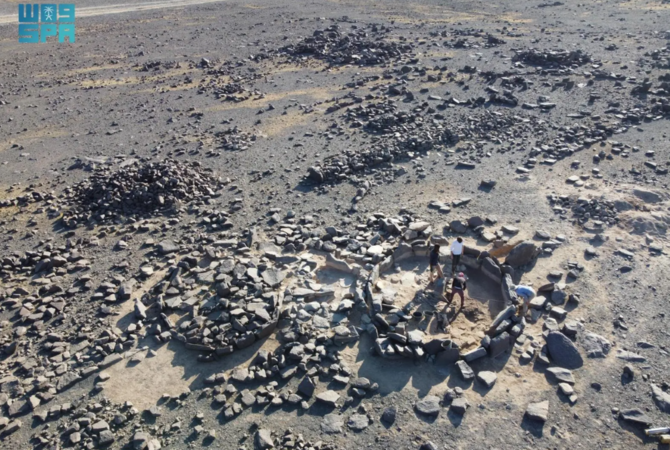
The research team has presented its latest conclusions and observations on archaeological investigations of structures known as standing stone circles. These dwellings consist of vertically placed stone slabs forming circles with diameters ranging from four to eight meters.
The study examined 431 standing stone circles at various sites in Harrat Uwayrid in AlUla, with 52 undergoing field surveys and 11 being excavated.
Researchers found that stone slabs, arranged in two concentric rows, likely served as foundations for wooden poles, possibly made of acacia. These poles would have supported the structure’s roof. At the center of each circular dwelling, a single stone slab appears to have anchored the main wooden column. This architectural feature suggests a sophisticated understanding of weight distribution and structural support among the ancient inhabitants. The discovery of various tools and animal remains at the site has led archaeologists to propose that dwelling roofs were fashioned from animal hides.
McMahon explained that “this research challenges hypotheses about how early northwest Arabian inhabitants lived.” She emphasized that these people were not merely simple pastoralists but had distinctive architecture, domesticated animals, jewelry, and diverse tools. Based on the number and size of stone circles, their population was likely substantial and much larger than previously thought.
Rebecca Foote, who heads archaeology and cultural heritage research at the RCU, has emphasized the significant impact of the commission’s archaeological initiatives. Under the RCU’s supervision, what is described as the world’s most comprehensive archaeological program has yielded crucial insights into the lives of Neolithic inhabitants in the region. Foote underscored the commission’s dedication to continued research efforts aimed at highlighting AlUla’s diverse cultural heritage and ongoing work towards establishing a globally recognized hub for archaeological studies.
Researchers examining animal bones from the Harrat Uwayrid site have uncovered evidence of a robust prehistoric economy. The findings indicate that the ancient inhabitants relied on a mix of domesticated animals like goats and sheep, and wild animals such as gazelles and birds for their livelihood. This diverse approach to animal exploitation likely provided the population with resilience in the face of environmental fluctuations.
Excavations have unearthed tools linked to animal husbandry, including implements for wool shearing and sheep slaughter.
Arrowheads discovered match types used in southern and eastern Jordan, indicating clear interaction between the regions.
Small perforated snail and seashells, likely used as decorative beads, were found at the sites. These shells correspond to those from the Red Sea, 120 km away, suggesting import from the coast during the Neolithic period.
Other artifacts include sandstone and limestone ornaments and bracelets, as well as a piece of red sandstone chalk, possibly used for drawing.
Researchers concluded that the study “greatly clarified the connected (yet distinct) nature of the Neolithic period in AlUla.”
The research team included experts from King Saud University, local AlUla residents like Youssef Al-Balawi who provided ethnographic and cultural insights, and students from the University of Hail.


