Pakistan PM discusses ways to enhance trade, investment cooperation with Iran’s president-elect 

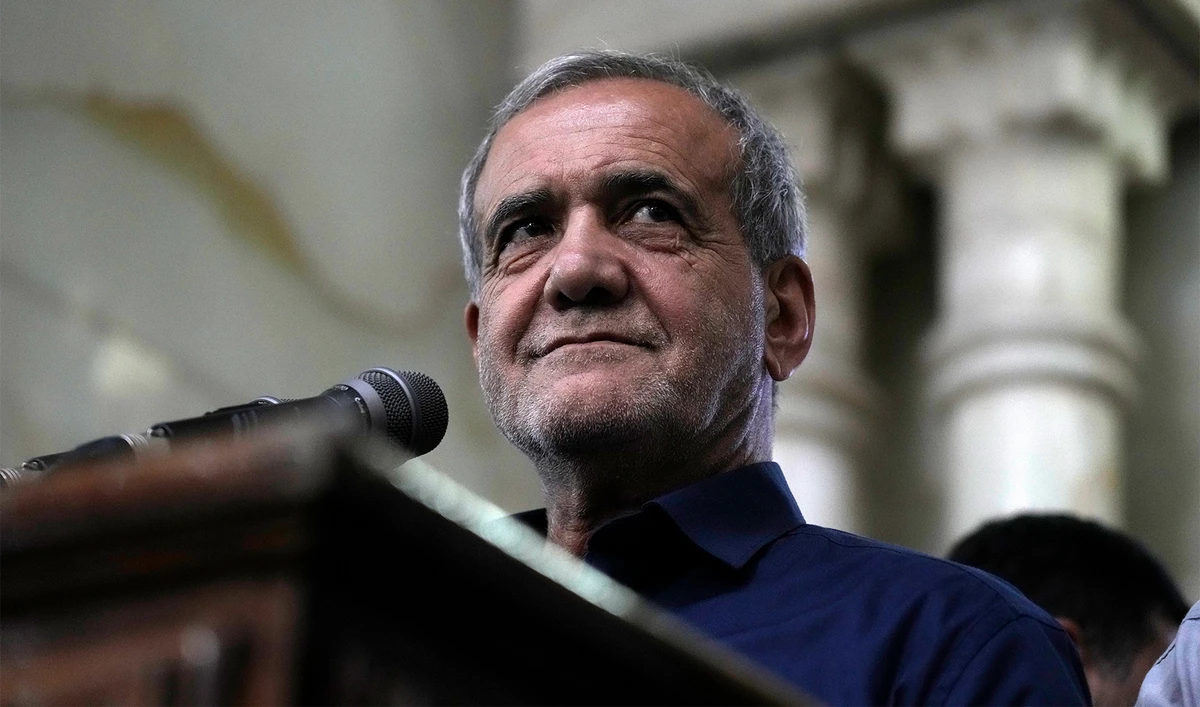
Iran's President-Elect Masoud Pezeshkian speaks during a meeting a day after the presidential election, at the shrine of the late revolutionary founder Ayatollah Khomeini, just outside Tehran, Iran, on July 6, 2024. (AP)
Short Url
Updated 09 July 2024
Follow

Pakistan PM discusses ways to enhance trade, investment cooperation with Iran’s president-elect 

  • PM Sharif congratulates Iran’s President-elect Masoud Pezeshkian on winning election in telephonic conversation
  • Pakistan, Iran have a shared vision for building a better future together for our people, says Pakistani PM 

ISLAMABAD: Pakistan’s Prime Minister Shehbaz Sharif congratulated Iran’s President-elect Masoud Pezeshkian on Monday for winning the recently held election in his country, as both leaders discussed opportunities to enhance cooperation in trade and investment, Sharif’s office said.

Masoud Pezeshkian, a relatively moderate candidate, secured 53.7 percent or 16.3 million votes in Iran’s presidential election held on Friday, defeating hard-liner Saeed Jalili’s 13.5 million votes. The reformist-backed candidate, who is 69 years old, will replace Ebrahim Raisi, who died in a plane crash last month. 

In a post on social media platform X, PM Sharif said he spoke to Pezeshkian over the phone to congratulate him on his victory. 

“We discussed ways to enhance cooperation, particularly in trade, commerce & investment, and foster a stronger partnership for regional stability,” Sharif wrote on X. “As brothers and neighbors, our two countries have a shared vision for building a better future together for our peoples.”

Pakistan and Iran agreed to enhance bilateral trade between the two countries to $10 billion in April when Raisi arrived in Islamabad. 

Both countries signed memorandum of understandings and agreements covering different fields including trade, science and technology, agriculture, health, culture, and judicial matters.

Pakistan and Iran have had a history of rocky relations despite a number of commercial pacts, with Islamabad being historically closer to Saudi Arabia and the United States. Their highest profile agreement is a stalled gas supply deal signed in 2010 to build a pipeline from Iran’s South Fars gas field to Pakistan’s southern provinces of Balochistan and Sindh.

The two countries are also often at odds over instability on their shared porous border, with both routinely trading blame for not rooting out militancy.

Tensions surged in January when Pakistan and Iran exchanged airstrikes, both claiming to target alleged militant hideouts in each other’s countries. Both sides have since then undertaken peace overtures and restored bilateral ties.
UN experts slam Pakistan lawyer convictions

Updated 04 February 2026
Follow

UN experts slam Pakistan lawyer convictions

  • Imaan Mazari, husband Hadi Ali Chattha were sentenced to 10 years last month for “anti-state” social media posts
  • Five UN special rapporteurs say couple jailed for exercising rights guaranteed by international human rights law

GENEVA, Switzerland: Five UN special rapporteurs on Wednesday condemned the conviction and lengthy jail sentences imposed on a prominent rights activist and her fellow lawyer husband in Pakistan over “anti-state” social media posts.

Imaan Mazari, a 32-year-old lawyer and vocal critic of Pakistan’s military, “disseminated highly offensive” content on X, according to an Islamabad court.

She and her husband Hadi Ali Chattha were jailed on January 25, with a court statement saying they “will have to remain in jail for 10 years.”

The UN experts said they had been jailed for “simply exercising rights guaranteed by international human rights law.”

“Lawyers, like other individuals, are entitled to freedom of expression. The exercise of this right should never be conflated with criminal conduct, especially not terrorism,” they said in a joint statement.

“Doing so risks undermining and criminalizing the work of lawyers and human rights defenders across Pakistan and has a chilling effect on civil society in the country.”

Mazari shot to prominence tackling some of Pakistan’s most sensitive topics while defending ethnic minorities, journalists facing defamation charges and clients branded blasphemers.

As a pro bono lawyer, Mazari has worked on some of the most sensitive cases in Pakistan, including the enforced disappearances of ethnic Balochs, as well as defending the community’s top activist, Mahrang Baloch.

Mazari and her husband have been the subject of multiple prosecutions in the past, but have never previously been convicted of wrongdoing.

“This pattern of prosecutions suggests an arbitrary use of the legal system as an instrument of harassment and intimidation in order to punish them for their work advocating for victims of alleged human rights violations,” the UN experts said.

“States must ensure lawyers are not subject to prosecution for any professional action, and that lawyers are not identified with their clients.”

The statement’s signatories included the special rapporteurs on human rights defenders, the independence of judges, freedom of opinion, freedom of association and on protecting rights while countering terrorism.

UN special rapporteurs are independent experts mandated by the UN Human Rights Council to report their findings. They do not speak in the name of the United Nations itself.

The UN experts have put their concerns to Islamabad.