

Major coalition partner calls for consensus before final decision on Pakistan anti-militancy operation

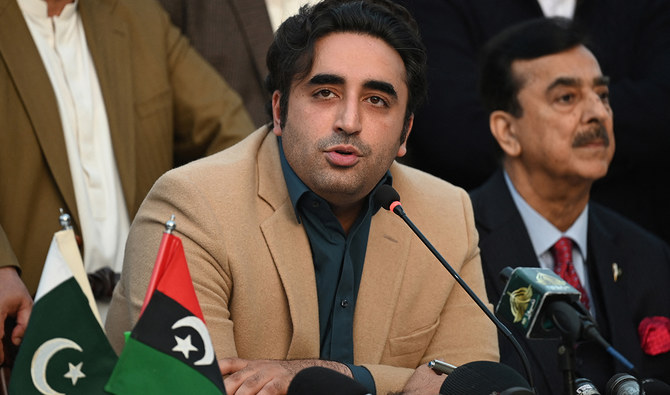
Pakistan Peoples Party (PPP) chairman Bilawal Bhutto Zardari speaks during a press conference in Islamabad on February 13, 2024. (AFP/File)
Short Url
Updated 09 July 2024
Follow

Major coalition partner calls for consensus before final decision on Pakistan anti-militancy operation

  • Pakistan’s top national security body last month notified decision to launch Operation Azm-e-Istehkaam amid spike in militancy
  • Bilawal Bhutto-Zardari urges stakeholders to avoid ‘partisan politics’ at the all-parties conference to be held in the coming days

ISLAMABAD: Bilawal Bhutto-Zardari, chairman of major coalition partner Pakistan Peoples Party (PPP), on Monday stressed a consensus between all stakeholders at the upcoming All Parties Conference (APC) to make a final decision on an operation to wipe out militants from the South Asian country.

Pakistan’s top national security body last month notified the launch of Operation Azm-e-Istehkaam amid a spike in militant violence in Pakistan. Leading opposition factions, including former prime minister Imran Khan’s Pakistan Tehreek-e-Insaf (PTI) party, objected to the announcement without any debate over the issue in parliament.
Following the backlash from the opposition, Prime Minister Shehbaz Sharif’s office issued a statement, clarifying that “no large-scale military operation” would be launched in Pakistan. Sharif’s government has now planned to convene an APC to address the concerns of political stakeholders in the South Asian country.
“PPP will try for a consensus and play its role,” Bhutto-Zardari said at a press conference in Peshawar. “The decision taken after a consensus will be a better decision.”
The statement came days after Pakistan’s top military brass raised concerns over “unwarranted” criticism of the newly announced operation, saying it would assist the government in addressing all security-related challenges undermining investor confidence in cash-strapped Pakistan that has been striving to boost foreign investment.
Confirming that his party would send a delegation to the APC, Bhutto-Zardari said he would share all concerns they had regarding the operation at the “appropriate forum,” adding that they wanted to hear the government’s motive behind it.
He highlighted that the security situation of the country was linked to the economy and both had to be managed properly. “Whatever decision the government takes, we feel the APC will be the appropriate forum to raise concerns,” the PPP chairman said.
He lauded PM Sharif’s decision to organize the APC and urged all political parties to keep their “partisan politics out of this game” as the matter at hand revolved around national security and fighting militant groups.
The government’s decision to launch the operation came against the backdrop of a surge in militant violence in different parts of the country. It also came shortly after a top Chinese leader visited Pakistan and expressed concerns about militant attacks against Chinese nationals working on various projects in Pakistan.
The Pakistani government plans to hold the all-parties conference to take all political stakeholders on board with its anti-militancy plan, though the exact date of the conference has yet to be announced.


Pakistani, Bangladeshi officials discuss trade, investment and aviation as ties thaw

Updated 28 December 2025
Follow

Pakistani, Bangladeshi officials discuss trade, investment and aviation as ties thaw

  • Pakistan and Bangladesh were once one nation, but they split in 1971 as a result of a bloody civil war
  • Ties between Pakistan, Bangladesh have warmed up since last year and both nations have resumed sea trade

ISLAMABAD: Pakistan's High Commissioner to Bangladesh Imran Haider on Sunday met Chief Adviser Muhammad Yunus in Dhaka, the latter's office said on, with the two figures discussing trade, investment and aviation.

Pakistan and Bangladesh were once one nation, but they split in 1971 as a result of a bloody civil war, which saw the part previously referred to as East Pakistan seceding to form the independent nation of Bangladesh.

Ties between Pakistan and Bangladesh have warmed up since former prime minister Sheikh Hasina’s ouster as a result of a student-led uprising in August 2024. Relations remain frosty between Dhaka and New Delhi over India’s decision to grant asylum to Hasina.

Pakistan has attempted to forge closer ties with Bangladesh in recent months and both South Asian nations last year began sea trade, followed by efforts to expand government-to-government commerce.

"During the meeting, both sides discussed ways to expand cooperation in trade, investment, and aviation as well as scaling up cultural, educational and medical exchanges to further strengthen bilateral relations between the two South Asian nations," Yunus's office said in a statement on X.

In 2023-24 Pakistan exported goods worth $661 million to Bangladesh, while its imports were only $57 million, according to the Trade Development Authority of Pakistan. In Aug. this year, the Pakistani and Bangladeshi commerce ministries signed a memorandum of understanding to establish a Joint Working Group on Trade, aiming to raise their bilateral trade volume to $1 billion in the financial year that began in July.

The Pakistani high commissioner noted that bilateral trade has recorded a 20 percent growth compared to last year, with business communities from both countries actively exploring new investment opportunities, according to the statement.

He highlighted a significant increase in cultural exchanges, adding that Bangladeshi students have shown strong interest in higher education opportunities in Pakistan, particularly in medical sciences, nanotechnology, and artificial intelligence. Haider also said that Dhaka-Karachi direct flights are expected to start in January.

"Chief Adviser Professor Muhammad Yunus welcomed the growing interactions between the two countries and emphasized the importance of increased visits as well as cultural, educational and people-to-people exchanges among SAARC (South Asian Association for Regional Cooperation) member states," the statement read.

"Professor Yunus also underscored the need to further boost Bangladesh–Pakistan trade and expressed hope that during Mr. Haider’s tenure, both countries would explore new avenues for investment and joint venture businesses."