Senior counter-terrorism official, passerby killed in Karachi gun attack — police

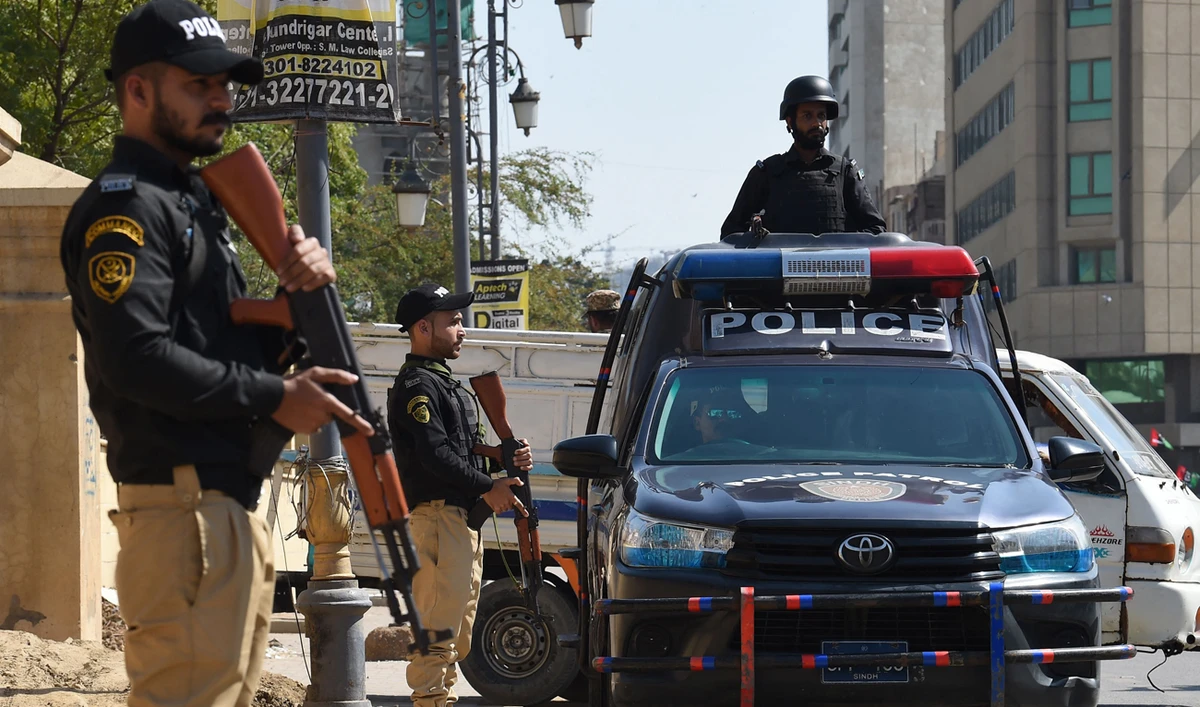
In this file photo, taken on February 8, 2024, policemen stand guard during Pakistan’s national elections in Karachi. (AFP/File)
Short Url
Updated 07 July 2024
Follow

Senior counter-terrorism official, passerby killed in Karachi gun attack — police

  • Deputy Superintendent of Police Ali Raza was posted in investigation cell of Sindh counter-terrorism department
  • The officer had been actively involved in operations against drug gangs, Pakistani Taliban and sectarian groups

KARACHI: A senior counter-terrorism official and a passerby were killed in a gun attack in the southern Pakistani city of Karachi, police officials said on Sunday.
Deputy Superintendent of Police (DSP) Ali Raza was posted in investigation cell of counter-terrorism department (CTD) of Sindh provincial police.
Speaking to the media, Deputy Inspector General (DIG) Asif Ejaz Shaikh said two attackers had opened fire on the police officer in Karimabad area.
“It’s hard to say anything at this time, but all CTD officers have been receiving threats,” he said.
No group has claimed responsibility for the attack.
Police surgeon Dr. Summayia Syed told Arab News that DSP Ali Raza had received multiple gunshot wounds to the chest, neck and head.
“The bullets were removed,” she told Arab News. “The family didn’t allow a complete postmortem.”
A 38-year-old passerby, Waqar, who worked as a guard with a private security company, was also injured in the attack and succumbed to his injuries during treatment at Jinnah Hospital.
“Waqar had sustained serious gunshot injuries to the chest, flank and inguinal region,” Syed added.
DSP Raza had been actively involved in operations against drug gangs based in Karachi’s Lyari area, Tehreek-e-Taliban Pakistan (TTP) and various sectarian groups, according to Raja Umar Khattab, a senior police officer and a longtime colleague of Raza.
“Ali Raza was a brilliant officer with several successful operations against outlawed groups to his credit,” Khattab told Arab News. “Today, the CTD has lost one of its key team members.”
Karachi, Pakistan’s commercial hub, has had a decades-long history of violence, especially against the law enforcers, by militant groups as well as political, drug and other mafias.
In 2013, the then government of three-time former premier Nawaz Sharif had sanctioned a joint operation against militants and violent criminals in the city, which significantly brought down the crime rate in the subsequent years.
However, sporadic incidents of targeted killings are still reported, while street crimes have continued unabated in the city of more than 20 million.

Islamic military coalition, Pakistan to deepen cooperation to combat ‘terrorism’ — Pakistani military

Updated 02 February 2026
Follow

Islamic military coalition, Pakistan to deepen cooperation to combat ‘terrorism’ — Pakistani military

  • Islamic Military Counter Terrorism Coalition is a 43-member alliance that includes Pakistan, Saudi Arabia, Egypt, Jordan, UAE and other nations
  • The Pakistani military statement comes after a meeting between IMCTC secretary-general and the chief of Pakistani defense forces in Rawalpindi

ISLAMABAD: Pakistan and the Islamic Military Counter Terrorism Coalition (IMCTC) have reaffirmed their commitment to deepening cooperation, including intelligence sharing and capacity building, to jointly combat “terrorism” and “extremism,” the Pakistani military said on Monday.

The IMCTC is a 43-member military alliance that was formed on Saudi Arabia’s initiative in Dec. 2015 to consolidate Muslim countries’ efforts in countering “terrorism.”

A 17-member IMCTC delegation is visiting Pakistan from Feb. 2-6 to conduct a training at National University of Sciences and Technology on “Re-integration and Rehabilitation of Extremist Elements,” according to the Pakistani military.

On Monday, IMCTC Secretary-General Maj. Gen. Mohammed bin Saeed Al-Moghedi held a meeting with Chief of Pakistani Defense Forces Field Marshal Asim Munir to discuss cooperation among IMCTC member states.

“During the meeting, matters of mutual interest were discussed, with particular emphasis on regional security dynamics and enhanced cooperation in counter-terrorism efforts,” the Inter-Services Public Relations (ISPR), the Pakistani military’s media wing, said in a statement.

“Both sides reaffirmed their shared commitment to combating terrorism and extremism through collaborative strategies, intelligence sharing, and capacity building among member states.”

The IMCTC features Pakistan, Saudi Arabia, Türkiye, Afghanistan, Egypt, Jordan, Qatar, Palestine, UAE, Bangladesh and other nations. In 2017, Pakistan’s former army chief Gen. (retd) Raheel Sharif was appointed as the IMCTC commander-in-chief.

During discussions with Major General Al-Moghedi, Field Marshal Munir appreciated the role of IMCTC in fostering stability and promoting coordinated counterterrorism initiatives across the Islamic world, according to the ISPR.

The IMCTC secretary-general acknowledged Pakistan’s significant contributions and sacrifices in the fight against militancy and lauded the professionalism of Pakistan’s armed forces.

“The meeting underscored the resolve of both sides to further strengthen institutional collaboration for peace, stability, and security in the region,” the ISPR added.

Pakistan enjoys cordial ties with most Muslim countries around the world, particularly Gulf Cooperation Council countries. In Sept. 2025, Pakistan signed a landmark defense pact with Saudi Arabia according to which an act of aggression against one country will be treated as an act of aggression against both.