



QUETTA: Come summer season, Hajji Baz Khan is a busy man. Eager to beat the heat and satiate their parched throats, hundreds of customers throng his shop daily for a tall glass of sugarcane juice. Khan repeatedly directs the servers at his shop to take customers’ orders, as the sound of a machine crushing the sugarcane for juice fills the air.
This is usually the scene at “Quetta Juice” shop on Jinnah Road, a busy place during summers in Pakistan’s southwestern city of Quetta. Pakistan has been in the grip of severe heat since May, with temperatures in the southern parts of the country soaring as high as 52 degrees Celsius. In Quetta, the temperature frequently crossed 40 degrees Celsius over the past few weeks.
And as the temperature rises, so does the number of customers at Quetta Juice to quench their thirst.
“Sometimes we face a shortage of glasses due to the large number of customers in the summer peak days,” Khan, 58, told Arab News. “Because people consider sugarcane juice as the source to beat the [high] temperature.”

Customers take sip of fresh juices at a local shop in Quetta on July 6, 2024. (AN Photo)
Sugarcane juice is a popular drink in Pakistan during the summer season. The juice is extracted on the spot by feeding sugarcane stalks into a machine, which is freshly squeezed out and served with ice cubes.
Pakistan’s macroeconomic crisis and double-digit inflation have made life for businesses difficult. Khan, who has been running the famous sugarcane juice shop since 1985, said he has to buy 40kg of sugarcane for Rs2500 ($9). And to make matters worse, the government has approved a surge in power tariffs.
“But yet my business is doing well, we are selling a single glass of sugarcane juice for 90 rupees ($0.32),” Khan said. “During the summer season, we use more than 100kg of sugar cane regularly for the traditional drink.”
Iftikhar Parvez, who traveled from Pakistan’s eastern city of Faisalabad to meet relatives in Quetta, couldn’t help but stop for sugarcane juice after visiting the nearby bazaar.
“In the summer season, the throat remains dry hence people prefer to drink sugarcane juice,” he said.
Wakeel Ahmed, a 44-year-old resident of Balochistan’s Sibi city who was visiting Quetta, said he had stopped for a sugarcane juice drink as he was suffering from low blood sugar.
The drink, he said, refreshed his mind and soul.
“Medically, sugarcane juice is very healthy for the human body and doctors always suggest it for hepatitis B and C patients,” Ahmed said.
‘KUSHTA’
While yogurt-based lassi, lemon sodas, milkshakes and fresh juices are popular in summer, another drink “kushta,” prepared with dried apricots and a mixture of salt and sugar, is also a much-relished beverage in Pakistan’s Balochistan province.
Ikram Ullah, 21, has been selling the drink for the last five years every summer.
“The residents love to drink apricot juice which gives me an earning of Rs3000 ($10.80) a single day,” he told Arab News.
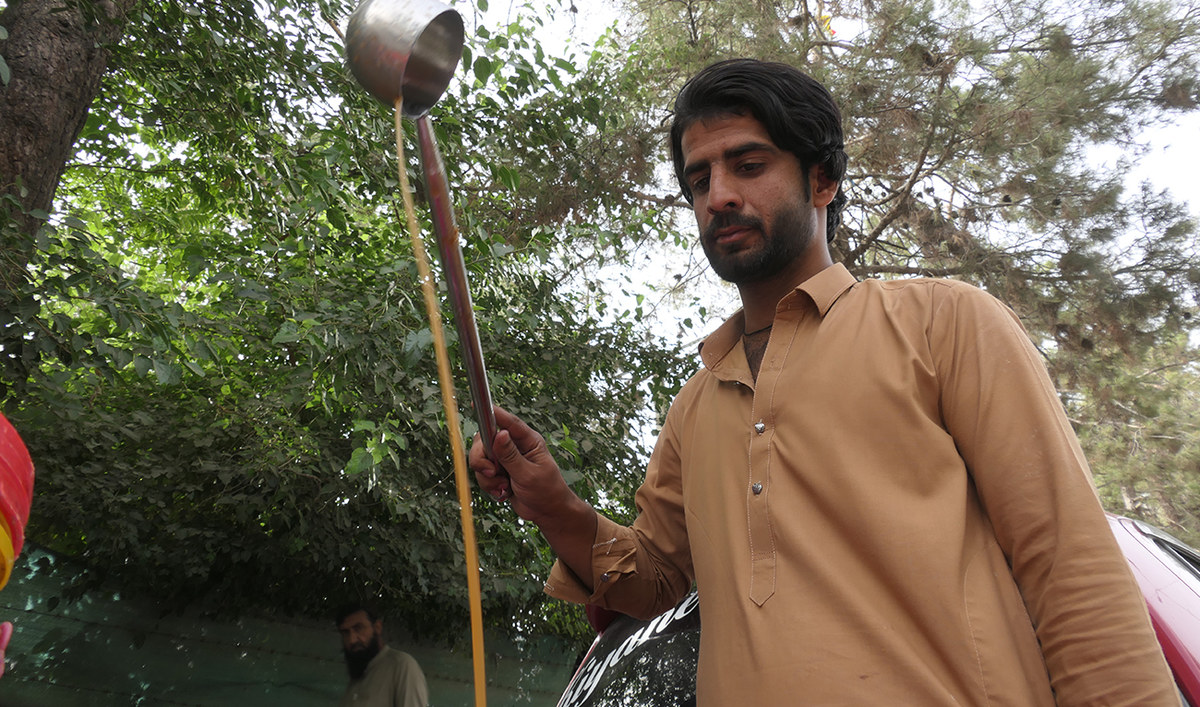
An Apricot juice seller, Ikram Ullah, mixes his poplar juice in Quetta on July 6, 2024. (AN Photo)
“When there is any public activity in the city, I sell two 35-liter jars of apricot juice. But normally, I sell one.”
Taj Muhammad, a resident of the city’s Sariab Road, said he was roaming through the bazaar when he came across a pushcart selling kushta. That was enough of a temptation for him to stop and drink a glass of fresh apricot juice.
“There are dozens of pushcarts in Quetta from the main city center to the end of Sariab Road selling this traditional drink because the demand for this beverage increases in the summer season.”

A vendor fills glasses with traditional sugar cane juice in Quetta on July 6, 2024. (AN Photo)


