

Karachi festival exhibits dozens of Sindh’s mango varieties to enthusiastic citizens

This photo shows the general view of the three-day mango festival, offering a wide variety of Pakistani mangoes, in Karachi on July 6, 2024. (AN Photo)
Short Url
Updated 07 July 2024
Follow

Karachi festival exhibits dozens of Sindh’s mango varieties to enthusiastic citizens

  • Growers say most people only know about a handful of mango varieties, urging them to try others
  • Mangoes produced in Sindh are known for exceptional taste due to specific climate and soil conditions

KARACHI: Dozens of mango varieties from Pakistan’s southern Sindh province were displayed at a three-day festival in Karachi on Saturday, aiming to introduce citizens to different types of the fruit and its products, according to the organizers.
Pakistan produces nearly 200 varieties of mangoes, frequently described as the “king of fruits,” particularly in the southeastern province of Sindh, which is home to vast mango orchards.
The most famous of these varieties include Sindhri, Dusheri, Chaunsa, Anwar Ratole and Langra. However, growers emphasize that many people are unaware of other varieties, such as Fajri, Saroli, Neelum, Gulab Khasa, Al-Phanso, Bagan Pali, and Paraga, among many others.
The three-day mango festival, hosted by the Sindh Agriculture University, Tandojam, in collaboration with the Pakistan Maritime Museum, began on Friday and will conclude on Sunday.
“The primary aim is to raise awareness among our people, who already love mangoes, that it’s not just about Sindhri and Chaunsa,” said Dr. Zulfiqar Yousufani, a progressive grower whose mangoes are exported to Europe, Saudi Arabia, the United Arab Emirates and other parts of the Middle East. “There are many varieties. Try them too.”
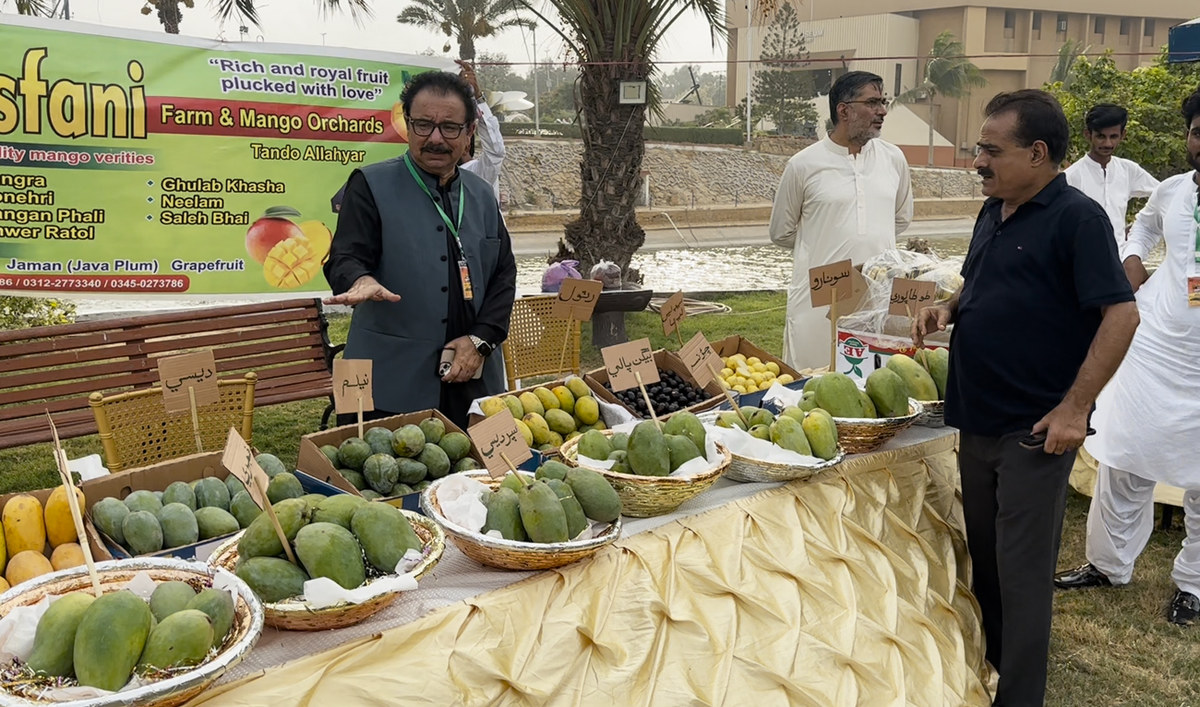


Dr. Zulfiqar Yousufani (left), a progressive grower, speaks to visitors at his stall during the second day of a mango festival, offering a wide variety of Pakistani mangoes, in Karachi on July 6, 2024. (AN Photo)

He said the idea behind the festival was to highlight that Pakistani mangoes were the best and loved across the world.
“Following Sindhri, Sonehri, Bagan Pali, and Chaunsa are also being exported in significant quantities,” Yousufani said, pointing to the mango varieties at his stall.
Tehseen Fatima, who teaches at the agriculture university in Tandojam, pointed out that mango products were also displayed to educate people about other uses of the fruit.
“You can see here, we have prepared various mango products to raise awareness among children, the community and students,” she said.
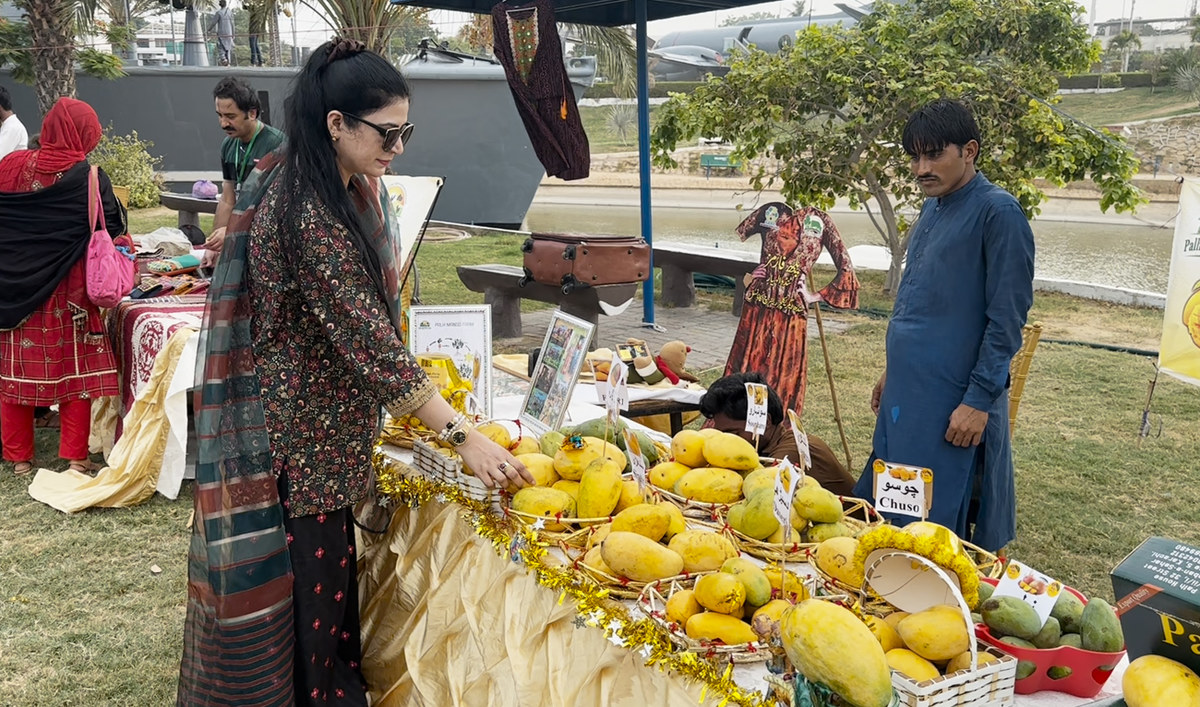


Tehseen Fatima, professor at the Sindh Agriculture University Tandojam, inspects mangoes during the second day of a mango festival, offering a wide variety of Pakistani mangoes, in Karachi on July 6, 2024. (AN Photo)

She informed that mangoes are predominantly cultivated in Mirpurkhas in Sindh.
“You can observe different farmers displaying their varieties, from off-season to on-season, premature to late-season,” she said.
Fatima pointed out that mangoes produced in Sindh were renowned for their exceptional taste due to specific climate and soil conditions that enhanced their nutritional quality while giving them vibrant color and appealing taste.
“This is why mangoes from Sindh are imported by various countries,” she continued.
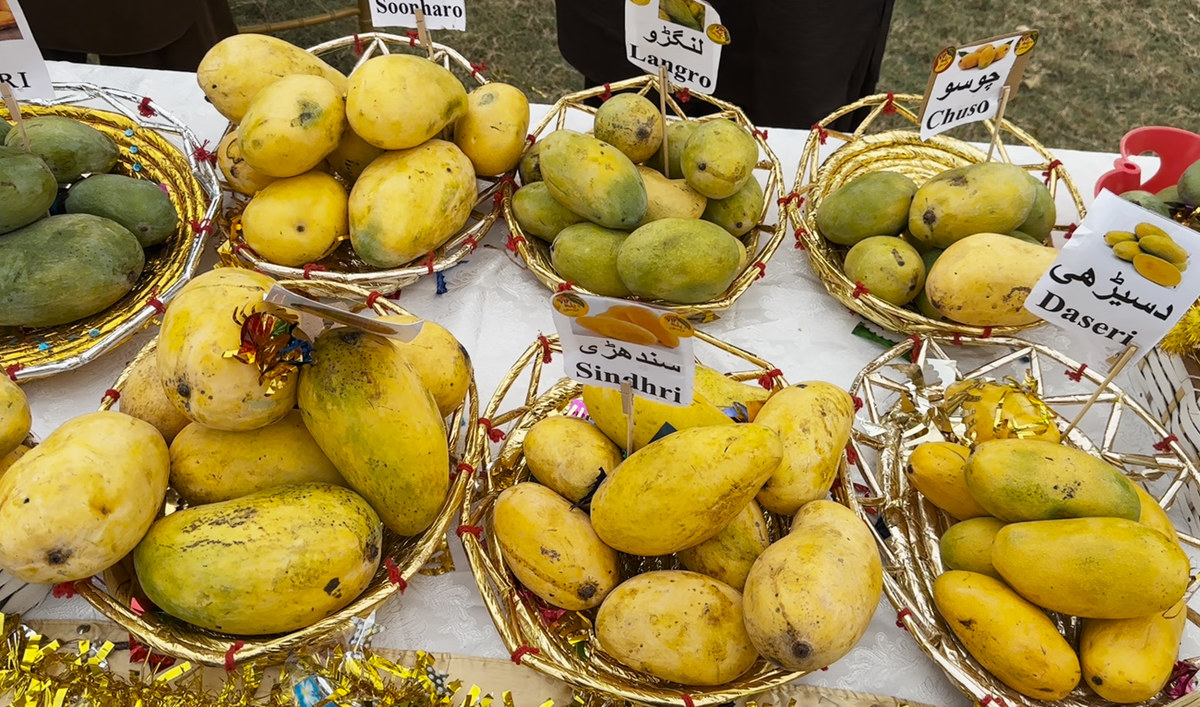


This photo shows the general view of the three-day mango festival, offering a wide variety of Pakistani mangoes, in Karachi on July 6, 2024. (AN Photo)

Speaking to Arab News, Lubna Aslam, a housewife attending the festival with her family, expressed surprise at the multitude of mango varieties.
“We were only familiar with a few types. After visiting the exhibition, I discovered the wide range of them,” she said, adding that she now wanted to explore and try other varieties as well.


Imran Khan’s party seeks ‘confidence-building measures’ after government’s talks offer

Updated 03 January 2026
Follow

Imran Khan’s party seeks ‘confidence-building measures’ after government’s talks offer

  • PTI says access to jailed founding leader essential for talks to be considered credible
  • Government says it’s ready for dialogue but nothing will happen until Khan favors the idea

ISLAMABAD: Pakistan’s jailed former prime minister Imran Khan’s party said on Saturday it would only consider the government’s offer for talks credible if it is accompanied by “concrete confidence-building measures,” such as unhindered access to its founding leader in a high-security prison in Rawalpindi.

Last month, Prime Minister Shehbaz Sharif said the government was fully prepared to hold a dialogue with Khan’s Pakistan Tehreek-e-Insaf (PTI) party to address political polarization that has deepened since the downfall of the PTI administration in a parliamentary no-confidence vote in 2022.

PTI has frequently complained about a state crackdown against its top leadership, including Khan and his wife, who are serving prison sentences in multiple cases ranging from corruption charges to inciting violence against state institutions and attacks on government properties.

Sharif’s offer for talks came amid media reports that PTI wanted a dialogue with the government, though he noted that negotiations would not be allowed to proceed on the basis of “blackmailing” or unlawful demands and would only cater to legitimate issues.

“Announcements of talks, without concrete confidence-building measures, cannot be treated as credible progress,” Azhar Leghari, PTI’s central deputy information secretary, told Arab News.

He recalled that Khan had authorized Mahmood Khan Achakzai and Allama Raja Nasir Abbas to carry forward with the dialogue process, adding that talks “require trust, and trust cannot be built at the cost of constitutional rights or democratic legitimacy.”

“For dialogue to be meaningful, it is essential that these authorized representatives are allowed regular and unhindered access to Imran Khan so that any engagement accurately reflects his views and PTI’s collective position,” he added.

Khan’s family, party and legal team have complained in the past they are stopped by the authorities from meeting the ex-PM in prison. Last month, they also raised concerns about his health, prompting the officials to allow one of his sisters to meet him, who said he was fine.

Shortly thereafter, a scathing message was posted on his social media account, criticizing the army chief. Khan’s post elicited a bitter response from the government and the military amid accusations of inciting people against state institutions.

Leghari’s comments came only a day after Rana Sanaullah, adviser to Prime Minister Sharif on political affairs, said PTI’s “second- or third-tier leadership” wanted dialogue, but nothing was going to happen until Khan favored these negotiations.

He also maintained that while the government was ready for talks, “uncertainty and delays from PTI are preventing progress.”

Meanwhile, a newly formed National Dialogue Committee of former PTI leaders told Arab News it had organized a session on Wednesday, January 7, in the federal capital that will bring together all major political parties, journalists, lawyers and representatives of civil society.

“Our goal is to bring political leaders together so that, while discussing their own issues, they can collectively seek solutions to the nation’s challenges,” Mahmood Baqi Moulvi, a Pakistani politician and member of the committee, said.

“The initiative also builds on previous efforts, including a letter to the prime minister requesting confidence-building measures to enable talks with PTI,” he added.

The National Dialogue Committee had urged the government in the letter to grant parole to jailed party figures in Lahore, including former foreign minister Shah Mahmood Qureshi and Dr. Yasmin Rashid, describing the move as vital for building trust ahead of negotiations.

It had also maintained such a step “would not only create an extremely positive, conducive, and trust-filled environment for the negotiations but would also lay a strong foundation for restoring mutual confidence among all stakeholders.”

While the government has also offered dialogue in the past, PTI leaders have conditioned participation on substantive measures, including what they describe as an end to politically motivated prosecutions and arrests, restoration of fundamental rights, respect for judicial independence and a credible roadmap toward free and fair elections.

“Reconciliation is possible, but it must be based on correcting injustices rather than managing optics,” Leghari said. “A genuine reset requires restoring respect for the Constitution, ending political victimization and allowing democratic processes to function without interference.”

Rana Sanaullah and Deputy Law Minister Barrister Aqeel Malik did not respond to requests for comment.