ISLAMABAD: Prime Minister Shehbaz Sharif on Saturday called for the early completion of two major hydropower projects in the country with the assistance of Chinese engineers while emphasizing their “foolproof security.”
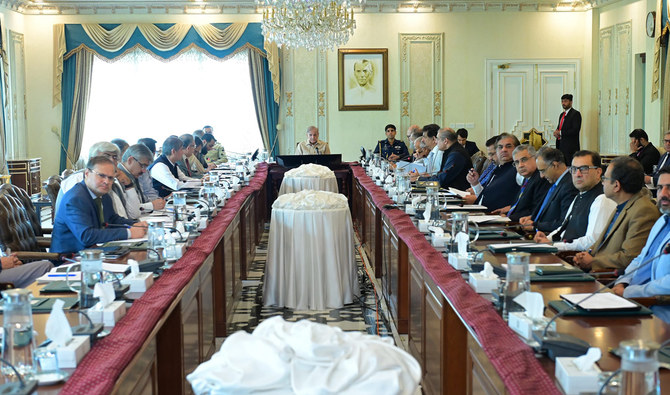
Sharif presided over a meeting in Islamabad to review the implementation of agreements and memoranda of understanding signed during his visit to China last month, aimed at enhancing collaboration in various fields, including business, agriculture, information technology, mining and energy.
During his five-day stay in China, he interacted with representatives of various firms and held meetings with top political leadership, highlighting Pakistan’s gradually improving macroeconomic situation while seeking business collaboration and increased investment.
Days after his return to Pakistan, however, a visiting Chinese official in Islamabad mentioned the country’s internal security deficit, describing it as a major challenge undermining the confidence of Chinese investors.
“The prime minister instructed WAPDA [Water and Power Development Authority] to establish safe centers to ensure foolproof security for Chinese nationals working on the Dasu and Diamer Bhasha projects,” said a statement released by his office, referring to two hydropower projects on the Indus River in Khyber Pakhtunkhwa and Gilgit-Baltistan regions.
“He also directed that these projects should be completed as soon as possible,” it added.
The prime minister said he would not tolerate any delay in the implementation of agreements with the Chinese authorities.
The meeting was told that a delegation of Chinese shoe manufacturing companies had visited Pakistan to discuss relocating their factories.
The statement said there was a potential for an investment of up to $8 billion by these companies.
The meeting was also briefed by the information technology ministry about Huawei’s progress on technical training for 300,000 students, facilitating business through a one-stop operation, and developments in smart governance and smart city projects.
The prime minister said he would personally oversee the implementation of various projects agreed between the two countries.
Discussing the development of agriculture in Pakistan on advanced and technological lines, he said it was vital to send 1,000 students to China on government scholarships for advanced training.
“Students from all four provinces, including Gilgit-Baltistan and Azad Kashmir, will be sent to China based on merit, with special preference given to students from underprivileged areas of Balochistan,” he said.
“The process of sending students for advanced agricultural training to China should begin from the next academic semester,” he added.
The prime minister also directed to expedite the development of Gwadar port, airport and industrial zone to turn it into a hub of regional trade.


![]()

PM Sharif directs fast-tracking of hydropower projects, emphasizes ‘foolproof security’ for Chinese workers
Short Url
https://arab.news/jx2u3
PM Sharif directs fast-tracking of hydropower projects, emphasizes ‘foolproof security’ for Chinese workers
- PM says he will not tolerate any delay in the implementation of agreements made during his China visit
- He instructs the authorities to expedite Gwadar’s development to turn it into a hub of regional trade
Latest updates


© 2026 SAUDI RESEARCH & PUBLISHING COMPANY, All Rights Reserved And subject to Terms of Use Agreement.