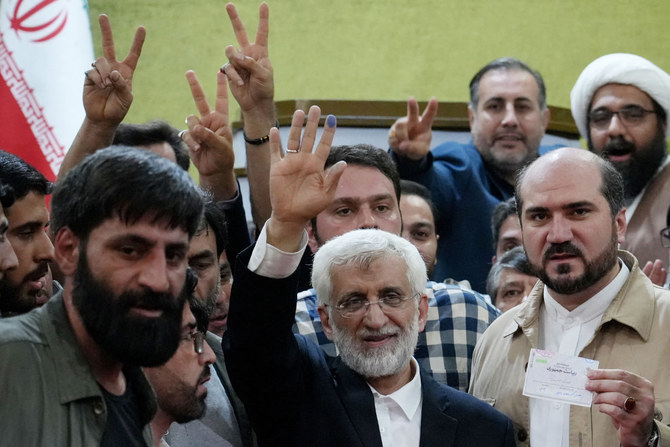
DUBAI: Reformist candidate Masoud Pezeshkian won Iran’s runoff presidential election Saturday, beating hard-liner Saeed Jalili by promising to reach out to the West and ease enforcement on the country’s mandatory headscarf law after years of sanctions and protests squeezing the Islamic Republic.
Pezeshkian promised no radical changes to Iran’s Shiite theocracy in his campaign and long has held Supreme Leader Ayatollah Ali Khamenei as the final arbiter of all matters of state in the country. But even Pezeshkian’s modest aims will be challenged by an Iranian government still largely held by hard-liners, the ongoing Israel-Hamas war in the Gaza Strip, and Western fears over Tehran enriching uranium to near-weapons-grade levels.
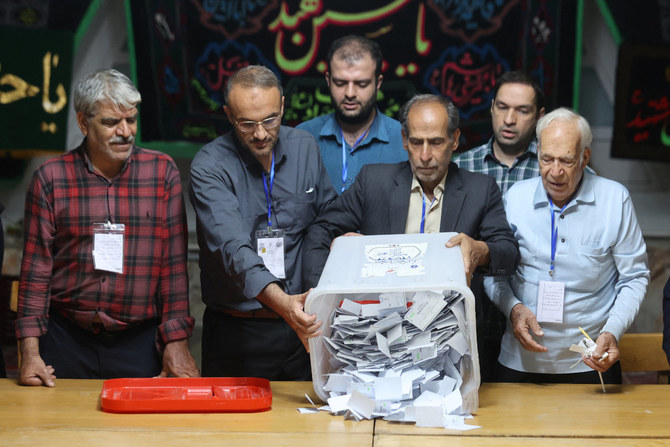
A vote count offered by authorities put Pezeshkian as the winner with 16.3 million votes to Jalili’s 13.5 million in Friday’s election.
Supporters of Pezeshkian, a heart surgeon and longtime lawmaker, entered the streets of Tehran and other cities before dawn to celebrate as his lead grew over Jalili, a hard-line former nuclear negotiator.
But Pezeshkian’s win still sees Iran at a delicate moment, with tensions high in the Mideast over the Israel-Hamas war in the Gaza Strip, Iran’s advancing nuclear program, and a looming US election that could put any chance of a detente between Tehran and Washington at risk.
The first round of voting June 28 saw the lowest turnout in the history of the Islamic Republic since the 1979 Islamic Revolution. Iranian officials have long pointed to turnout as a sign of support for the country’s Shiite theocracy, which has been under strain after years of sanctions crushing Iran’s economy, mass demonstrations and intense crackdowns on all dissent.
Government officials up to Supreme Leader Ayatollah Ali Khamenei predicted a higher participation rate as voting got underway, with state television airing images of modest lines at some polling centers across the country.
However, online videos purported to show some polls empty while a survey of several dozen sites in the capital, Tehran, saw light traffic amid a heavy security presence on the streets.
The election came amid heightened regional tensions. In April, Iran launched its first-ever direct attack on Israel over the war in Gaza, while militia groups that Tehran arms in the region — such as the Lebanese Hezbollah and Yemen’s Houthis — are engaged in the fighting and have escalated their attacks.
Iran is also enriching uranium at near weapons-grade levels and maintains a stockpile large enough to build several nuclear weapons, should it choose to do so. And while Khamenei remains the final decision-maker on matters of state, whichever man ends up winning the presidency could bend the country’s foreign policy toward either confrontation or collaboration with the West.
The campaign also repeatedly touched on what would happen if former President Donald Trump, who unilaterally withdrew America from the Iran nuclear deal in 2018, won the November election. Iran has held indirect talks with President Joe Biden’s administration, though there’s been no clear movement back toward constraining Tehran’s nuclear program for the lifting of economic sanctions.
More than 61 million Iranians over the age of 18 were eligible to vote, with about 18 million of them between 18 and 30. Voting was to end at 6 p.m. but was extended until midnight to boost participation.
The late President Ebrahim Raisi, who died in a May helicopter crash, was seen as a protégé of Khamenei and a potential successor as supreme leader.
Still, many knew him for his involvement in the mass executions that Iran conducted in 1988, and for his role in the bloody crackdowns on dissent that followed protests over the 2022 death of Mahsa Amini, a young woman detained by police over allegedly improperly wearing the mandatory headscarf, or hijab.


![]()
![]()
![]()

Reformist Pezeshkian wins Iran’s presidential runoff election, beats hard-liner Jalili

Short Url
https://arab.news/593kw
Reformist Pezeshkian wins Iran’s presidential runoff election, beats hard-liner Jalili
- Vote count put Pezeshkian as the winner with 16.3 million votes to Jalili’s 13.5 million
- Pezeshkian promised to reach out to West in bid to ease economic sanctions


Latest updates


© 2026 SAUDI RESEARCH & PUBLISHING COMPANY, All Rights Reserved And subject to Terms of Use Agreement.