

What will UK foreign policy look like under Labour?

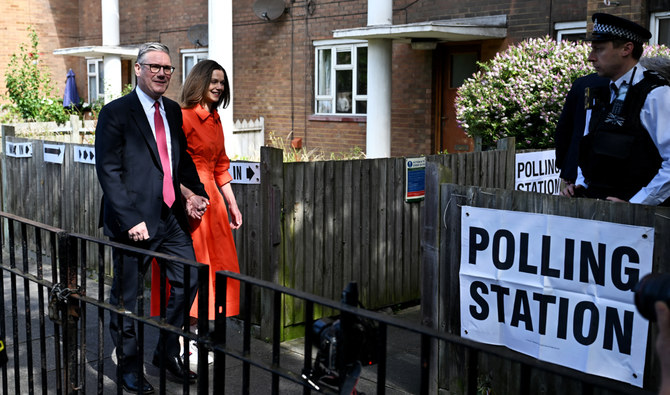
Britain's opposition Labour Party leader Keir Starmer and his wife Victoria arrive to cast their votes at a polling station in London on July 4, 2024 as Britain holds a general election. (AFP)
Short Url
Updated 05 July 2024
Follow

What will UK foreign policy look like under Labour?

LONDON: The first month of a Keir Starmer premiership will be a whirlwind of international diplomacy including meetings with US President Joe Biden and European leaders.

His first steps on the world stage will be just days away, at the NATO 75th anniversary summit being held in Washington next Tuesday to Thursday.

Starmer will then play host at Blenheim Palace, near Oxford, in central England, on July 18, at a European Political Community meeting, with France’s Emmanuel Macron and Germany’s Olaf Scholz expected.

Labour, out of power since 2010, has pledged a foreign policy of “progressive realism,” seeing a more volatile world “as it is not as we would want it to be,” said David Lammy, who is expected to become foreign secretary.

The party has also pledged to “make Brexit work” and seek “an ambitious” security pact with the the European Union.

Here is a rundown of how a Labour government could approach the major international issues it faces.

Labour would undertake a “full audit” across all government departments of the UK’s relationship with China to “set the direction and course” of its China policy, Lammy told reporters this week.

Starmer last year said the UK needed to “wean itself off” China on issues like trade, commerce and technology while acknowledging the importance of being able to cooperate on issues such as tackling climate change.

The challenge will be to balance the UK’s trade and economic interests with security imperatives.

That could be complicated by a possible return of Donald Trump in Washington after the US presidential election in November.

Trump would be expected to ramp up pressure on allies to be tougher with Beijing.

Labour says it is committed to recognizing a Palestinian state “as a contribution to a renewed peace process which results in a two-state solution.”

But it has not set out any timescale for doing so.

Other commitments include pushing for an immediate ceasefire, the release of all hostages and an increase in the amount of aid getting into Gaza.

Starmer has pledged to work with France’s far-right National Rally (RN) party if it wins power.

“I will work with any government in Europe and across the world if we are elected... For me, that’s what serious government is about,” he said.

He said both bilateral deals with France and agreements with the whole EU, which the UK voted to leave in 2016 leading to a messy divorce, were important to address the issue of migrants crossing the Channel in small boats.

Pressed on RN leader Marine Le Pen’s preference for bilateral deals over EU-wide ones, Starmer said the two were not mutually exclusive.

He said existing bilateral agreements with France needed to be strengthened and improved “particularly in relation to smashing the gangs that are running the vile trade of putting people into boats.”

“But there are also EU measures,” he added. “The security agreement we want with the EU when it comes to dealing with smuggling gangs is really important.”

The UK has been one of Kyiv’s staunchest supporters and has provided money, weapons and troop training to help it repel Russia’s invasion.

Labour have stressed continued support for Ukraine if they win, and Starmer would be expected to meet Ukrainian President Volodymyr Zelensky early to reaffirm that message in person.

Starmer has said a meeting with Russian President Vladimir Putin is “simply not an issue” at the moment and described him as “the aggressor in Ukraine.”

“The most important thing is to be absolutely clear that our support for Ukraine is on a united front in this country,” he said.

A strategic defense review would be carried out within the first year of government to set out a path to an increase in defense spending to 2.5 percent of GDP.


Cambodia says Thailand bombs casino hub on border

Updated 7 sec ago
Follow

Cambodia says Thailand bombs casino hub on border

PHNOM PENH: Cambodia said Thailand’s military on Thursday bombed the casino town of Poipet, a major crossing between the two nations, as foreign powers pressured them to halt reignited border clashes.
Thai forces “dropped two bombs in the area of Poipet Municipality, Banteay Meanchey Province” at around 11:00 am (0400 GMT) Thursday, the Cambodian defense ministry said in a statement.
Thailand has not yet confirmed any strike on Poipet — a bustling casino hub popular with Thai gamblers.
The renewed fighting between the Southeast Asian neighbors this month has killed at least 21 people in Thailand and 17 in Cambodia, while displacing around 800,000, officials said.
The conflict stems from a territorial dispute over the colonial-era demarcation of their 800-kilometer (500-mile) border and a smattering of ancient temple ruins situated on the frontier.
Each side has blamed the other for instigating the fresh fighting and traded accusations of attacks on civilians.
Thailand said Tuesday that between 5,000 and 6,000 Thai nationals remained stranded in Poipet after Cambodia closed its land border crossings with its neighbor.
Cambodia’s interior ministry said the border closures were a “necessary measure” to reduce risks to civilians amid the ongoing combat, adding that air travel remained an option for those seeking to leave.
At least four casinos in Cambodia have been damaged by Thai strikes, the interior ministry said this week.
- ‘Shuttle-diplomacy’ -
Five days of fighting between Cambodia and Thailand in July killed dozens of people before a truce was brokered by the United States, China and Malaysia, and then broken within months.
US President Donald Trump, who has repeatedly intervened in the long-standing conflict this year, claimed last week that the two countries had agreed to a new ceasefire.
But Bangkok denied any truce had been agreed, and fighting with artillery, tanks, drones and jets has continued daily since a border skirmish earlier this month sparked the latest round of conflict.
China said it was sending its special envoy for Asian affairs to Cambodia and Thailand on Thursday for a “shuttle-diplomacy trip” to help bridge the gaps and “rebuild peace.”
“Through its own way, China has been working actively for deescalation,” Beijing’s foreign ministry said in a statement late Wednesday.
Foreign ministers from ASEAN regional bloc nations are due to meet on Monday in Malaysia for emergency talks aimed at finding a diplomatic solution.
“Our duty is to present the facts but more important is to press upon them that it is imperative for them to secure peace,” Malaysian Prime Minister Anwar Ibrahim told journalists late Wednesday.
“We are appealing to them to immediately stop this frontline offensive and if possible, an immediate ceasefire,” Anwar said at his official residence in Putrajaya, adding that he was “cautiously optimistic” about the talks.
European Commission vice president Kaja Kallas said in a statement that she had spoken with the foreign ministers of Cambodia and Thailand on Wednesday, offering the European Union’s support for ceasefire monitoring with satellite imagery.
“The conflict between Thailand and Cambodia must not be allowed to spiral further. That’s why the ceasefire needs to be immediately restored,” Kallas said.
