

Scientists from Pakistan, other OIC countries begin vaccine development training in Jakarta

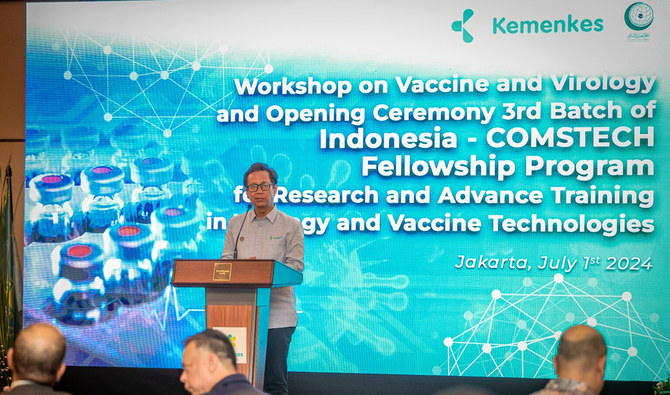
The picture shared by Pakistan state-run media APP on July 4, 2024, shows participants attending the Indonesia-COMSTECH Fellowship Program for Research and Advance Training in Virology and Vaccine Technologies. (APP)
Short Url
Updated 04 July 2024
Follow

Scientists from Pakistan, other OIC countries begin vaccine development training in Jakarta

  • Program to strengthen vaccine development and manufacturing capabilities within Organization of Islamic Cooperation countries
  • Features twelve researchers from Indonesia, Cameroon, Kazakhstan, Malaysia, Egypt, Pakistan, Somalia, Tanzania, and Uganda

ISLAMABAD: Scientists from Pakistan and other Organization of Islamic Cooperation (OIC) member states are taking part in a month-long vaccine development training program in Jakarta, the state-run Associated Press of Pakistan (APP) reported on Thursday.

The third phase of the training program has been launched by the Standing Committee for Scientific and Technological Cooperation (COMSTECH), one of the four OIC standing committees, in collaboration with Indonesia’s health ministry, vaccine developer PT Bio Farma and the Padjadjaran University.

Twelve researchers from Indonesia, Cameroon, Kazakhstan, Malaysia, Egypt, Pakistan, Somalia, Tanzania, and Uganda have been enrolled in the program for training in virology and vaccine technology.

The third phase of the month-long training program is being held in Jakarta and will also be conducted in Bandung, West Java. The first two phases of the same program were conducted in Indonesia in 2022 and 2023.

“The program offers a comprehensive learning experience, encompassing the workshops, industry visits, and laboratory training,” APP said. 

Trainees will undergo intensive training at PT Bio Farma’s laboratory and central laboratories of UNPAD Bandung and Jatinangor. 

“The program is designed to foster knowledge sharing and equip researchers with the necessary skills and expertise in virology and vaccine technology,” APP said. “Ultimately strengthening vaccine development and manufacturing capabilities within OIC member countries.”

Indonesia’s Health Minister Budi Gunadi Sadikin stressed the role of the program in strengthening the capabilities of researchers from OIC countries in vaccine manufacturing.

“He highlighted the importance of expanding vaccine research and development beyond developed nations, aiming for a more equitable global vaccine production capacity,” APP said. 

A vital part of the OIC, COMSTECH aims to strengthen cooperation among member states in science and technology and enhance their capabilities through training in emerging areas. 


Pakistan’s space agency says country will witness first supermoon of 2026 on Saturday

Updated 3 sec ago
Follow

Pakistan’s space agency says country will witness first supermoon of 2026 on Saturday

  • The supermoon will coincide with the Quadrantid meteor shower, which peaks in early January
  • The space agency says no further supermoon will occur until a new cycle begins in Nov. 2026

ISLAMABAD: Pakistan will witness the first supermoon of 2026 on Saturday evening, a rare celestial event that will coincide with the Quadrantid meteor shower, which is active in early January, the country’s space agency said Friday.

The Jan. 3 supermoon will be the last in a cycle that began in October 2025, while also marking the first supermoon of the new year. Supermoons occur when a full moon coincides with the Moon’s closest approach to Earth, making it appear larger and brighter than usual.

“The January 3 supermoon, traditionally known as the Wolf Moon, marks the final supermoon of the ongoing cycle began in October 2025,” Pakistan’s national space agency, SUPARCO, said in a statement, adding that it also “simultaneously represents the first supermoon of 2026.”

The agency said the supermoon would rise in Pakistan at 5:51 p.m. local time on Jan. 3 and remain visible through the nights of Jan. 3 and Jan. 4, with illumination reaching 99.8 percent.

According to SUPARCO, the Moon will be at a distance of about 362,312 kilometers (225,130 miles) from Earth during the event, making it appear six to seven percent larger and up to 10 percent brighter than a typical full moon.
The astronomical significance of the event will be enhanced by its timing.

“The supermoon of Jan 3 offers an early highlight among the year’s celestial events such as coinciding with the peak activity of the Quadrantid meteor shower during the same time period,” the statement said.

SUPARCO noted that supermoons usually occur in clusters of three to four consecutive events and said the current cycle would conclude with Friday’s phenomenon.

“The next supermoon cycle starts in November 2026,” the agency said, adding that there would be no further supermoon after this until the end of 2026.