

Italy’s ambition to be on cricket’s world stage

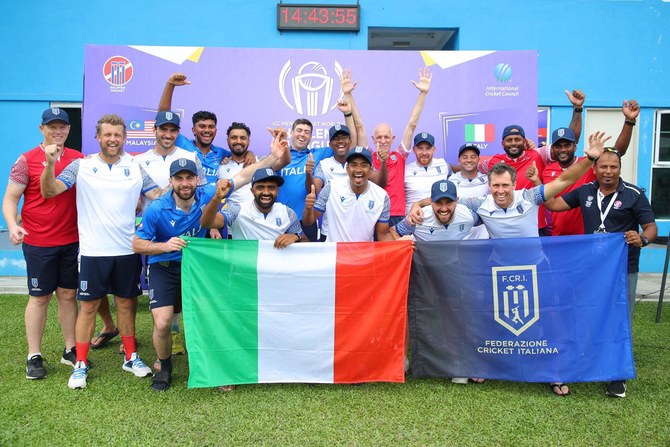
Between June 9 and 16, the Italian men’s cricket team participated in the 2026 ICC Men’s T20 World Cup Sub Regional Europe Group A Qualifier tournament, involving 10 teams. (X: @FedCricket)
Short Url
Updated 04 July 2024
Follow

Italy’s ambition to be on cricket’s world stage

  • The Italian team are rising up the rankings, with players drawn from several leading cricket-playing nations

“They play cricket there, really?” This is a common refrain when certain countries are mentioned in the same breath as cricket.

Actually, the list of such countries is long. The International Cricket Council has 12 full members who qualify to play official Test matches, whereas there are 96 associate members.

This is roughly half the number of countries which are members of the UN and leaves plenty of scope for the quizzical response: “They play cricket there, do they?” Saudi Arabia is one such country, Thailand is another, along with Greece.

In the last week, I have been met with incredulity when I have dropped into conversations that Italy’s men’s cricket team have been doing well recently. This at a time when its football team was knocked out of Euro 2024 at an early stage.

Between June 9 and 16, the Italian men’s cricket team participated in the 2026 ICC Men’s T20 World Cup Sub Regional Europe Group A Qualifier tournament, involving 10 teams. They were undefeated and handsomely beat Romania by 160 runs in the final. The team will progress to the final stage of European qualification to be held in 2025. Currently, they are ranked 29th in the ICC T20I rankings. Saudi Arabia is 32nd.

Italian cricket looks to be ascendant. It has not always been that way. This has been chronicled in two books authored by Simone Gambino, a past chairman of the Italian Cricket Federation and now its honorary president. He has penned a fascinating story which he has graciously summarized for me in English, and that has informed much of this article.

It is thought that British merchants and sailors introduced cricket to Italian ports in the late 18th and early 19th centuries. There is even mention of Vice Admiral Horatio Nelson organizing a match in Naples in 1793.

Cricket became popular amongst the elite in Italy and flourished throughout the 19th century. In September 1893 the Genoa Cricket and Athletic Club was formed by a group of British emigrants, football being a secondary concern.

In 1899, another group of emigrants led by Herbert Kilpin of Nottingham founded the Milan Foot-ball and Cricket Club, AC Milan, to remind them of home.

This apparent focus on cricket was soon eclipsed by the rise of football, and later by the rise of fascism. Its refusal of all that was English, excluding football, meant that cricket disappeared, not to be reborn until after 1945.

This was driven by cricket-loving staff of embassies and international organizations. When these suffered staff cutbacks in the late 1970s, Gambino became involved in running Italian cricket, having developed a passion for the game through his London-based American grandfather.

On Nov. 26, 1980, he founded the Associazione Italiana Cricket. In 1984 the ICC created the affiliate status, Italy becoming the first beneficiary. Between then and 1987 four summer tours to London were undertaken by the Italian national team, mostly composing indigenous players like Gambino. Three more summer tours took place between 1990 and 1992 featuring an all-indigenous Italian youth team.

A tour of Italy in 1993 by the Marylebone Cricket Club enhanced the profile of Italian cricket. This was followed by an application for Italy to be elevated to ICC associate membership, achieved in July 1995. According to Gambino, “it was the beginning of the end of clandestinity.” He uses this designation because cricket had not been officially recognized.

The Comitato Olimpico Nazionale Italiano had ignored the AIC since 1980 but was preparing a bid for the Olympics to be held in Rome in 2004. Since ICC associate status brings financial support, suddenly the value of officially recognizing cricket to gain English-speaking votes at the International Olympic Committee conference became apparent.

Gambino was summoned by CONI and official recognition ensued on Feb. 28, 1997. The AIC was transformed into the current Federazione Cricket Italiana.

Accession to associate status unlocked requests by Italian citizens living abroad, mainly from Australia and South Africa, wishing to represent Italy at cricket. Under ICC rules of the time, they were not eligible. Only birth in the country and residency counted, not citizenship.

Tension grew between the FCI and the ICC on the issue, culminating in the 2001 ICC qualifying event for the 2003 Cricket World Cup. The ICC ruled that four Italian citizens were ineligible due to their non-residency in Italy.

Gambino withdrew the team from the tournament, officially readdressing the matter to an independent sports tribunal in Lausanne. Initially, the ICC accepted but then tried to divert the arbitration to London. Gambino refused to accept.

He was aware that the ICC had a much bigger problem. It wanted to join the Olympic committee. This would require adaptation of its eligibility rules to include citizenship. A compromise prevailed by which Italy was allowed to withdraw without sanction and the ICC undertook to fully revise its eligibility rules, which it did.

Having been the catalyst for change, Italy needed to take advantage. At that time, children of parents from the Indian subcontinent who had emigrated to Italy were barred from playing cricket for the country because they did not possess citizenship.

On Dec. 7, 2002, the FCI passed a rule that all minors who wished to play cricket should be recognized as if they were Italian citizens. CONI originally opposed the decision but withdrew after Gambino pointed out that playing cricket “is a civil liberty just as going to the theater and, furthermore, the parents of these youths are all taxpayers.” It has proved to be a controversial topic.  

In the last 20 years, Italy’s men’s and women’s teams have climbed the ICC rankings and the game has spread all over the country, exposing a lack of proper playing facilities. Its current men’s national team is a mix of those with subcontinental backgrounds and those with citizenship acquired by descent.

The addition of several high-quality players in the second category has transformed results. This includes Wayne Madsen, born in South Africa, who has played almost 15 years in the English county championship, scoring over 15,000 runs. And Joe Burns who has played 23 times for Australia and is an opening batsman.

There is a fierce battle between ICC associate members to qualify for world cups. Italy is making a bold statement with its current strategy. Whether it can join the ranks of countries known for their cricketing prowess remains to be seen.

What it does possess is a rich, largely unknown and fascinating history on which to draw.


Enduring cricket aspects that may carry over into 2026 

Updated 12 sec ago
Follow

Enduring cricket aspects that may carry over into 2026 

  • Over the last 24 months, One-Day International cricket has generally been regarded as under threat, caught in the pincers between Test and T20 cricket

Two years ago, my column reflected on significant moments in matches which I attended in 2023 and which seemed to have deep significance for the game. Five themes emerged.
First was the increase in franchised T20 leagues. Second was the experience of attending ODI World Cup matches in India. Third was the shifting balance in the number of international matches played in each format. Fourth was the gallant strategy adopted by the England’s men’s test team to breathe fresh life into the format. Fifth was a dispelling of the notion, in the form of Australia’s Pat Cummins, that a fast bowler cannot be a successful captain.
My reflection at the end of 2025 is geared to exploring how these themes played out over the last 24 months and how they may continue in 2026.
January 2023 heralded the inaugural edition of the DP World ILT20 in the UAE. At the time, it looked like another brick in the wall of the modern game, symptomatic of its future shape. In the last two years, there have been three more editions of ILT20, the latest of which started on Dec. 2 and will conclude on Jan. 4, 2026. In South Africa, SA20 opened its third edition on Dec. 26, 2025, as did the Bangladesh Premier League.
Australia’s Big Bash League began its 15th edition on Dec. 14, 2025. Each of these leagues has been establishing its place in cricket’s global landscape, developing its own characteristics and points of difference. They compete for players and there is some player movement between the leagues during their schedules, usually at the beginning and toward the end.
After the clutch of leagues in January/February, there is a break until the Pakistan Super League, which will run between March 26 and May 3, 2026. This will overlap with the Indian Premier League, which occupies the space between March 26 and May 31, 2026. The PSL is set to expand from six to eight teams, with an auction set for Jan. 8, 2026. Another league with expansionist plans is the Major Cricket League in the US, scheduled to run between June 18 and July 18, 2026.
This means it will not clash with The Hundred in England and Wales, during August. Equity has been acquired in each of the eight franchises by outside investors at significant cost. A European franchise league is mooted, whilst the sixth edition of the Lanka Premier League, originally scheduled for December 2025, is now set for July 8 to Aug. 8. The postponement was made so that stadiums can be made ready to host matches in the ICC Men’s T20 World Cup 2026, which will be co-hosted by Sri Lanka and India during February and March 2026. Completing this second clutch of leagues, the Caribbean Premier League is scheduled between Aug. 15 and Sept. 22.
What might have looked in 2023 as a gamble for the two new entrants, ILT20 and SA20, is not turning out that way. ILT20 differs from other franchise leagues in that it mandates the inclusion of players from the UAE and actively seeks to recruit players from associate countries. One of its franchises is owned by Americans, who have recruited several Pakistani players. These strategies are planned to have long-lasting benefits for UAE cricket. It must also be said that South Africa’s performances on the world stage have improved sensationally over the last 24 months, since SA20 began. Expansion may be expected in terms of team numbers in several of the leagues, but over the last 24 months a place for them has emerged within cricket’s calendar.
The second theme in my end-of-year 2023 reflections relating to the experience of attending World Cup matches in India was probably a one-off, albeit an unforgettable one. There was little doubt it provided an eye-opener into the Indian way of attending cricket. It was clear that interest in matches which did not involve India was low, but the passion when the Indian team was playing was overwhelming. This was also apparent in the summer of 2025 when India toured England, as passions spilled over onto the field. Unfortunately, these passions have manifested themselves in and around matches between India and Pakistan over the last 24 months.
In terms of the third theme, the balance between formats, One-Day International cricket is generally regarded as under threat, caught in the pincers between Test and T20 cricket. In 2023, the highest-ever number of men’s ODI internationals was played, 220, exceeding the previous high of 197 in 2007, also a World Cup year. The yearly average of ODIs played between 2000 and 2023 was 144. In 2024 and 2025, the numbers fell to 103 and 114, respectively, giving some support for concerns of its decline.
In comparison, 448 men’s T20Is were played in 2023, a fall from the highest-ever number of 536 in 2022, a T20I World Cup year. The average number played between 2007 and 2018 was 60. In April 2018, the ICC decided to grant, with effect from Jan. 1, 2019, T20I status to all of its 105 members, not just Full members. At one fell swoop, the mechanism to formally increase the number of T20Is was introduced. They soared to 324 in 2019. In 2024, a World Cup year, they doubled to 653 and fell back slightly to 576 in 2025. A more meaningful statistic might be how many ODIs and T20Is full members have played. Nevertheless, the shift of focus and balance of resources is clear to see in cricket’s growth landscape, based on the T20 format.
The impact on Test cricket appears to be neutral, so far. The long run average of Tests played per year between 2000 and 2023, excluding COVID-19-affected 2022, is 44, in a range of 31 to 55. In 2023, 34 were played, but it is not uncommon for the number to fall in an ODI World Cup year. This was the case in both 2019 and 2007. In 2024, 61 were played and 41 in 2025. The numbers do not yet give cause for concern, but performances do, leading onto the fourth theme. In 2023, the new leaders of the England’s men’s test team adopted an attacking mentality and removed fear of failure. It was termed “Bazball” by several in the media to reflect the influence of the coach, Brendon McCullum, who dislikes the moniker.
There is no doubt that the approach has generated some exhilarating cricket and some extreme lows. It has also generated intense debate, books, millions of column inches and acrimony. The ultimate aim of the approach was to win the current Ashes tour of Australia. After defeat in the first three Tests, myriad obituaries were written for “Bazball.” Apart from failure, it was accused of having become a cult in which its members were impervious to criticism, had developed groupthink and had become arrogant to the point of boorishness. Yet, the obituaries proved to be premature. Over the course of two days at Melbourne, England’s approach dramatically overcame the odds.
The main controversy over the match was the pitch. An unusual amount of grass was left on it, providing conditions more suited to bowlers than batters. One of the highlights of cricket’s calendar, the Melbourne Test, which attracted a record crowd of 91,000 on the first day, ended prematurely. Not only was this a disappointment to ticketholders for days three to five, but it also means heavy financial losses for Cricket Australia, broadcasters and other stakeholders. When added to the losses suffered by the premature ending of the Perth Test, this Ashes series will be remembered with a degree of infamy. It has also raised questions about the impact of T20 cricket on batter’s techniques and their ability and willingness to construct the longer innings traditionally required for Test cricket.
A corollary of batters’ changing techniques is the ability of bowlers to take advantage. In Test cricket history, few fast bowlers have been made captain, the subject of theme five.
Eyebrows were raised when Pat Cummins was made Australia’s captain in November 2021. Since then, his win percentage as captain in 38 Tests is 63, placing him behind only Steve Waugh, with a 72 percent record and on a par with Ricky Ponting. He has led in 17 ODIs, achieving a 76 percent record, as well as leading teams which won the ODI World Cup and the World Test Championship.
He has only played one Test in the current Ashes series, because of a back injury, something which plagued his early career. In the last 24 months he has established a place in Test cricket’s history as possibly the most successful fast bowler captain ever. I say possibly, because the fast-bowling allrounder, Imran Khan, would be the first person to spring to mind. Perhaps the most poignant reflection on the last 24 months should focus on the fate that has befallen one of cricket’s all-time great players.