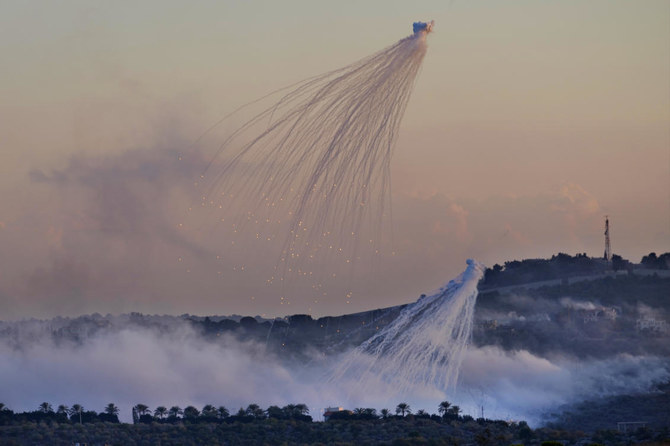
BAGHDAD: As war rages in Gaza and threatens to spread to Lebanon, Iraqi militant groups warn they are ready to enter the fray against Israel and the United States.
A field commander of the so-called Islamic Resistance in Iraq said there would be “escalation for escalation” in the event of a full-scale war in Lebanon.
The commander, speaking to AFP on condition of anonymity, said the Iran-backed group had already sent “experts and advisers” to Lebanon.
Iraqi political scientist Ali Al-Baidar agreed that a major war between Israel and Lebanon’s Hezbollah, if it happens, “will not be limited to Lebanese territory.”
“In Iraq and in the region armed groups will enter into the confrontation,” he said, adding that they would want to show “their abilities, but also their loyalty” to their allies.
The bloodiest-ever Gaza war broke out when Palestinian militant group Hamas attacked southern Israel on October 7.
The conflict quickly widened to involve several pro-Iran armed groups in the so-called “Axis of Resistance” expressing solidarity with the Palestinians and demanding an end of the Israeli offensive in Gaza.
The alliance includes Lebanon’s Hezbollah and Yemen’s Houthi rebels, who have attacked Israel and Israeli-linked shipping, but also armed groups in Syria and Iraq.
In recent weeks, the Islamic Resistance in Iraq has claimed responsibility for drone strikes against targets in Israel, labelling many of them “joint operations” with the Houthis.
The Israeli army, without naming an attacker, has confirmed several aerial attacks from the east since April, but has said they were all intercepted before entering its airspace.
The Islamic Resistance in Iraq has previously shown its willingness to launch attacks.
Last winter, it carried out more than 175 rocket and drone strikes against US troops based in Iraq and Syria as part of an international anti-jihadist coalition.
On Sunday, the so-called Coordination of the Iraqi Resistance issued further threats against Israel and Israel’s top ally the United States.
Citing the threat of “total war against Lebanon,” it warned that “if the Zionists (Israelis) carry out their threats, the pace and scale of operations targeting them will intensify.”
It added that “the interests of the American enemy” in Iraq and around the region would also be “legitimate targets.”
The group includes the Hezbollah Brigades, Al-Nujaba and the Sayyed Al-Shuhada Brigades, all of whom are under US sanctions.
Al-Baidar noted the past experience of “operations and attacks against American forces and diplomatic missions” in Iraq.
“It is possible these attacks will repeat themselves with greater intensity,” he said.
In late January, a drone strike launched by Iraqi armed groups killed three US soldiers in a base just across the border in Jordan and provoked an armed response.
The US military — which has some 2,500 troops deployed in Iraq and 900 in Syria with the international coalition — responded with deadly strikes against pro-Iran factions and has vowed to retaliate if attacked again.
“We will not hesitate to take all appropriate actions to protect our personnel,” a State Department spokesperson told AFP, requesting anonymity.
“Iran-aligned militia groups in Iraq undermine Iraq’s sovereignty by conducting unauthorized attacks against third countries, potentially making Iraq a party to a larger regional conflict.”
Many of the Iraqi factions have fighters who are veterans of Iraq’s recent wars or have been deployed in the civil war in Syria, which is separated from Israel by the Israeli-occupied Golan Heights.
Militants are based south of the capital Damascus, and “elite troops” are stationed in the Golan region near the Israeli-occupied sector, says the group Syrian Observatory for Human Rights.
Iraq specialist Tamer Badawi said the importance of Iraqi groups’ “coordinated attacks” carried out with the Houthis “lies in their symbolism.”
He said they aim to highlight “the idea that groups separated by significant geographic distances are capable of synchronizing their armed action against a common adversary.”
Badawi, a doctoral student at Kent University, said any Iraqi intervention in Lebanon — whether by sending “fighters en masse” or just “advisers” — would “depend on Hezbollah’s warfare needs.”
The scale of mobilization would respond to the need of “projecting the optics of transnational solidarity,” Badawi said.
“Symbolism matters for those groups across the region and is part of their branding as members of one league, as much as actual involvement in armed action.”
Many analysts suggest Israel, Hezbollah and Iran do not want a costly full-scale war in Lebanon but caution about the potential for miscalculations that could escalate tensions dangerously.
Hezbollah’s leader Hassan Nasrallah recently tempered the zeal of his allies in Iraq, Syria and Yemen on the subject of sending their fighters to Lebanon.
Regarding “human resources,” Nasrallah said, “the resistance in Lebanon has numbers exceeding its needs and the imperatives of the front, even in the worst fighting conditions.”


![]()

Iraqi armed groups say ready to fight Israel if Lebanon war breaks out
Short Url
https://arab.news/rc3dr
Iraqi armed groups say ready to fight Israel if Lebanon war breaks out
- The bloodiest-ever Gaza war broke out when Palestinian militant group Hamas attacked southern Israel on October 7
- The conflict quickly widened to involve several pro-Iran armed groups in the so-called “Axis of Resistance”
Latest updates


© 2026 SAUDI RESEARCH & PUBLISHING COMPANY, All Rights Reserved And subject to Terms of Use Agreement.