

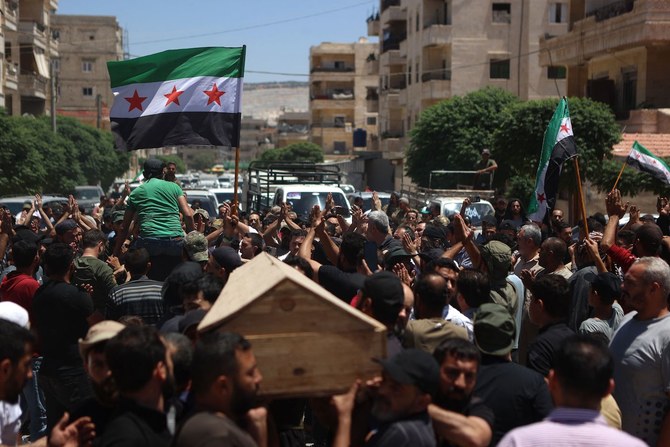

ANKARA: Tensions continue to rise amid Turkiye’s normalization efforts with Syria after attacks were carried out on Syrian refugees in the country and Turkish flags were targeted in northern Syria.
The events re-opened the debate on refugees and over Ankara’s ties with its war-torn neighbor.
Both Syrian President Bashar Assad and Turkish President Recep Tayyip Erdogan recently signaled a willingness to mend their fractured relations.
This comes after Turkiye reopened the Abu Al-Zandeen crossing near Al-Bab, establishing commercial connections between Turkish-controlled zones and regime-held areas in eastern Aleppo. Additionally, efforts are underway to widen the Hajjez Al-Shatt highway in Turkish-held Azaz, linking Aleppo to the Turkish border city of Gaziantep.
Turkiye also controls a buffer zone in northern Syria. However, the normalization efforts and the reopening of trade routes have ignited tensions in northern Syria.
BACKGROUND
Turkiye hosts about 3.1 million Syrian refugees, according to official data, and one motivation behind Ankara’s renewed dialogue with Damascus is the potential facilitation of refugee repatriation.
In recent days, anger has boiled over, with attacks targeting Turkish flags and trucks. Many Syrians in Turkish-controlled zones are demanding the withdrawal of Turkish forces, exacerbating the already volatile situation.
Reports indicate that Turkish-trained forces have even been filmed shooting at Turkish armored vehicles, prompting Turkiye to deploy additional troops to the region to maintain control.
The unrest is not confined to northern Syria. In Turkiye, tensions flared after a Syrian national allegedly harassed a Syrian child, sparking overnight violence in several cities, beginning in Kayseri. People were heard shouting: “We don’t want any more Syrians,” and “we don’t want any more foreigners.”
Turkish authorities detained 474 people for attacking Syrian-owned vehicles and shops. Simultaneously, approximately 79,000 social media accounts on X were identified for inciting violence.
Turkiye hosts about 3.1 million Syrian refugees, according to official data, and one motivation behind Ankara’s renewed dialogue with Damascus is the potential facilitation of refugee repatriation.
However, under dire economic conditions, with inflation in Turkiye running at 75 percent, Syrian refugees are often scapegoated and targeted by locals. In 2021, several refugees were targeted in Ankara after two Turkish citizens were allegedly stabbed by a Syrian.
Following the incident in Kayseri, Erdogan condemned the anti-Syrian riots, stating: “Turkiye is not and will not be a state that abandons its friends. We will proudly wear the medal of honor of being host to Syrian refugees in their most difficult days. Just as we know how to break the corrupt hands that reach out to our flag, we also know how to break the hands that reach out to the oppressed who take refuge in our country.”
Erdogan also criticized the opposition’s “poisonous” rhetoric about refugees. “Burning people’s homes, relatives, or setting fire to the streets is unacceptable, no matter who they are,” he declared.
The president’s remarks came on the same day he met Saudi Defense Minister Prince Khalid bin Salman Al-Saud in Ankara.
Omar Kadkoy, program coordinator at Heinrich Boll Stiftung, explained that the policy solution to the violence over the past few years had involved relocating Syrians to provinces with lower refugee populations and closing new registrations in over 1,200 neighborhoods across several cities.
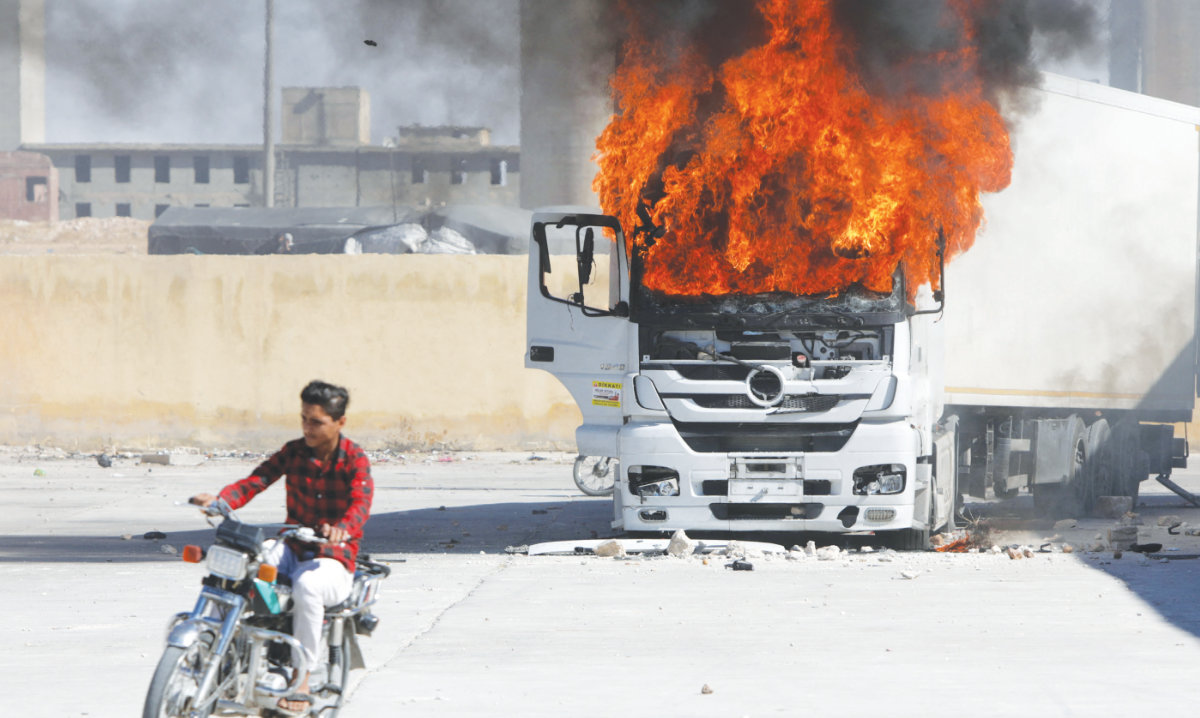
A man rides a motorcycle near a burning Turkish truck during protest sagainst Turkiye in Al-Bab, northern Syrian opposition-held region of Aleppo, on July 1, 2024. (AFP)
However, Kadkoy noted that the events in Kayseri underscore the policy’s failure.
“It is becoming harder for Turks and Syrians alike to make ends meet. Under similar conditions, almost universally, a tendency to blame others emerges. The same applies in Turkiye. Therefore, implementing humane, sustainable and respecting international law and human rights migration policy under a declining purchasing power due to high inflation is rather difficult.
Kadkoy emphasized that the recent riots in northern Syria are not solely due to Turkiye’s normalization efforts.
“The recent unrest in northern Syria is not exclusive to Turkiye’s statement about normalization with Syria a few days ago. One reason is the recent opening of an internal crossing, Abu Al-Zandeen, with Turkish-Russian consensus. The crossing connects Al-Bab in eastern Aleppo, (the) Euphrates Shield Zone, with the Syrian government in western Aleppo. The step generated reaction as the opening of the crossing meant dealing politically with the Syrian government — a taboo still in the northwest. Another reason has to do with Syrians’ long-standing discontent about the overall living conditions in the area. A third reason reflects Syrians’ dissatisfaction with the Syrian opposition’s failure to produce a democratic environment. Lastly, the violence in Kayseri where Syrians were subject to collective punishment over an alleged Syrian’s crime was that final straw the set off everything.”
Turkiye remains committed to UN Security Council resolutions that advocate for the voluntary, safe, and dignified return of refugees to Syria. However, experts caution that current conditions are far from meeting these standards.
Metin Corabatir, president of the Ankara-based Research Center on Asylum and Migration, said that any repatriation could only materialize after free and fair elections and the drafting of a new constitution in Syria, as mandated by the Security Council.
“Syrians in Turkiye feel very bad and unsafe after these incidents. Even Syrians with Turkish citizenship are living under the same fear. There is a horrifying hate speech that is becoming increasingly widespread. Political parties and some respected journalists are also fueling it. If this continues to spread, refugees will have nowhere to run, and their safety will be compromised,” Corabatir told Arab News.
Corabatir argues that the solution to the refugee crisis lies not in repatriation but in clarifying the legal status of refugees as they are still registered with “temporary protection” in the country.
“The anti-Syrian sentiment has turned into racism that vilifies Arabs. At this stage, at the very least, Erdogan and Ozgur Ozel, the leader of the main opposition CHP, need to come together and resolve this issue in cooperation,” he said.
Although Ankara has received billions of dollars in funding from international donors over the past decade, primarily from the EU to provide health care, education and employment opportunities for Syrians in the country, experts note that these projects are still a drop in the ocean to ensure a sustainable local integration especially amid deteriorating economic conditions.
Corabatir called for a tripartite agreement under UN supervision to facilitate the repatriation of refugees once safe conditions are established.
Zakira Hekmat, president of the Afghan Refugees Solidarity Association in Turkiye, resides in Kayseri. “Three Afghan youngsters were recently killed in Kayseri. There has been an organized anti-refugee sentiment in the region for a long time. We have been advising our community to remain silent during these chaotic times. People have come to our neighborhood and demolished shops. For the past three days, we have stayed in our homes out of fear. Many people cannot even buy bread and water. This situation will eventually impact the Turkish economy. Syrians, despite having work permits, cannot go to the shops in the industrial zone where they are employed.”
Pro-government journalist Abdulkadir Selvi suggested on Wednesday that Erdogan may meet Assad on the sidelines of the Shanghai Cooperation Organization meeting in Astana on 3-4 July as part of the new Turkiye-Syria rapprochement bid. However, there has been no official statement confirming any plans for such high-level backstage diplomacy.


