Russia’s Dagestan bans niqab over ‘threats’ after attacks

Russia’s FSB security service officers conduct an anti-terrorist operation in Dagestan. (AFP/File)
Short Url
Updated 03 July 2024
Follow

Russia’s Dagestan bans niqab over ‘threats’ after attacks

  • This veil is “temporarily prohibited until the elimination of existing threats,” said Dagestan’s highest religious body
  • Few details have surfaced about the identities and motivations of the attackers in Dagestan

MOSCOW: Russia’s southern Dagestan region on Wednesday issued a temporary ban against wearing the niqab in the Muslim-majority republic, citing security reasons after a recent attack against churches and synagogues.
This veil — which hides the entirety of a woman’s face with the exception of the eyes — is “temporarily prohibited until the elimination of existing threats,” said Dagestan’s highest religious body.
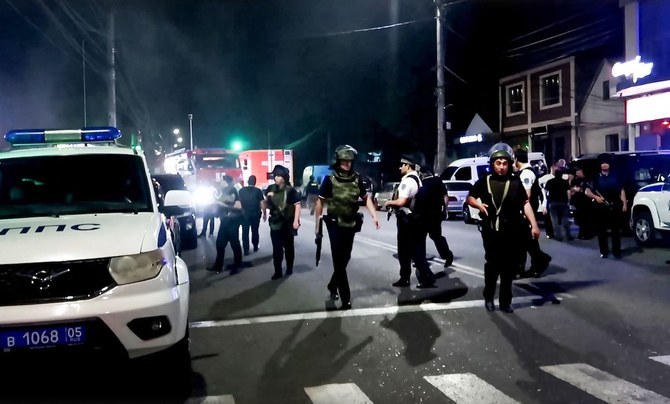
Last month, gunmen simultaneously attacked two churches, two synagogues and a police checkpoint in two cities in Dagestan, killing 22 people.
The attacks came just three months after Daesh fighters killed more than 140 in an assault on a Moscow concert hall, the deadliest terror attack in Russia for almost two decades.
Few details have surfaced about the identities and motivations of the attackers in Dagestan.
The incidents had echoes of the kind of insurgent violence that struck the North Caucasus during the 1990s and 2000s, however, the Kremlin has dismissed fears of a renewed wave of violent unrest.
In the 1990s, Moscow fought two wars for control of the neighboring Chechnya region, with President Vladimir Putin touted his success in quashing the insurgency at the start of his presidency.
Militants from Dagestan are known to have traveled to join Daesh in Syria.


Taiwan says Chinese drone made ‘provocative’ flight over South China Sea island

Updated 11 sec ago
Follow

Taiwan says Chinese drone made ‘provocative’ flight over South China Sea island

TAIPEI: A Chinese reconnaissance drone briefly flew over the Taiwan-controlled Pratas Islands at the top end of the South China Sea on Saturday, in ​what Taiwan’s defense ministry called a “provocative and irresponsible” move.
Democratically governed Taiwan, which China claims as its own territory, reports Chinese military activity around it on an almost daily basis, including drones though they very rarely enter Taiwanese airspace.
Taiwan’s defense ministry said the Chinese reconnaissance drone was detected around dawn on Saturday ‌approaching the Pratas ‌Islands and flew in its ‌airspace ⁠for ​eight ‌minutes at an altitude outside the range of anti-aircraft weapons.
“After our side broadcast warnings on international channels, it departed at 0548,” it said in a statement.
“Such highly provocative and irresponsible actions by the People’s Liberation Army seriously undermine regional peace and stability, violated international legal ⁠norms, and will inevitably be condemned,” it added.
Taiwan’s armed forces will ‌continue to maintain strict vigilance and monitoring, ‍and will respond in ‍accordance with the routine combat readiness rules, the ‍ministry said.
Calls to China’s defense ministry outside of office hours on a weekend went unanswered.
In 2022, Taiwan’s military for the first time shot down an unidentified civilian drone that ​entered its airspace near an islet off the Chinese coast controlled by Taiwan.
Lying roughly between ⁠southern Taiwan and Hong Kong, the Pratas are seen by some security experts as vulnerable to Chinese attack due to their distance — more than 400 km (250 miles) — from mainland Taiwan.
The Pratas, an atoll which is also a Taiwanese national park, are only lightly defended by Taiwan’s military, but lie at a highly strategic location at the top end of the disputed South China Sea.
China also views the Pratas as its ‌own territory.
Taiwan’s government rejects Beijing’s sovereignty claims.