

Pakistan petroleum union announces strike against new tax from July 5, government rejects ‘blackmailing’

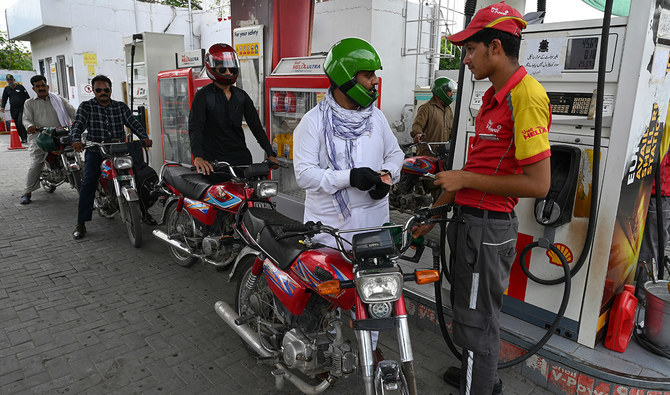
A worker pumps petrol in a motorbike at a fuel station in Rawalpindi on July 16, 2023. (AFP/File)
Short Url
Updated 03 July 2024
Follow

Pakistan petroleum union announces strike against new tax from July 5, government rejects ‘blackmailing’

  • Petroleum dealers association says government’s move to impose 0.5 percent advance tax will “devastate” their business
  • Pakistani official says government has taken steps to ensure “smooth” supply of petroleum products across the country 

ISLAMABAD: The Pakistan Petroleum Dealers Association (PPDA) have announced it would close petrol pumps across the country on July 5 to protest the government’s decision to impose an advance tax on turnover, saying the move would “devastate” their businesses already reeling from high taxes and inflation. 

Petroleum dealers in Pakistan are demanding the government withdraw an advance income tax of 0.5 percent imposed in the recently passed federal budget 2024-25.

Pakistan’s tax-heavy $67.76 billion budget for the new fiscal year came into effect on Monday amid an annual inflation projection of up to 13.5 percent for June. The ambitious budget with a challenging tax revenue target of Rs13 trillion ($46.66 billion) has drawn the ire of the government’s allies and opposition alike. The revenue collection target for the new fiscal year is almost 40 percent higher than the last fiscal year. 

The PPDA says its members are earning minimal profit due to staggering inflation and high taxes. Talks between the government and the association this week failed to break the deadlock between the two sides. 

“We are going on a nationwide strike starting July 5 and plan to close petrol pumps across the country,” PPDA Chairman Abdul Sami Khan told Arab News on Wednesday. 

“Our demand is simple: the government should immediately withdraw the advance tax decision.”

Khan said the move would “devastate” the petrol pump business in the country, adding that dealers would be left with no other option but to wind up their businesses for good if the government does not reverse its decision.

“We are ready to discuss our concerns and possible solutions with the government,” Khan said. “We request the prime minister, petroleum minister and finance minister to immediately abolish this tax, otherwise we will be unable to continue running our businesses.”

Imran Ahmed, the director general of oil at Pakistan’s petroleum ministry, rejected the strike call. He said the government would not entertain “blackmailing tactics” but was willing to discuss petroleum dealers’ genuine concerns. 

“We will not support the strike or such tactics,” he told Arab News. “This new advance tax applies to all traders, not only petroleum dealers.”

Ahmed said the government is in talks with the dealers and their representatives, whom he said have also met officials of the Federal Board of Revenue (FBR), Pakistan’s tax authority. 

He said the ministry has instructed oil marketing companies to keep as many sites open as possible to ensure a smooth supply of petroleum products in the country. 

“We have also instructed PSO [Pakistan State Oil] to ensure maximum supply and storage of petroleum products by keeping their sites open,” Ahmed said. 


Pakistan’s president defends ongoing strikes in Afghanistan, urges Kabul to dismantle militants

Updated 7 sec ago
Follow

Pakistan’s president defends ongoing strikes in Afghanistan, urges Kabul to dismantle militants

  • Afghanistan on Thursday launched attacks in retaliation for Pakistani airstrikes the previous Sunday
  • Pakistan’s military says it is only targeting Afghan military installations to avoid civilian casualties

ISLAMABAD: Pakistan’s president on Monday defended his country’s ongoing military strikes in neighboring Afghanistan, saying Islamabad tried all forms of diplomacy before targeting militants operating from Afghan territory, and called on the Taliban government in Kabul to disarm groups responsible for attacks in Pakistan.

Pakistan earlier said it is in “open war” with Afghanistan, alarming the international community. The border area remains a stronghold for militant organizations including Al-Qaeda and the Daesh (Islamic State) group.

“(The Afghan Taliban) must choose to dismantle the terror groups that survive on conflict and its war economy,” Asif Ali Zardari said during a speech to lawmakers, adding that “no state accepts serial attacks on its soil.”

Afghanistan on Thursday launched attacks in retaliation for Pakistani airstrikes the previous Sunday. Since then, Pakistan has carried out operations along the border, with Information Minister Attaullah Tarar claiming the killing of 435 Afghan forces and the capture of 31 Afghan positions.

Kabul has denied such claims.

In Afghanistan, the deputy government spokesman Hamdullah Fitrat said Pakistan’s military fired mortar shells at a refugee camp in eastern Kunar province, killing three children and injuring three others.

Afghanistan’s defense ministry said Afghan forces carried out strikes targeting a Pakistani military facility near Paktia province, causing “substantial losses and heavy casualties.”

Pakistan’s military did not respond to questions. It has said Pakistan is only targeting Afghan military installations to avoid civilian casualties.

Pakistan has witnessed a surge of violence in recent months and blames it on the outlawed Pakistani Taliban, known as Tehreek-e-Taliban Pakistan or TTP. It operates both inside Pakistan and from Afghan territory.
Islamabad accuses Afghanistan’s Taliban government of providing safe havens for the TTP, which Kabul denies.

The latest cross-border fighting ended a ceasefire brokered by Qatar and Turkiye in October. The two sides failed to reach a permanent agreement during talks in Istanbul.

Zardari reiterated Pakistan’s call for talks, saying, “We have never walked away from dialogue.”

The Pakistani leader again accused Afghanistan of acting as a proxy for India by sheltering militant groups.

“Stop being used by another country as a battlefield for their ambitions,” he said.

Zardari cited a recent report from the United Nations Security Council’s monitoring team that described the presence of militant groups in Afghanistan as an extra-regional threat.