

Pak-Russia not driven by geopolitics, relations with other countries, PM Sharif tells Putin

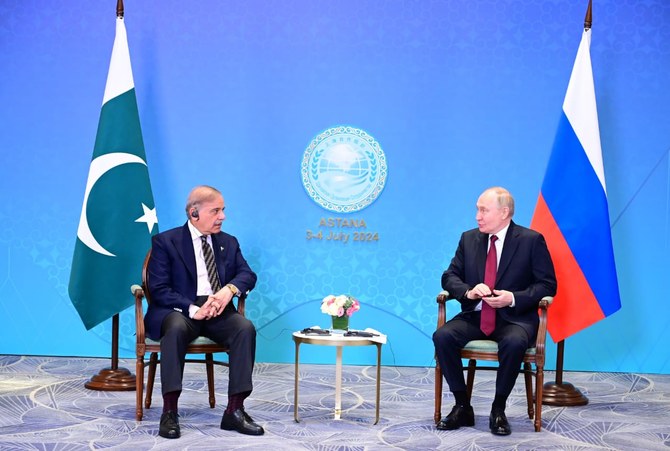
Pakistan Prime Minister Shehbaz Sharif meets Russian President Vladimir Putin at the sidelines of the Shanghai Cooperation Organization (SCO) leaders’ summit in Astana on July 3, 2024. (Government of Pakistan)
Short Url
Updated 03 July 2024
Follow

Pak-Russia not driven by geopolitics, relations with other countries, PM Sharif tells Putin

  • Sharif meets Russian President Vladimir Putin at sidelines of Shanghai Cooperation Organization summit in Astana 
  • Pakistani premier says both countries can overcome banking, financial issues to further enhance bilateral trade

ISLAMABAD: Prime Minister Shehbaz Sharif met Russian President Vladimir Putin at the sidelines of the Shanghai Cooperation Organization (SCO) leaders’ summit on Wednesday, saying that ties between both countries stand on their own strength and are not driven by “geopolitical contingencies” or Islamabad’s relations with other nations. 

Pakistan and Russia, once Cold War rivals, have warmed up to each other in recent years through regular business and trade interactions. As Islamabad seeks to enhance its role as a transit hub for landlocked economies in Central Asia, it has expressed interest in connecting with Russia through Central Asia for bilateral trade. 

Last year, Pakistan began making purchases of discounted Russian crude oil under a deal struck between Islamabad and Moscow. Pakistan also received its first shipment of liquified petroleum gas from Russia, marking Islamabad’s second major Russian energy purchase, despite Western powers’ move to impose sanctions on Moscow for invading Ukraine in 2022. 

Pakistan has carefully sought to balance its ties with Washington, a longtime bitter rival of Russia and China, as it moves to enhance trade with Moscow. 

“Your excellency, our relations stand on our own strength,” Sharif told Putin on the sidelines of the summit in Astana where leaders and diplomats from India, China, Turkiye, Iran, Kazakhstan, Kyrgyzstan, Tajikistan and Uzbekistan are also in attendance.

 “Neither our relations are driven by any geopolitical contingency nor these are impacted by our relations with other countries.”

The South Asian country notified a mechanism for barter trade with Russia, Iran and Afghanistan in February 2023, allowing state-owned enterprises and private sector entities to engage both in imports and export of goods.

Sharif recalled how Pakistan used to engage in barter trade with Russia during the 1950s and the 1960s, saying that Islamabad used to import heavy machinery from Moscow and exported leather goods and textile products to it.

“I think today is the time we can overcome financial and other banking issues by renewing our trade and expanding our trade under barter that will be very beneficial for Pakistan and overcome many problems,” he said. 

The Pakistani prime minister congratulated Putin on getting re-elected in March, hoping Russia would progress under his administration. 

He said both countries can enhance bilateral trade, which at the moment stood at $1 billion. 

Last year, Pakistan began making purchases of discounted Russian crude oil under a deal struck between Islamabad and Moscow. Pakistan also received its first shipment of liquified petroleum gas from Russia, marking Islamabad’s second major Russian energy purchase. 

“We received a shipment of oil from your great country and I am very grateful for that,” he said. “But we really need to move further in that direction.”


Pakistani, Bangladeshi officials reaffirm strong ties, discuss trade and regional issues

Updated 11 January 2026
Follow

Pakistani, Bangladeshi officials reaffirm strong ties, discuss trade and regional issues

  • The statement comes after Pakistani and Bangladeshi foreign ministry officials’ meeting in Jeddah on the sidelines of an OIC session
  • Pakistan, Bangladesh, which split in 1971, have moved closer since the ouster of former PM Sheikh Hasina, an India ally, in Aug. 2024

ISLAMABAD: Top Pakistani and Bangladeshi officials on Sunday reaffirmed the strength of their relations as they discussed bilateral, regional and global issues, the Pakistani foreign ministry said.

The statement came after a meeting between Pakistani Foreign Minister Ishaq Dar and Bangladesh’s Adviser on Foreign Affairs Touhid Hossain on the sidelines of an extraordinary session of the Organization of Islamic Cooperation (OIC) in Jeddah.

Pakistan and Bangladesh were part of the same country until Bangladesh’s secession following a bloody civil war in 1971, an event that long cast a shadow over bilateral ties. Both countries have moved closer since 2024, following the ouster of former premier Sheikh Hasina who was considered an India ally.

The two foreign ministry officials discussed a range of regional and global issues as well bilateral cooperation in diverse fields, according to a Pakistani foreign ministry statement.

“Both dignitaries expressed satisfaction over the robustness of Pakistan-Bangladesh relations,” the statement read. “They discussed bilateral relations in diverse fields, especially high-level exchanges, trade, and educational collaboration.”

Dar arrived in Saudi Arabia on Friday to attend the 22nd OIC Council of Foreign Ministers held in Jeddah on Jan. 10 to discuss Israel’s move last month to recognize Somaliland, a breakaway region of Somalia, as a separate nation. The act has drawn sharp criticism from Muslim nations worldwide.

Muslim countries, including Pakistan, believe the move could be part of Tel Aviv’s plan to forcibly relocate Palestinian Muslims to Somaliland. Several international news outlets last year reported that Israel had contacted Somaliland over the potential resettlement of Palestinians forcibly removed from Gaza.

“We believe that such recognition of an integral part of a sovereign state is not a diplomatic act, but an act of political aggression that sets a perilous precedent, threatening peace and security in the Horn of Africa, the Red Sea region, and beyond,” Dar told participants of the meeting in Jeddah.

The Pakistani foreign minister said Islamabad considers the move a flagrant violation of international law and a direct assault on the territorial integrity of Somalia. He called on all states to refrain from engaging with Somaliland authorities.