

Pakistani court grants bail to ex-PM Khan’s wife in land graft case— lawyer ​

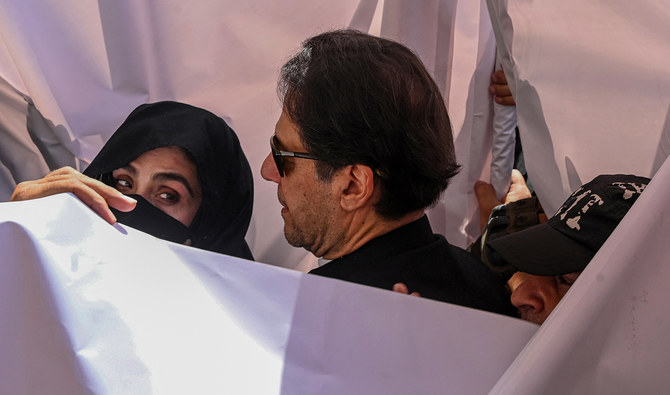
Former Pakistan Prime Minister Imran Khan (C) with his wife Bushra Bibi (L) arrive to appear at a high court in Lahore on May 15, 2023. (AFP/File)
Short Url
Updated 02 July 2024
Follow

Pakistani court grants bail to ex-PM Khan’s wife in land graft case— lawyer ​

  • Former premier, wife charged with receiving land worth millions of dollars as bribe from real estate tycoon
  • Despite bail, ex-PM Khan’s wife Bushra Wattoo will remain in prison due to her conviction in another case

ISLAMABAD: An accountability court in Pakistan’s Rawalpindi city on Tuesday granted pre-arrest bail to former prime minister Imran Khan’s wife in a corruption case, his lawyer confirmed, saying that no evidence had been found she had gained financial benefit from a trust. 

Government officials allege Khan, 71, and his third wife Bushra Wattoo received land worth millions of dollars as a bribe from a real estate tycoon Malik Riaz Hussain through the Al-Qadir Trust, a non-governmental welfare organization set up by Wattoo and Khan in 2018 when he was still in office.

The trust runs a university outside Islamabad devoted to spirituality and Islamic teachings, a project inspired by the former first lady, who is also commonly known as Bushra Bibi and has a reputation as a spiritual healer.

“NAB court confirmed pre-arrest bail of Bushra Bibi today in Al Qadir Trust 190 million pounds case,” Barrister Salman Safdar, Khan’s lawyer, wrote on social media platform X. 

“There was no evidence of financial gain; benefitting in any manner from the trust.” 

Khan was briefly arrested on May 9 in connection with the case, with riots breaking out throughout the country that saw military and government installations attacked. The former prime minister was released shortly but was arrested in August in a separate case related to the sale of state gifts illegally.

The National Accountability Bureau (NAB), Pakistan’s corruption watchdog, filed a reference against Khan in December 2023 in the case. In February this year, the former prime minister and Wattoo were indicted by an accountability court.

Despite the bail, however, Wattoo will stay in prison as she is also serving a sentence in another case, where a trial court declared her marriage to Khan in 2018 as unlawful. 

Local media reports said the prosecution presented three more witnesses in court during Tuesday’s hearing in the case, who were cross-examined by defense lawyers. The court summoned other witnesses in the next hearing, which was adjourned till July 5.

Khan, who is the founder of the Pakistan Tehreek-e-Insaf (PTI) party, has been in jail since last August and was convicted in some cases ahead of a national election in February. He is also fighting dozens of other cases which are continuing. Khan and his party say the charges were politically motivated to thwart his return to power.

In recent months, Pakistani courts have suspended Khan’s jail sentences in two cases about the illegal acquisition and sale of state gifts and also overturned his conviction on charges of leaking state secrets.
However, he has remained in prison due to the unlawful marriage case conviction. Khan also faces a trial under anti-terrorism charges in connection with the May 9 violence. 

With input from Reuters


Pakistan reviews austerity measures amid Middle East crisis, urges strict nationwide implementation

Updated 11 March 2026
Follow

Pakistan reviews austerity measures amid Middle East crisis, urges strict nationwide implementation

  • Deputy Prime Minister Ishaq Dar chairs review meeting of austerity steps
  • Officials briefed on salary cuts, school closures, four‑day week, petrol conservation

ISLAMABAD: Pakistan’s government on Wednesday assessed progress on a sweeping set of austerity measures introduced to mitigate the country’s economic strain from sharply rising global oil prices and supply disruptions linked to the ongoing war in the Middle East.

Prime Minister Shehbaz Sharif this week announced a series of austerity steps, including a four‑day work week for government offices, requiring 50  percent of staff to work from home, cutting fuel allowances for official vehicles by half, grounding up to 60  percent of the government fleet and closing all schools for two weeks to conserve fuel amid the global oil crisis.

The measures were unveiled in response to global oil market volatility triggered by the conflict involving the United States, Israel and Iran, which has disrupted supply routes such as the Strait of Hormuz and pushed crude prices sharply higher, straining Pakistan’s heavily import‑dependent energy sector.

“The meeting stressed the importance of strict and transparent adherence to the austerity measures, promoting fiscal responsibility and prudent use of public resources,” Deputy Prime Minister and Foreign Minister Senator Mohammad Ishaq Dar said in a statement.

He was chairing a meeting of the Committee for Monitoring and Implementation of Conservation and Additional Austerity Measures, constituted under the directions of the PM, bringing together federal and provincial officials to review execution of the broad cost‑cutting plan. 

Dar emphasized the government’s commitment to enforcing the PM’s austerity steps nationwide. The committee’s review also covered reductions in departmental expenditure, deductions from salaries of senior officials earning over Rs. 300,000 ($1,120), and coordination with provincial administrations to ensure uniform implementation of the plan.

Participants at the meeting reiterated that all ministries and divisions must continue strict monitoring and reporting, with transparent oversight mechanisms, as Pakistan navigates the economic pressures from the prolonged Middle East crisis and its fallout on global energy and trade markets.