

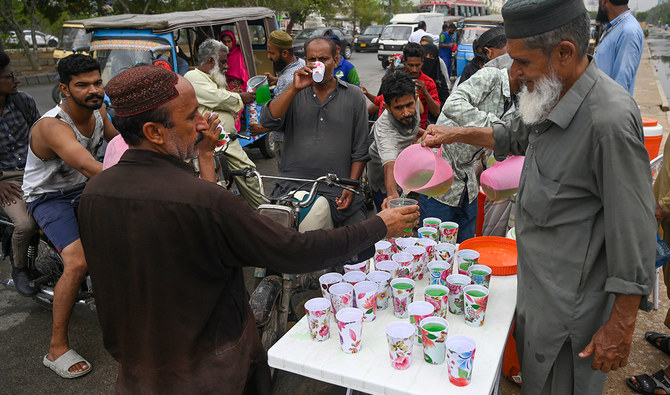

KARACHI: Pakistan’s Chief Meteorologist Dr. Sardar Sarfaraz said on Monday an eight-day heat wave in Pakistan’s largest city of Karachi was over with at least 49 dead, while relief agencies and health experts disputed the government figures, saying the death toll was likely much higher.
Pakistan has been in the grips of a heat wave since May, with temperatures rising above 52 degrees Celsius (125.6 degrees Fahrenheit) in the southern province of Sindh, of which the port city of Karachi is the capital. For over a week now, Karachi has seen an unusual spike in temperatures, with the mercury rising above 40 °C (104 °F) throughout last weekend and reaching 47.2 °C (117 °F) on June 25.
“As of today, the sea breeze has been restored and the heat wave is over,” Dr. Sarfaraz told Arab News. “During four of the eight heat wave days, temperatures reached up to 42°C but felt like 54°C due to low-pressure formation over southeast Karachi.”
Dr. Sarfaraz noted that this heat wave was the longest in Karachi since June 2015 when a “killer” episode claimed over 2,000 lives. He said 49 people had died in Karachi during this heat wave.
However, Muhammad Amin from the Edhi Foundation charity, one of the largest in Pakistan, estimated that the death toll from heat-induced causes was much higher given the number of bodies received at morgues.
“We have received 1,309 dead bodies since June 19, which is a significant increase, almost three times higher, than our average during this period,” Amin said, although he was unable to confirm if all the bodies received by Edhi were of people who had died due to complications from the heat wave.
Dr. Irfan Siddiqui, the head of emergency services at Jinnah Hospital, one of the biggest government-operated hospitals in Karachi, said the figures compiled by the government were authentic.
“We have reported these figures [49] after ascertaining the cause of death. One cannot attribute a death to a certain condition on mere speculations,” he said about the Edhi estimates.
However, Dr. Siddiqui acknowledged that some heat wave deaths may have gone unreported.
“While one cannot rely solely on figures from rescue services, the government’s data may also be inaccurate,” Dr. Abdullah Muttaqi, a senior health practitioner, told Arab News. “If morgues are receiving a large number of bodies during this period, heat likely played a role, but without medical confirmation of the cause, these figures cannot be cited.
“In the case of the government, figures are likely underreported, not properly documented, and inaccurately presented.”
Dr. Qaiser Sajjad, former general secretary of the Pakistan Medical Association, also said morgues had been receiving more bodies than usual and advised that the “government should sit with rescue services and rationalize its data.”
Pakistan is one of the countries most vulnerable to climate change. In 2022, devastating rains and floods killed 1,739 people, destroyed 2 million homes, and submerged as much as one-third of the country under water. The deluges also caused more than $30 billion in damages to Pakistan’s already cash-strapped economy.


