

Seven dead in torrential rains in southwest Pakistan amid warnings of more pre-monsoon showers

Onlookers gaze towards municipal workers using heavy machinery to level the ground after damage due to floodwaters following heavy rains on the outskirts of Quetta on April 15, 2024. (AFP/File)
Short Url
Updated 30 June 2024
Follow

Seven dead in torrential rains in southwest Pakistan amid warnings of more pre-monsoon showers

  • Provincial Disaster Management Authority calls Dera Bugti the most highly affected area due to the rainfall
  • Balochistan also bore a significant brunt of the devastation caused by heavy monsoon rains two years ago

QUETTA: Torrential rains killed seven people, including two children, and injured at least 25 in southwest Pakistan, a Provincial Disaster Management Authority (PDMA) official in Balochistan said on Sunday, adding that Dera Bugti district, about 360 kilometers from Quetta, was the most affected area.
Pakistan’s struggle with natural disasters intensified in 2022, as unprecedented monsoon rains wreaked havoc nationwide, claiming 1,700 lives and resulting in an estimated $35 billion in financial losses.
The country’s southern belt, including Balochistan, bore a significant brunt of the devastation.
Pakistan contributes less than one percent to global carbon emissions, though it ranks among the top ten nations most vulnerable to climate change.
“Relief operation is underway, and we have provided food items and tents to the affected,” Muhammad Younus, who supervises the PDMA emergency cell, told Arab News while confirming the number of fatalities. “Officials are doing the damage assessment survey.”
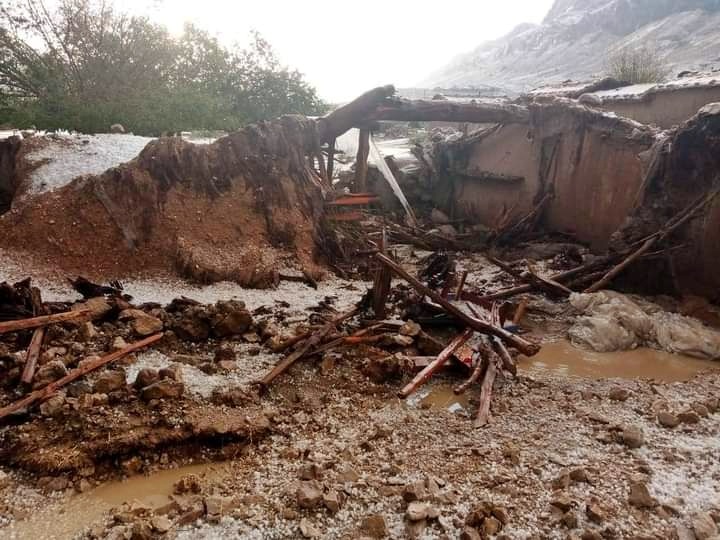


The photo taken on June 30, 2024, shows a house destroyed by torrential rains in the southwest Pakistan. (AN Photo)


Younus informed the province expected pre-monsoon rainfall early next month, starting from July 7.
“Relevant departments have been asked to clear the water channels before any disaster,” he added.
Speaking to Arab News, Riaz Ali, a resident of Sajjo Colony in Sui, a town in Dera Bugti district, said he lost his 17-year-old son a day earlier when the roof of a local restaurant collapsed due to heavy rain.
“It was 4 or 5 PM when the heavy rainstorm began and lasted for 30 minutes,” he recalled. “In the evening, I received a call from my neighbor, who works at a hospital, to tell me that my son had died. I went to the hospital to receive his body. He had been injured in his head.”
The current situation has reminded the residents of the province of the catastrophe two years ago when heavy rains led to flash floods that destroyed houses, agricultural fields and public infrastructure in the province.
Sannaullah Panezai, an associate professor of geography at the University of Balochistan, noted the rise in erratic weather patterns in Pakistan.
“Such rains mostly began by the end of July and lasted till September in the past,” he said, pointing out the region did not receive much rain in 2023. “Climate change has been affecting rainfall and causing flash floods.”
The recent rains in Balochistan have also caused concern for agricultural production in the area.
“Our garden of apples has been partially affected,” Fazal Deen, who has his own fields in Ziarat, told Arab News. “We have also planted vegetables on 10 acres of land that have been completely destroyed.”


Pakistani, Bangladeshi officials discuss trade, investment and aviation as ties thaw

Updated 28 December 2025
Follow

Pakistani, Bangladeshi officials discuss trade, investment and aviation as ties thaw

  • Pakistan and Bangladesh were once one nation, but they split in 1971 as a result of a bloody civil war
  • Ties between Pakistan, Bangladesh have warmed up since last year and both nations have resumed sea trade

ISLAMABAD: Pakistan's High Commissioner to Bangladesh Imran Haider on Sunday met Chief Adviser Muhammad Yunus in Dhaka, the latter's office said on, with the two figures discussing trade, investment and aviation.

Pakistan and Bangladesh were once one nation, but they split in 1971 as a result of a bloody civil war, which saw the part previously referred to as East Pakistan seceding to form the independent nation of Bangladesh.

Ties between Pakistan and Bangladesh have warmed up since former prime minister Sheikh Hasina’s ouster as a result of a student-led uprising in August 2024. Relations remain frosty between Dhaka and New Delhi over India’s decision to grant asylum to Hasina.

Pakistan has attempted to forge closer ties with Bangladesh in recent months and both South Asian nations last year began sea trade, followed by efforts to expand government-to-government commerce.

"During the meeting, both sides discussed ways to expand cooperation in trade, investment, and aviation as well as scaling up cultural, educational and medical exchanges to further strengthen bilateral relations between the two South Asian nations," Yunus's office said in a statement on X.

In 2023-24 Pakistan exported goods worth $661 million to Bangladesh, while its imports were only $57 million, according to the Trade Development Authority of Pakistan. In Aug. this year, the Pakistani and Bangladeshi commerce ministries signed a memorandum of understanding to establish a Joint Working Group on Trade, aiming to raise their bilateral trade volume to $1 billion in the financial year that began in July.

The Pakistani high commissioner noted that bilateral trade has recorded a 20 percent growth compared to last year, with business communities from both countries actively exploring new investment opportunities, according to the statement.

He highlighted a significant increase in cultural exchanges, adding that Bangladeshi students have shown strong interest in higher education opportunities in Pakistan, particularly in medical sciences, nanotechnology, and artificial intelligence. Haider also said that Dhaka-Karachi direct flights are expected to start in January.

"Chief Adviser Professor Muhammad Yunus welcomed the growing interactions between the two countries and emphasized the importance of increased visits as well as cultural, educational and people-to-people exchanges among SAARC (South Asian Association for Regional Cooperation) member states," the statement read.

"Professor Yunus also underscored the need to further boost Bangladesh–Pakistan trade and expressed hope that during Mr. Haider’s tenure, both countries would explore new avenues for investment and joint venture businesses."