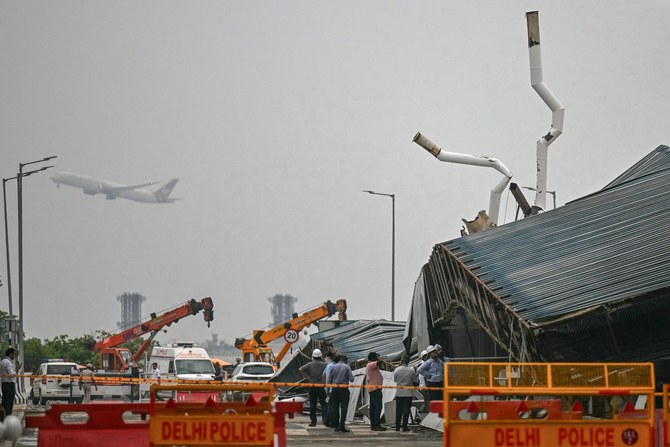

NEW DELHI: The recent deadly roof collapse at New Delhi's main airport was the latest in a series of construction safety incidents in the country, triggering concerns over India’s multibillion-dollar infrastructure drive.
A portion of a canopy and pillars at a departure terminal in the Indira Gandhi International Airport, one of the country’s busiest, collapsed following heavy rain on Friday morning, killing at least one person and injuring several others.
The collapse also caused a temporary suspension of operations at the airport’s Terminal 1, which is used for domestic flights, impacting the travel plans of thousands of people.
It joins a growing list of infrastructure incidents in India in recent years that have raised questions about the rapid pace of mega-development projects in the country under Prime Minister Narendra Modi.
Narayan Moorthy, a Delhi-based architect, blamed it on many factors, including “slipshod work culture,” frequent use of poor-quality materials, “reckless hurry towards the end of projects so that some politician can inaugurate it on a pre-decided and politically significant date,” and lack of maintenance after construction.
“This whole cocktail comes together to result in unmitigated disasters, like the collapsed airport roof in Delhi that killed one hapless soul and injured many others … Similar is the case of the roof of the brand-new Jabalpur airport that thankfully had no human casualties but exposes our systemic rot,” he told Arab News.
“We have much to be ashamed of in the quality of our supposedly ‘world-class’ constructions.”
A day before the Delhi accident, a part of the canopy of Jabalpur airport in Rajasthan collapsed under heavy rains, while on Saturday, a canopy fell down at the passenger pickup area at Rajkot airport in Gujarat.
In the eastern state of Bihar, four bridges also recently collapsed and an $80 million underpass in Delhi, which was inaugurated just ahead of India’s hosting of the G20 summit last year, has been waterlogged for several days, disrupting traffic in Delhi’s main thoroughfare.
Under Modi’s building spree, about 44.4 trillion rupees ($532 billion) in new infrastructure will become operational over the next two years, according to Bloomberg Economics.
Modi has presided over many ribbon-cutting ceremonies of these projects, as modernizing infrastructure was a key part of his campaign during this year’s national election, when he won a third term as India’s premier. Over the past decade, his government said it has built 80 new airports, upgraded railways and expanded highways by thousands of kilometers.
The projects have been criticized by India’s opposition leaders, with Mallikarjun Kharge, president of the Indian National Congress party, among the latest to accuse Modi’s government of corruption following Friday’s incident.
“Corruption and criminal negligence is responsible for the collapse of shoddy infrastructure falling like a deck of cards, in the past 10 years of Modi Govt,” Kharge wrote on X.
Niranjan Sahoo, a senior fellow at the Observer Research Foundation in New Delhi, highlighted how infrastructure was “turned into a vote bank ploy” under Modi’s government at an unmatched level.
“While the government might have good intent to build infrastructure at a rapid pace to match the requirements of a growing nation, (it) is done without adequate attention to their up-keeping, reliable maintenance and auditing,” Sahoo told Arab News.
“Never before has the country witnessed a kind of infrastructure blitz largely timed before the elections,” he added. “In a sense, infrastructure fits into populist narratives of taking India to the comity of great powers. However, the recent incidents badly expose India’s ambition and capabilities.”
Prof. A.K. Gosain, a civil engineer at the Indian Institute of Technology in Delhi said one of the major reasons for infrastructural failures can be traced back to “falling quality” of construction, adding that “there is no accountability at the top,” leaving people at the lower levels as scapegoats whenever problems arise.
Anuj Srivastava, an architect from the School of Planning and Architecture in the Indian capital and a veteran of the Corps of Engineers of the Indian Army, also highlighted the lack of maintenance and accountability in India’s infrastructure projects and the indifference toward the environment amid a rapidly changing climate.
“The reason for accidents and collapse of infrastructure is the lack of concern for the environment and the haste in planning and executing the project, proving the adage ‘haste makes waste’,” Srivastava told Arab News.
“Infrastructure disaster damages India’s reputation in the world. In the unseemly haste to build ‘world-class infrastructure’ in a hurry and its subsequent collapse, irreparable damage is being caused to India’s reputation.”