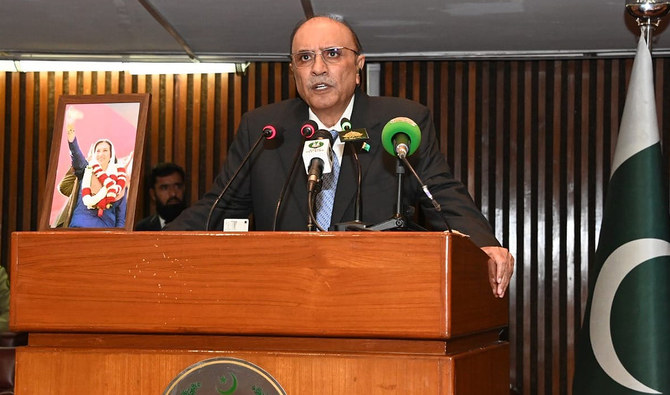
ISLAMABAD: Pakistani President Asif Ali Zardari has signed the Finance Bill 2024-25 into law, state-run media reported on Sunday, with the newly announced tax-laden budget to go into effect from tomorrow, Monday, the beginning of the new fiscal year.
Parliament passed the government’s finance bill on Friday amid an annual inflation projection of up to 13.5 percent for June. The bill comes ahead of more talks with the IMF for a loan of up to $8 billion to avert a debt default for Pakistan, the slowest-growing economy in South Asia.
“President Asif Ali Zardari has given assent to the Finance Bill 2024-25 under Article 75 of the Constitution for next year’s federal budget,” Radio Pakistan said on Sunday. “The Finance Bill will be applicable from July 1.”
The government presented the national budget on June 12 with a challenging tax revenue target of 13 trillion rupees ($46.66 billion) for the year starting July 1, up about 40 percent from the current year, to strengthen the case for a new rescue deal with the international money lender.
The budget is gearing the country toward “an era of sustainable and inclusive growth,” a finance ministry report issued on Friday said, projecting annual consumer price inflation for June 2024 between 12.5 percent to 13.5 percent, up from 11.8 percent in May.
The rise in the tax target is made up of a 48 percent increase in direct taxes and a 35 percent hike in indirect taxes over revised estimates of the current year. Non-tax revenue, including petroleum levies, is seen increasing by 64 percent.
The tax would increase to 18 percent on textile and leather products as well as mobile phones besides a hike in the tax on capital gains from real estate.
Workers will also get hit with more direct tax on income.
Opposition parties, mainly parliamentarians backed by the jailed former Prime Minister Imran Khan, and top trade bodies have rejected the budget, saying it will be highly inflationary and lead to industry shutdowns.
Pakistan’s central bank has also warned of possible inflationary effects from the budget, saying limited progress in structural reforms to broaden the tax base meant increased revenue must come from hiking taxes.
The upcoming year’s growth target has been set at 3.6 percent with inflation projected at 12 percent.
Pakistan has projected a sharp drop in its fiscal deficit for the new financial year to 5.9 percent of gross domestic product (GDP), from an upwardly revised estimate of 7.4 percent for the current year.
Since 2022, Islamabad has taken painful measures demanded by the IMF for the last bailout loan, which included hiking fuel and energy prices, causing prices of essential commodities to skyrocket. Inflation surged to 38 percent in May 2023 before dropping to a 30-month low of 11.8 percent in May 2024.
With inputs from Reuters


![]()

Pakistan president gives assent to tax-laden budget coming into effect tomorrow
Short Url
https://arab.news/jc4u4
Pakistan president gives assent to tax-laden budget coming into effect tomorrow
- Bill comes ahead of more talks with IMF for fresh bailout loan
- Opposition parties, major trade bodies have rejected the budget
Latest updates


© 2026 SAUDI RESEARCH & PUBLISHING COMPANY, All Rights Reserved And subject to Terms of Use Agreement.