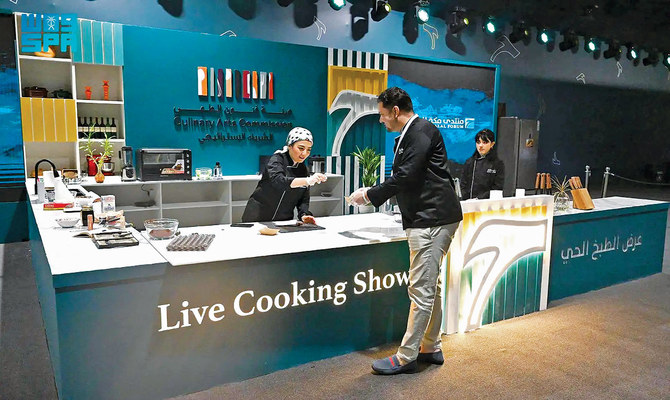

JEDDAH: Saudi Arabia stands at the forefront of the global halal product industry, capitalizing on its unique status as the birthplace of Islam, thus earning the trust of around 2 billion Muslims worldwide.
This unparalleled position imbues Saudi halal regulations and certifications with a high degree of religious authenticity and credibility, making them highly respected and sought after worldwide. The Kingdom’s regulatory framework, spearheaded by key bodies such as the Saudi Food and Drug Authority, ensures stringent compliance with halal standards, reinforcing its leadership in the market.
The Kingdom’s importance in the sector was underscored during the inaugural edition of the Makkah Halal Forum, held in January and attended by Saudi Minister of Commerce Majid bin Abdullah Al-Qasabi. The minister pointed out that the industry is one of the most rapidly expanding sectors globally.
“Presently, the food market is valued at approximately $2.5 trillion, and is expected to reach $5.8 trillion in 2033.” the minister said at that time.
As part of its Vision 2030 initiative, Saudi Arabia is actively fostering innovation and investment in the halal sector, aiming to diversify its economy and expand its influence in the global halal market.
Through strategic collaborations, international forums like the Makkah Halal Forum, and advanced certification processes, Saudi Arabia is not only meeting the growing global demand for halal products but also shaping the future of the industry.
In a recent interview with Arab News, Yousuf Khalawi, secretary-general of the Islamic Chamber of Commerce and Development, highlighted the significant regulations overseeing the production and certification of halal products in Saudi Arabia.
He emphasized that key regulatory bodies governing the halal industry in the Kingdom include the Saudi Food and Drug Authority, the Saudi Standards, Metrology and Quality Organization, and the Saudi Accreditation Center.
“The government of Saudi Arabia regulates the halal market using the GSO 2055-1:2015 (Gulf Standardization Organization), which sets the general requirements for halal food throughout the production chain,” Khalawi said. He added that companies that deal in halal products need to be certified for compliance to Saudi standards by Saudi accredited conformity assessment bodies.
Khalawi pointed out that while many countries have other halal standards and regulations, the Islamic Chamber’s halal conferences, held around the world, are striving to pave the way for businesses to navigate such different standards and regulatory requirements.
“In the meanwhile, and through the Islamic Chamber halal services, we strive to simplify companies’ compliance with multiple standards through our unique auditing process that combines standards using artificial intelligence algorithms and ends with granting a halal certificate which can be verified using simple quick-response code readers,” he said. Commenting on Saudi Arabia’s position as the birthplace of Islam, influencing consumer perceptions and demand for halal products globally, the secretary general said that this position adds a layer of trust and potential influence in the global halal market, but it is not the only factor.
“Saudi Arabia’s status as the Islamic holy land imbues their halal regulations with a perception of greater authenticity and religious legitimacy. Some Muslim consumers might view products originating from or certified by Saudi Arabia as more trustworthy in adhering to Islamic principles,” he said.
He added: “Manafea emphasized those facts and organized the Makkah Halal Forum to be the platform where halal leaders from all over the world meet to shape the halal future.”
In 2022, the Makkah and Madinah chamber, along with the Islamic Chamber, signed the Manafea agreement, which aims to transform the two holy cities into hubs for financial and business activities in the Islamic world.
From another perspective, he said, Saudi Arabia is a major consumer and investor in the halal industry. This gives the country significant influence in shaping the global halal market and that is why the Halal Product Development Company was the strategic partner sponsoring Makkah Halal Forum.
Khalawi shed light on the strategies Saudi Arabia has employed to take its halal products to international markets, saying that the Saudi Halal Center and its collaboration with the Saudi Exports Development Authority streamline the certification process for exporters.
“This aims to make Saudi certification more attractive and user-friendly for international companies. Saudi Arabia promotes its halal standards – based on GSO 2055-1 – as a globally recognized benchmark for halal production. This leverages their position as the birthplace of Islam to enhance the credibility of their certifications,” he said.

Saudi Arabia’s status as the Islamic holy land imbues their halal regulations with a perception of greater authenticity and religious legitimacy.
Yousuf Khalawi, Secretary-general of the Islamic Chamber of Commerce and Development
The official added that to help Saudi business reach trade partners around the globe, they are availing halal exchange, HalEx, an online platform for halal products and services exchange, operated by the Islamic Chamber’s halal services and allowing only halal products to be listed.
Moreover, Vision 2030’s focus on economic diversification presents an opportunity to attract investment in the Saudi halal industry.
Khalawi added that in the latest Makkah Halal Forum, 21 presidents of Muslim countries’ chambers of commerce attended the event to network and discuss business.
Elaborating on how Saudi Arabia is supporting the development of the halal industry within the country, he said that as part of Vision 2030, the national economic diversification plan prioritizes attracting investment in the halal sector.
“This fosters innovation and the development of new products and technologies to meet the evolving demands of the global halal market. The Saudi government is actively supporting the development of the halal industry within the country, the Halal Products Development Company plays a key role seeking partnerships with foreign companies to establish production facilities in Saudi Arabia. This strategy aims to create a robust domestic halal industry with the capacity to serve international markets,” Khalawi said.
Giving an idea about how Saudi Arabia is collaborating with other countries and organizations to promote halal standards and trade facilitation on a global scale, the Islamic Chamber’s secretary-general said that Saudi Arabia is a key player in shaping the global halal landscape through its collaborations with international organizations and bilateral agreements.
“Saudi Arabia works closely with the Organization of Islamic Cooperation to achieve harmonization of halal standards across member states and catalyst trade. Manafea is striving to bridge the gaps between countries through the Makkah Halal Forum where major players in the global halal economy meet,” he concluded.
Karim Chehade, associate partner at Bain & Co. highlighted the key factors driving the growth of the global halal product industry, emphasizing that Muslims represented around 12 percent of the world population in the beginning of the last century, but now account for nearly 25 percent.
“This number grew over the years to reach 2 billion today … with further rise expected in the future to 2.8 billion in 2050 – accounting for around 30 percent of the global population,” he said.
Chehade added that purchasing power per Muslim around the world is also on the rise, and said: “On the supply side, companies around the world have adapted their offering to meet this growing demand.
“Food sector multinationals have widened their portfolio to include halal-certified SKUs. Other sectors such as pharmaceuticals, cosmetics, fashion have also tailored part or the entirety of their portfolio to ensure they are halal-compliant.”
He went on to say that technology advancement and automation is another key factor, leading to higher productivity levels and increased yields, and making it financially sustainable for companies to meet halal standards, typically more stringent, while remaining competitive with main market leaders
Moreover, Chehade believes the wider assortment of halal products, driven both by new entrants and market incumbents, have improved the perceived quality, leveling it to non-halal offering and making it attractive to a non-Muslim population that is interested in the overall value proposition offered rather than the religious aspect.
“Also, governments of Muslim countries around the world are becoming more active in supporting their local champions to ensure a wider presence in local and international markets,” he said.
“Private sector companies have evolved from ensuring to meet halal certification requirements to now investing in research and development to create new halal products that meet the evolving needs and preferences of consumers,” Chehade added.
Religious institutions also play a role in shaping the halal product industry in Saudi Arabia with the Islamic Fiqh Academy, an international organization, providing guidelines and recommendations for the certification of halal products, the Bain & Co. official said, noting that many halal certification bodies follow these guidelines to ensure that their products are in compliance with Islamic laws and regulations.
Speaking about the challenger and opportunities facing the halal product industry in Saudi Arabia, both domestically and internationally, Chehade pointed out that some of the challenges include the ability for companies to scale, operational complexity, and international regulations, as well as the recent growing Islamophobia sentiment coupled with unfavorable macro-conditions could also play a role in limiting halal products consumption in selected non-Muslim countries.
As for the opportunities, the Bain & Co. associate partner highlighted growing global demand, diversification of products, and Saudi Arabia’s position as a trusted halal exporter as key opportunities.
Explaining how Saudi Arabia’s position in the halal product industry contributes to its broader economic goals and strategies, Chehade stated that the development of a strong industry in this arena serves the Vision 2030 objectives by diversifying the economy.
“The halal industry is a significant contributor to Saudi non-oil exports. The country’s position in the industry has enabled it to increase its exports of halal products to other countries, particularly in Asia and Africa,” he said.
The halal sector is also a significant employer in Saudi Arabia, providing jobs for both men and women in various areas, including manufacturing, distribution, and certification.
“Also, the halal product industry is closely linked to Islamic values, and the Saudi government has identified it as a means of fostering Islamic values of moderation and tolerance,” he concluded.