Police officer wounded, ‘attacker’ killed in front of Israeli embassy in Belgrade: minister

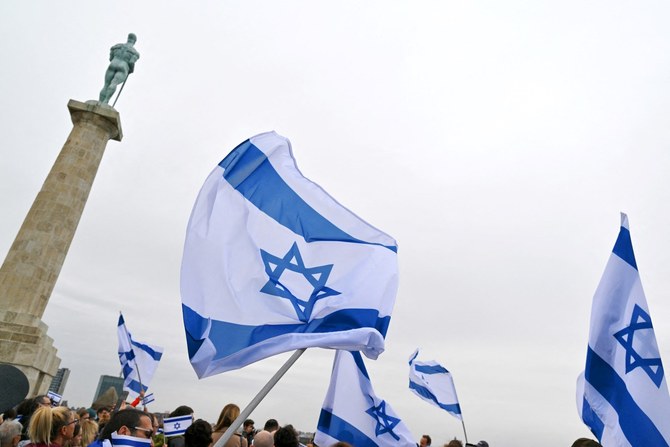
Protestors wave Israeli flags during the "Walk for peace in Israel" in support of the people of Israel, in Belgrade on October 15, 2023, following the October 7 Hamas attacks in Israel. (AFP)
Short Url
Updated 29 June 2024
Follow

Police officer wounded, ‘attacker’ killed in front of Israeli embassy in Belgrade: minister

  • The officer “used a weapon in self-defense and defeated the attacker, who died as a result of his injuries”

BELGRADE: An attacker who fired a crossbow at a police officer guarding the Israeli embassy in Belgrade was shot and killed on Saturday in what Interior Minister Ivica Dacic called a terrorist attack against Serbia.
The policeman is in a life-threatening condition and is undergoing surgery, Serbian news agency Tanjug quoted Dacic as saying. No embassy employees were wounded, the Israeli foreign ministry said.
Dacic said the police officer who was attacked was hit in the neck with an arrow and fired several shots at the attacker, killing him.
“This is a terrorist attack against Serbia,” he said in the statement carried by Tanjug.
He said that several people believed to have been linked to the incident had been arrested.
“There are some indications that they (those arrested) are already known to security services and we are talking about the Wahhabi organization, but that is not confirmed,” Dacic said, referring to a strict school of Islam.
Israel’s foreign ministry said that there had been “an attempted terrorist attack in the vicinity of the Israeli embassy in Belgrade.”
“The embassy is closed and no employee of the embassy was injured. The circumstances of the incident are being investigated,” its statement said.
Israel-linked institutions around the world have been on high alert for attacks and protests since Israel launched its war to eliminate Hamas in the Palestinian enclave of Gaza, after the Islamist militant group led deadly attacks on southern Israel on Oct. 7, 2023.
The police officer was in a guard house and the attacker had approached him several times asking him where a museum was. He carried a bag from which at one point he took the crossbow and shot the guard, Dacic said.
Police investigators in white forensic suits surrounded the body of the suspect on the street outside the building, which was swarmed with police vehicles.
In 2009, a Serbian court sentenced four Muslims, followers of the puritanical Sunni Wahhabi sect, to prison for plotting to attack a football stadium in a southern town of Novi Pazar, the capital of Serbia’s Sandzak region, where the majority of the population are moderate Muslims.


Unprecedented gagging order over Afghan data breach should have been avoided, former secretary says

Updated 5 sec ago
Follow

Unprecedented gagging order over Afghan data breach should have been avoided, former secretary says

  • Ben Wallace tells MPs that he had ordered time-limited injunction to protect lives of Afghan veterans
  • Sensitive details of thousands was leaked via email mistake because ‘someone didn’t do their job’ 

LONDON: The former UK defense secretary has said he would not have proposed a secret gagging order to conceal the catastrophic data breach that threatened the lives of thousands of Afghans.

Ben Wallace told MPs on Tuesday that he had ordered a time-limited injunction to protect the news of the data leak, The Independent reported.

At the time, in mid-2023, the Ministry of Defence had scrambled the learn the source of the leak, which took place when an official accidentally emailed a sensitive spreadsheet containing Afghans’ contact details outside of the ministry.

It led to the publication of the identities of thousands of Afghans who had served alongside British forces during the war against the Taliban, placing them at risk of reprisal.

They were secretly relocated to the UK, and the leak was only revealed to the British public when a High Court judge lifted a superinjunction last year.

It followed a longtime lobbying effort by The Independent and other news organizations to have the details of the leak released.

Wallace told MPs: “We are not covering up our mistakes. The priority is to protect the people in Afghanistan and then open it up to the public. We need to say a certain amount are out of danger.”

On the indefinite injunction, he added: “I didn’t think it was the right thing to do; I didn’t think it was necessary.

“I said, ‘we’re not doing that.’ The only thing we’re going to do, is we need to basically hold off in public until we get to the bottom of the threat these people are under. I said we won’t cover up our mistakes; we’ll talk about them.”

The rules surrounding a superinjunction forbid even mentioning its existence.

Wallace said: “You can have an injunction, I think, without reporting the contents … a superinjunction; my understanding is you can’t even say there’s an injunction. I think I would never have been in that space. Public bodies are accountable. If necessary you could even ring up the journalist and say ‘please hold off, people are at risk.’ Most journalists don’t want to put people at risk.”

The superinjunction was applied by a judge shortly after Wallace had left government.

It came after the MoD applied to the High Court for a regular injunction.

Grant Shapps, the subsequent defense secretary, then maintained the gagging order until the 2024 general election, when the Labour opposition took government.

Wallace blamed the 2022 breach on negligence, adding: “Someone didn’t do their job.”

The former defense secretary had implemented new checking procedures in the ministry after another Afghan data breach, but that “that clearly didn’t happen on this occasion; someone clearly didn’t do their job,” he told MPs.

Wallace said that military and defense spending is not a priority for voters, “partly because they don’t know” the true nature of the threat facing Britain.