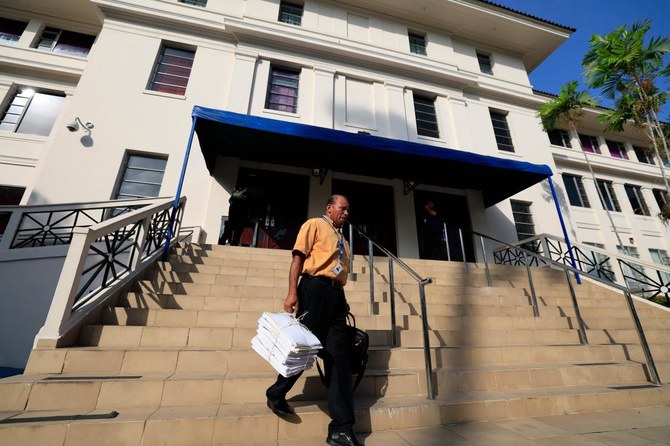
PANAMA CITY: A Panamanian court on Friday acquitted 28 people charged with money laundering at the center of the “Panama Papers” scandal, the court said.
Judge Baloisa Marquinez “acquitted 28 people accused... of money laundering” relating to the now-defunct Panamanian law firm Mossack Fonseca, the court said in a statement.
Among those acquitted were the firm’s founders, Jurgen Mossack and Ramon Fonseca. The latter died in May in a Panamanian hospital.
During the trial, which was held in Panama City in April, the prosecution asked for 12 years in prison for the duo, the maximum sentence for money laundering.
However, Marquinez found that evidence collected from the law firm’s servers had not been gathered in line with due process, raising doubts about its “authenticity and integrity.”
The judge also ruled that “the rest of the evidence was not sufficient and conclusive to determine the criminal responsibility of the defendants,” the court statement said.
Leaked documents from Mossack Fonseca in 2016 revealed how many of the world’s wealthy stashed assets in offshore companies, triggering scores of investigations around the globe.
Others implicated included former British premier David Cameron, football star Lionel Messi, Argentina’s then-president Mauricio Macri and Spanish filmmaker Pedro Almodovar, to name but a few.

Panamanian court acquits 28 defendants in ‘Panama Papers’ trial
https://arab.news/v4dvn
Panamanian court acquits 28 defendants in ‘Panama Papers’ trial
- Prosecution asked for 12 years in prison for Jurgen Mossack and Ramon Fonseca, the maximum sentence for money laundering
- The duo were founders of now-defunct Panamanian law firm Mossack Fonseca
Funding gaps threaten lives of 1.9 mn displaced in South Sudan: UN
- IOM said humanitarian needs were dramatically outstripping resources in one of the world’s most displacement-affected countries
- “Critical funding shortfalls are putting the lives of over 1.9 million displaced people in South Sudan at risk“
GENEVA: The lives of more than 1.9 million displaced people in South Sudan are being put at risk due to aid funding shortages, the UN’s migration agency said Wednesday.
The International Organization for Migration (IOM) said humanitarian needs were dramatically outstripping resources in one of the world’s most displacement-affected countries.
“Critical funding shortfalls are putting the lives of over 1.9 million displaced people in South Sudan at risk,” the agency said in a statement.
South Sudan, the world’s newest sovereign country, has been beset by civil war, poverty and massive corruption since it was formed in 2011.
South Sudan is grappling with new arrivals fleeing the conflict in neighboring Sudan, while dealing with its own displacement caused by years of conflict, flooding and instability, the IOM said.
The agency said that since the war in Sudan erupted in April 2023, more than 1.3 million people had crossed into South Sudan — two-thirds of them being South Sudanese returnees.
The IOM said this had put “immense pressure” on border communities, and the country’s overstretched services and fragile infrastructure.
“South Sudan is carrying an extraordinary burden, and funding shortfalls risk undermining progress toward durable solutions for millions,” said Ugochi Daniels, the IOM’s deputy director general for operations.
“Displaced families and host communities are trying to rebuild their lives, but the strain is real. Without sustained support and progress toward peace, these communities could face renewed instability and displacement.”
The IOM said its 2026 response plan was $29 million short.
The United States was the biggest contributor to the UN but has slashed its foreign aid funding since President Donald Trump returned to power in January 2025 — while other countries have also tightened their belts.
There has been rising violence in recent weeks between supporters of South Sudan’s President Salva Kiir and his long-time rival Riek Machar — much of it centered on Jonglei state where at least 280,000 people have been displaced, according to the UN.
The conflict in has largely pitted the two largest ethnic groups against each other — the Dinka aligned mostly with Kiir, and the Nuer mostly with Machar.


