

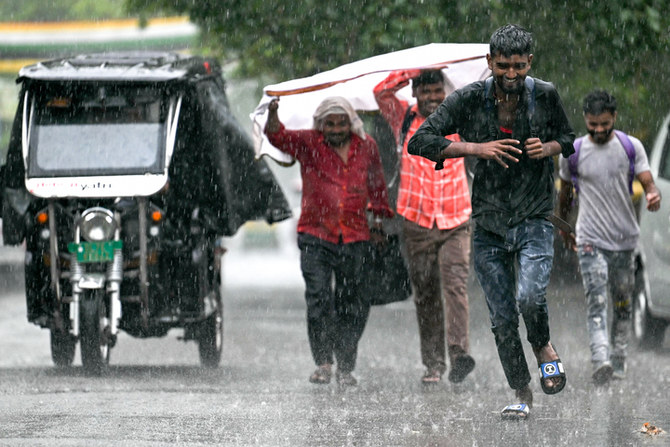

NEW DELHI: The monsoon reached the Indian capital on Friday after two months of severe heatwaves, with heavy rains wreaking havoc at Delhi airport and grounding domestic flights.
Prolonged extreme heat roiled parts of South Asia, affecting some of the world’s most densely populated regions in May and June. In India it hit especially the country’s north — home to more than 400 million people — including Delhi, with its 30 million inhabitants.
Until last week, temperatures in the Indian capital still soared above 45 degrees Celsius, as it suffered a water crisis requiring tankers to be used for distribution when water taps ran dry in parts of the city.
The Indian Meteorological Department said on Friday morning that the monsoon had advanced into the entire Delhi region, as heavy rains lashed the city. killing one person whenr the roof of a domestic flight terminal building at Indira Gandhi International Airport collapsed under the downpour.
At least eight people were injured.
“As a result, all departures have been temporarily suspended and all check-in counters have been closed till further notice,” the Ministry of Civil Aviation said in a statement.
Aviation Minister Ram Mohan Naidu Kinjarapu, said he was “personally” monitoring the collapse and announced compensation of 2 million rupees ($24,000) to the family of the person who was killed in the accident, and 300,000 rupees for the injured.
“I will see that a thorough examination of the terminal structure is conducted by experts to ensure safety,” he said. “This is taken as a very serious incident, not just in this airport, but across the country.”
Friday’s downpour has pushed the city into chaos and several main roads were inundated.
Rains are forecast to continue for more than a week.
“The monsoon has arrived. (For) the next eight to 10 days, it’s going to be rainy. Possibly tomorrow or day after, it could be another deluge in Delhi,” G.P. Sharma, chief forecaster at Skymet, India’s leading weather and agriculture risk consultancy, told Arab News.
“We can say that the heatwave is over ... now the temperature is 37 and it will further drop.”
Sharma predicted that hot days will, however, return in July.
“Once the temperature reaches 40 degrees, and if it is 4.5 degrees above the normal, then it is called a heatwave. It does happen in July also, even in August,” he said.
“(But) you will not find the temperature exceeding 45 or 46 — what we saw in May and early June.”


