Pakistan’s key stock index records highest year-end close amid budget, IMF optimism

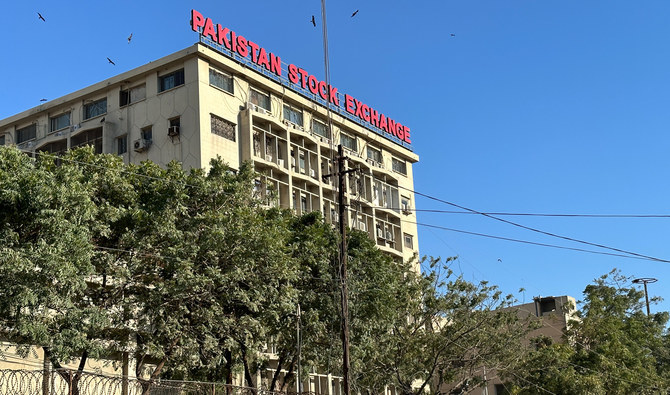
This photo, taken on February 23, 2024, shows Pakistan Stock Exchange building in Karachi. (AN Photo/File)
Short Url
Updated 28 June 2024
Follow

Pakistan’s key stock index records highest year-end close amid budget, IMF optimism

  • Benchmark index witnessed an increase of 36,992 points or 89.2% on an annual basis during FY24 to close at 78,445 points
  • Pakistan is eyeing another loan program from the International Monetary Fund as it grapples with a macroeconomic crisis

KARACHI: Pakistan’s stock market ended fiscal year 2024 on a high, with its key stock index recording 78,444 points on Friday, the highest level reached on the last day of a fiscal year amid renewed optimism among investors that Islamabad would secure a fresh loan from the International Monetary Fund (IMF). 

Pakistan’s National Assembly on Friday passed the government’s tax-laden finance bill for the next fiscal year starting July 1, 2024. Finance Minister Muhammad Aurangzeb presented the budget on June 12 which featured a challenging tax revenue target of Rs13 trillion ($46.55 billion), up by about 40 percent from the target set in the current fiscal year.

The new budget has further burdened Pakistan’s salary class by imposing more direct tax on their income. Meanwhile, tax has also been increased to 18 percent on textile and leather products and mobile phones. However, analysts noted that the tax-heavy budget is in line with the IMF’s conditions for Pakistan to secure another financial bailout package. 

Pakistan’s stock market rebounded last year after the South Asian country secured a last-gasp $3 billion short-term loan from the global lender that proved instrumental in the country avoiding a sovereign default. 

“The KSE-100 index witnessed an increase of 36,992 points or 89.2 percent on an annual basis during FY24 to close at 78,445 points,” Tahir Abbas, head of research at Arif Habib Limited, told Arab News. He noted that this was the highest increase in percentage terms since FY03.

However, the market closed the last trading day of the outgoing fiscal year on a bearish note, with the index losing 83 points.

“Stocks closed lower amid pressure at the fiscal year-end close and on concerns of an expected higher CPI inflation for June 2024, and $918 million profit repatriations causing massive foreign outflows in May 2024,” Ahsan Mehanti, a senior stock analyst, explained.

Pakistan’s currency also stabilized during the outgoing fiscal year, as the Pakistani rupee appreciated by 2.8 percent on an annual basis against the US dollar. The local currency’s performance was a welcome sight, considering it had underperformed over the past three years. 

The currency appreciated primarily due to the decrease in the current account deficit, an improvement in Pakistan’s foreign inflows, a reduction in the gap between the open and interbank rates, and other administrative measures by the government.

Inflation, which surged to a record high of 38 percent in May 2023, has also declined considerably to 11.8 percent in May 2024 as per official data. 

However, the inflation outlook for June 2024 has increased slightly compared to the previous month but remains well below the June 2023 level. This rise can be attributed primarily to higher prices of perishable items, driven by the Eid Al-Adha event, according to a monthly report issued by the finance ministry.

“FY2024 is going to end with an economic stabilization path accompanied by improved macroeconomic indicators,” the finance ministry’s report for June 2024 said. 

The report added that subsiding inflationary pressures, stability in external accounts and exchange rate, fiscal consolidation and gradual recovery in industrial activities are restoring confidence among economic agents. 


Pakistan, Iraq agree on tighter coordination over pilgrims under new regulated travel system

Updated 4 sec ago
Follow

Pakistan, Iraq agree on tighter coordination over pilgrims under new regulated travel system

  • New system requires all Iraq-Iran pilgrimages to be organized by licensed groups under state oversight
  • Long-running “Salar” model relied on informal caravan leaders, leading to overstays and missing pilgrims

ISLAMABAD: Pakistan and Iraq this week agreed to closely coordinate on the management and security of Pakistani pilgrims, as Islamabad rolls out a new, tightly regulated travel system aimed at preventing overstays, undocumented migration and security breaches during religious visits to Iraq and Iran.

The understanding was reached during a meeting between Pakistan’s Interior and Narcotics Control Minister Mohsin Naqvi and Iraq’s Interior Minister General Abdul Amir Al-Shammari on Thursday evening, where both sides discussed measures to facilitate pilgrims while strengthening oversight, Pakistan’s interior ministry said.

The agreement comes as Pakistan dismantles its decades-old pilgrim travel model and replaces it with a centralized, licensed system after authorities confirmed that tens of thousands of Pakistani pilgrims had overstayed or gone missing abroad over the past decade, triggering concerns from host governments.

“You have, for the first time during your tenure, taken effective measures to organize pilgrim groups, which are commendable,” Al-Shammari told Naqvi, according to Pakistan’s interior ministry.

“All pilgrims included in the list provided by Pakistan’s Ministry of Interior will be allowed to enter Iraq,” he added, making clear that only travelers cleared under the new system would be permitted.

Naqvi said Pakistan would strictly enforce return timelines under the revised framework.

“Pilgrims traveling to Iraq will not be allowed to stay beyond the designated period,” he said, adding that relevant authorities in both countries would remain in close coordination.

Both interior ministers also agreed to strengthen information-sharing and joint mechanisms on security cooperation, counterterrorism and the prevention of human smuggling, officials said.

“The safety, dignity, and facilitation of Pakistani pilgrims is the top priority of the Government of Pakistan,” Naqvi said.

Al-Shammari said he would visit Pakistan soon to finalize a joint roadmap to further improve pilgrim facilitation, security coordination and broader bilateral cooperation, according to the interior ministry.

Pakistan’s government has overhauled its pilgrim travel regime this year, abolishing the long-running “Salar” system under which informal caravan leaders managed pilgrimages. The move followed official confirmation that around 40,000 Pakistani pilgrims had overstayed or disappeared in Iran, Iraq and Syria over the past ten years.

Under the new Ziyarat Management Policy, only licensed Ziyarat Group Organizers (ZGOs) are allowed to arrange pilgrimages, with companies held directly responsible for ensuring pilgrims return on time. Authorities have completed security clearance for 585 companies seeking registration, while scrutiny of applications remains ongoing.

Islamabad has also barred overland travel for major pilgrimages, including Arbaeen, citing security risks in Pakistan’s southwestern Balochistan province, meaning all travel to Iraq and Iran is now restricted to regulated air routes.

Tens of thousands of Pakistani pilgrims travel each year to Iraq and Iran to visit some of the most revered shrines in Shia Islam, including the mausoleums of Imam Ali in Najaf and Imam Hussain in Karbala in Iraq, and major religious sites in Mashhad and Qom in Iran. Pilgrimages peak during religious occasions such as Arbaeen, when millions of worshippers converge on Karbala from across the region. The scale of travel, often involving long stays and cross-border movements, has long posed logistical, security and migration-management challenges for Pakistani authorities and host governments alike.