PARIS: Game designer Sam Alfred is keenly aware of the challenge he faces in trying to build a video game with climate change at its heart.
Lists of best-selling games are filled with titles pushing destruction and violence rather than constructive engagement with the environment.
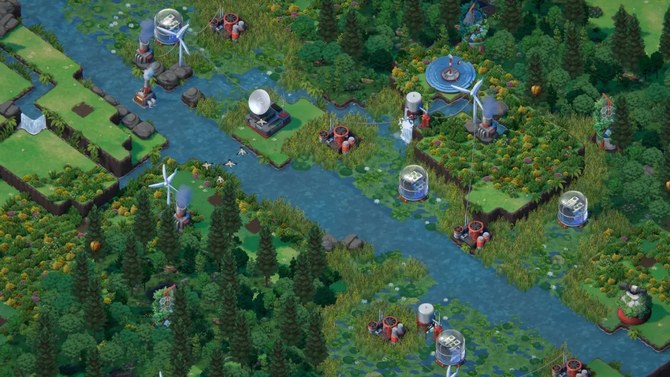
Yet “Terra Nil,” a strategy game designed by Alfred and released in March last year, puts players in charge of rebuilding ecosystems — and has since attracted 300,000 players, according to the publisher Devolver Digital.
“I’ve lost count of how many people have dismissed the game or made fun of the game, because of its nature, because it’s a game which is not about shooting people or rampant expansionism,” said Alfred.
“The environment was the focus of the game. The one angle was trying to show players and other game developers and people that it’s possible to build a strategy game without exploitation of the environment.”
True to his word, the 30-year-old South African asks players of Terra Nil to help decontaminate radioactive zones with sunflowers and save the Great Barrier Reef among other climate-related tasks.
He is not the first designer to include an environmental message in their games — nor is he the first to be criticized for it.
In 2017, “Cities: Skylines,” a city-building game, introduced its “Green Cities” offshoot where players could create their ideal metropolis while taking into account pollution and environmental management.
“I remember the Green Cities extension was something that surprisingly polarized the audience,” said Mariina Hallikainen, managing director of Colossal Order, the Finnish studio behind the game.
“There was actually feedback that we are now ruining the game by going political.”
The team behind the game deny there was any overt political message, flagging that players could choose whether to make their city green or not.
And other studios have not been discouraged from putting climate into their games.
The daddy of all strategy games, “Civilization,” included climate change in and offshoot of its sixth edition in 2019.
With an estimated three billion people playing video games at least once a year, climate campaigners have long targeted them as a potential audience.
Even the United Nations has tried its hand at creating a climate game — “Mission 1.5” — that it said reached more than six million people.
Industry figures have joined together in several collectives to see how they can include the climate in their games.
Studios, trade associations and investors formed “Playing for the Planet,” an alliance backed by the United Nations that has held a “Green Game Jam” each year since 2020.
Other industry figures bandied together to form a climate branch of the International Game Developers Association (IGDA) in 2019.
“You have a superpower: you’re gamemakers,” Arnaud Fayolle, artistic director at publisher Ubisoft and key mover in the IGDA’s climate branch, told their conference last year.
“You can talk to three billion players around the planet who already trust what you have to say, you can teach complex problems in fun and engaging way that schools never can match.”
The IGDA branch brings together nearly 1,500 industry professionals, university professors and ecology and climate specialists, who share their expertise to infuse video games with climate issues and encourage gamers to get involved.
“The idea is to generate a positive cultural impact through aesthetics, storytelling, game mechanics and technology,” said Fayolle.
This is where people like Sam Alfred earn their money.
“A lot of our mechanics in the game are our way of trying to translate either real-life natural processes or real-life ecosystem restoration practices into game form,” he said.
“That means oversimplifying them and it means, you know, taking some creative liberties.”


![]()

Video game designers battle to depict climate impacts
Short Url
https://arab.news/9deku
Video game designers battle to depict climate impacts


Latest updates


© 2026 SAUDI RESEARCH & PUBLISHING COMPANY, All Rights Reserved And subject to Terms of Use Agreement.