

Pakistan’s first Olympic markswoman guns for historic medal

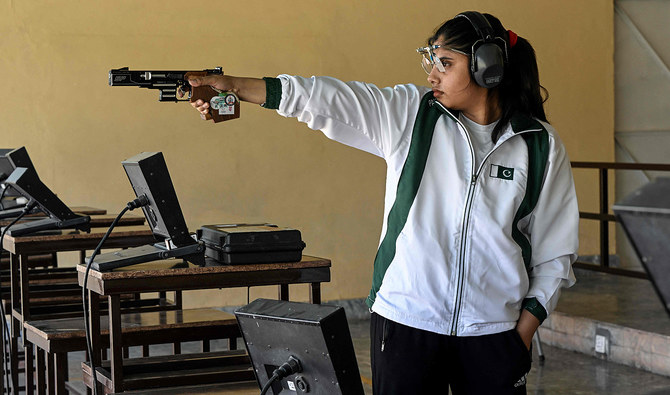
In this photograph taken on May 21, 2024 Kishmala Talat, Pakistan’s first female to qualify for Olympic shooting, aims an air pistol at a 25m target range during a practice session at the Army Marksmanship Unit (AMU) in Jhelum. (AFP)
Short Url
Updated 28 June 2024
Follow

Pakistan’s first Olympic markswoman guns for historic medal

  • Pakistan have only ever won 10 Olympic medals — all by men — and none since the 1992 Games
  • Kishmala Talat will compete in the 10m air pistol and 25m pistol events at the Paris Games

JHELUM, Pakistan: Slowing her breath and focusing on a bullseye in her pistol’s sights, Kishmala Talat is aiming to become the first woman from Pakistan to win an Olympic medal.

At the Paris Games starting on July 26, Talat will compete in the 10m air pistol and 25m pistol events, going for glory abroad and defying stereotypes back home.

Pakistan’s medal prospects are undercut by modesty codes which dissuade women from participating in sport.

The 21-year-old Talat, who comes from a military family, is the first Pakistani woman to qualify for Olympic shooting.

“In Pakistan there’s a prevalent taboo that dictates girls should stay at home, do girly things, and play with dolls, while boys are to play with guns,” she said.

“I see no one as competition. I compete with myself,” she told AFP at a target range in the eastern city of Jhelum.



In this photograph taken on May 21, 2024 Kishmala Talat, Pakistan’s first female to qualify for Olympic shooting, aims an air pistol at a 10m target range during a practice session at the Army Marksmanship Unit (AMU) in Jhelum. (AFP)

Talat has won dozens of medals at national level and four internationally, including Pakistan’s first shooting medal ever, a bronze, at the Asian Games last year.

Pakistan have only ever won 10 Olympic medals — all by men — and none since the 1992 Games.

Talat, who has just completed her university degree in communications, realistically faces an uphill task to get on the podium in Paris.

She has a global ranking of 37th in the 10m event and is 41st in the 25m, according to the International Shooting Sport Federation.

“I longed for recognition. I wanted to do more,” she said.

“I wanted that whenever shooting is discussed, or ‘Kishmala’ is mentioned, it would be associated with someone who did something great for Pakistan.”

Hoping to defy the odds, she spends 10 hours a day training — one hour of physical exercise and then four hours each on the 10m and 25m ranges.

The last hour in the evening is spent meditating, concentrating on the flickering flame of a candle in an attempt to hone the zen needed to find her target.


In this photograph taken on May 21, 2024 Kishmala Talat, Pakistan’s first female to qualify for Olympic shooting, speaks during an interview with AFP at Army Marksmanship Unit (AMU) in Jhelum. (AFP)

“I am dedicated to giving my best performance to let Pakistan’s name shine,” said Talat.

She takes her shots with her spare hand stuffed in her pocket and one eye covered by custom-fit glasses, her face frozen in expressionless concentration.

The sport of target shooting is not a common pursuit in Pakistan.

Cricket is by far the most popular pastime, but all sports suffer from chronic underfunding.

However, guns are omnipresent in Pakistan.

Swiss weapons research group the Small Arms Survey estimated in 2017 that there were nearly 44 million legal or illicit guns held by civilians in Pakistan.

The figure is the fourth highest globally and means there are 22 weapons per every hundred citizens in the nation of more than 240 million.

Talat’s talent has been nurtured by Pakistan’s military, the sixth-largest in the world with a vast budget allowing it to operate ski resorts, polo grounds and mountaineering academies.

Talat is trained by officers and a foreign coach at a military facility in Jhelum, known as “City of Martyrs” for its strong ties to the armed forces.

She hails from the garrison city of Rawalpindi, where the armed forces are headquartered.

Her 53-year-old mother, Samina Yaqoob, serves as a major in the military’s nursing service and proudly displays her daughter’s many medals in the family living room.


In this photograph taken on June 11, 2024 Samina Yaqoob, a major in Pakistan military’s nursing service, stands beside medals awarded to her daughter Kishmala Talat, the country’s first female to qualify for Olympic shooting, as she speaks during an interview with AFP in Rawalpindi. (AFP)

Yaqoob once dreamed of competing herself.

“I got married and got busy with that life, but it makes me happy when I see my daughter move forward with my dream,” she said.

“Girls should step forward, observe, work diligently and their parents should support them,” the mother said.

“She believes she can do anything. That’s just who she is.”


Pakistan Army’s logistics firm to run national shipping corporation, confirm officials

Updated 4 sec ago
Follow

Pakistan Army’s logistics firm to run national shipping corporation, confirm officials

  • Government to transfer 30 percent shares in Pakistan National Shipping Corporation, management control to NLC firm, say officials
  • Officials say the move will increase PNSC’s shipping fleet from 10 to 54, save $6 billion Islamabad pays in foreign freight annually

KARACHI: The government has decided to transfer the state-run Pakistan National Shipping Corporation’s (PNSC) management to the military-run National Logistics Corporation (NLC), officials confirmed on Thursday, saying the move is expected to save $6 billion that Islamabad currently pays in foreign freight annually. 

A week earlier, Prime Minister Shehbaz Sharif’s government sold 75 percent of its shareholding in the national flag carrier Pakistan International Airlines (PIA) to a business consortium led by Arif Habib Group for Rs135 billion ($482 million).

The government’s current drive to privatize state-owned enterprises (SOEs) is a key requirement of the International Monetary Fund’s (IMF) $7 billion loan program. The global lender wants Islamabad to privatize its loss-making state assets to save valuable revenue. 

PNSC reported a 34 percent decline in its profit, which reduced to Rs3.71 billion ($13.2 million) in the July-September quarter this year. Its revenues from shipping business fell by 2 percent to Rs9.32 billion ($33 million) in the same period, according to the company’s filing to the Pakistan Stock Exchange (PSX) seen by Arab News. The PNSC’s profits remained almost stagnant at Rs20 billion ($73 million) in FY25 while its shipping income shrank 18 percent to Rs33.7 billion ($120.3 million).

“We received a letter about one month ago in which the government asked us to sort out things before Dec. 30,” a PNSC official told Arab News on condition of anonymity as he was not authorized to speak to media. “The management control will go to the NLC.”

An NLC official confirmed the same. 

“Yes, this is happening,” an NLC official told Arab News on condition of anonymity. He said details will be shared in due course.

Muhammad Arshad, a spokesman at Pakistan’s Maritime Affairs Ministry, and PNSC Spokesperson Muhammad Farooq Nizami both declined to comment on the matter.

“We can’t say anything about this development until we get an official notification,” Nizami told Arab News. 

Officials said that as per the PNSC Revitalization and Improvement Plan, the government would sell about 30 percent of its PNSC shareholding to NLC, which would then have a controlling share in the corporation’s management.

As of Jun. 30, the government holds 87.56 percent shares in PNSC, whose 198.1 million shares are listed on the PSX with a market capital of Rs109 billion ($389 million). 

The NLC will be required to increase the PNSC’s shipping fleet, which currently comprises only 10 ships, to 54 over the next five years, the shipping company’s official said.

This would help Pakistan’s government save about $6 billion in freight costs as the PNSC’s current 10 ships are only able to handle 11 percent of the country’s commercial cargo, he added.

“As a result, Pakistan has to pay approximately $6 billion annually in foreign exchange to foreign shipping companies as freight charges,” he said. 

Among other objectives, the military-led company is also expected to rid PNSC of its aging fleet, as many vessels are nearing the end of their operational life and won’t be able to sail profitably beyond 2030.

“This initiative will ensure 100 percent replacement of all old PNSC vessels along with the induction of new ships,” the PNSC official said. 

News reports of the transfer of management have led to a rise in the PNSC’s shares at the PSX, which gained by around 21 percent in the last two trading sessions. The stocks traded at Rs548.89 ($1.9) per share on Thursday morning, taking its year-to-date gains to 17 percent.

Pakistan’s government has been cautious in spending its $16 billion foreign exchange reserves as it aims to keep its current account balance in check. 

Pakistan’s current account reported a $812 million deficit in the July-November period from a $503 million surplus last year, according to data shared by the central bank. 

The PNSC official said the increase in the company’s shipping fleet will enhance its share in global maritime freight from $162 million to $1.79 billion. 

“Despite significant growth potential in the shipping industry, the absence of private operators is hindering market dynamism and efficiency,” he said. 

“World-class financial and legal advisers will be appointed for institutional restructuring, transforming PNSC into a modern, agile, and professionally managed organization.”